Oracle’s AI Slip, Fed’s New Crypto Stance, and What Investors Should Really Be Watching
A Market Hook That’s Hard to Ignore 🚨 For months, the AI-fueled stock rally has felt unstoppable—like every chip, cloud, and chatbot ticker was destined to soar forever. But recent cracks suggest investors may need to sharpen their pencils instead of just riding the wave.…
A Market Hook That’s Hard to Ignore 🚨
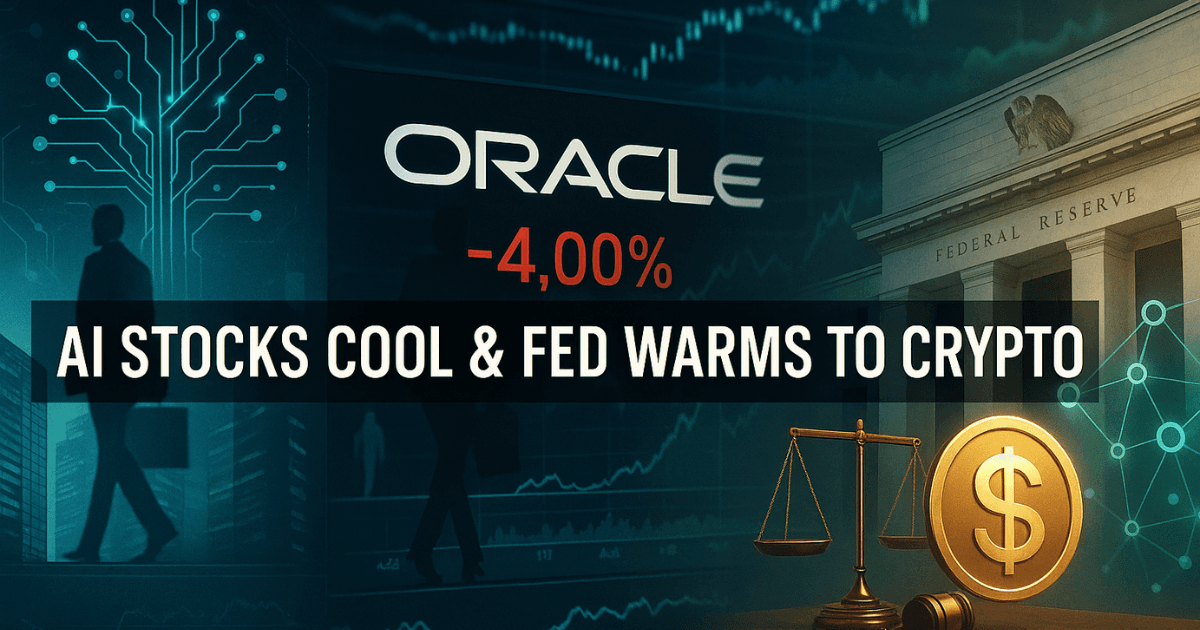
For months, the AI-fueled stock rally has felt unstoppable—like every chip, cloud, and chatbot ticker was destined to soar forever. But recent cracks suggest investors may need to sharpen their pencils instead of just riding the wave. Oracle’s sudden 4% dip, concerns over executive churn, and Fed Governor Michelle Bowman’s surprising call to “ditch the cautious mindset” on crypto and AI are reshaping the narrative. When the poster children of the AI surge start stumbling and regulators suddenly sound friendlier to disruptive finance, the market mood inevitably shifts. The question isn’t whether AI is the future—it’s whether the current valuations and strategies can handle reality. Let’s find them out.
Oracle’s Slip: When the Cloud Turns Overcast ☁️
Oracle had been riding high. From June to late July, its stock surged more than 50%, buoyed by its AI-linked cloud deals, including a much-publicised 4.5GW data center expansion tied to OpenAI. Investors were giddy—until the music slowed. The sell-off came as news broke of layoffs within Oracle Cloud Infrastructure (OCI), targeting teams in the U.S. and India. To add salt to the wound, the long-serving Chief Security Officer, Mary Ann Davidson, stepped down abruptly, amplifying leadership uncertainty. The market noticed. Shares slid over 4% in mid-August, only partially rebounding to $236.37 by the end of the week—still nearly 10% shy of their July peak. As Investor’s Business Daily put it, “Oracle’s upcoming Q1 earnings could determine whether its AI story is just smoke or a sustainable flame.” Smart Capital Signal: For investors, the message is clear—don’t let AI euphoria blind you. Earnings, not headlines, will decide which companies actually capture durable growth.
AI Stocks Cool: Nvidia, Palantir, and the Rally That Might Not Last 📉
Oracle wasn’t alone. Nvidia and Palantir also slipped, hinting that the market is starting to ask tougher questions about the sustainability of AI’s pricing power. Nvidia still commands record-high multiples, but the pressure on chip demand and rising competition from AMD and Intel mean the company can’t afford even minor execution slips. Palantir, meanwhile, continues to sell investors on its role as the “AI operating system for defence and enterprise.” Yet, as enthusiasm fades, valuation versus delivery could be its Achilles’ heel. Tactical Insight: A cooling period isn’t doom—it’s reality. For long-term investors, this shake-out might be the chance to separate hype from durable earnings machines.
The Fed Changes Its Tune: Bowman Pushes for a Bolder Future 💵🤖
Perhaps the most intriguing twist came not from Wall Street but Washington. At the Wyoming Blockchain Symposium, Fed Governor Michelle Bowman urged regulators to “move away from an overly cautious mindset” on crypto, blockchain, and AI. Her message was clear: U.S. finance can’t afford to keep innovation at arm’s length. Bowman highlighted the GENIUS Act, passed in July, which establishes a federal framework for stablecoins—potentially opening the door to banks and fintechs weaving tokenisation and AI-driven payments into the mainstream. Even more striking, Bowman suggested regulators themselves should be allowed to hold small amounts of crypto: “There’s no replacement for practice versus reading about it.” The Fed also ended its “novel activities” oversight program, signaling that technologies like blockchain and AI are no longer fringe experiments but are now core to financial infrastructure. Investor Radar: Regulatory tone shifts don’t always make headlines—but they change the rules of the game. The U.S. signalling support for stablecoins, tokenisation, and AI innovation could accelerate institutional adoption far faster than expected.
Conclusion: The AI Boom Isn’t Over, but the Easy Ride Might Be 🚦
Investors are learning that AI and cloud growth stories are not bulletproof. Oracle’s stumble reminds us that execution, leadership, and cost management matter just as much as vision. Meanwhile, Nvidia and Palantir’s slips show that market patience has limits. On the other hand, the Fed’s pivot toward embracing digital assets and regulating AI may spark the next chapter of financial innovation, balancing recent market jitters with longer-term optimism. The market isn’t rejecting AI—it’s just demanding proof. And in investing, proof always comes down to earnings, execution, and regulatory clarity. Keep a sharp eye on corporate results and regulatory follow-through. The biggest winners won’t just be those who shout “AI” the loudest, but those who quietly build sustainable businesses while regulators redraw the map.
Sources
- Investor’s Business Daily – Oracle Stock, AI Cloud Concerns
- MarketWatch – Oracle Corp Stock Update
- Barron’s – Fed’s Bowman Urges Less Cautious Mindset on Crypto/AI
- Reuters – Bowman Suggests Fed Staff Should Hold Crypto
- American Banker – Fed Ends “Novel Activities” Program
- America’s Credit Unions – GENIUS Act & Tokenisation
Market Munchies and Mode Mobile communications are for informational purposes only, and are not a recommendation, solicitation, or research report relating to any investment strategy, security, or digital asset. All investments involve risk including the loss of principal and past performance does not guarantee future results.
Any information contained in this commentary does not purport to be a complete description of the securities, markets, or developments referred to in this material. The information has been obtained from sources considered to be reliable, but we do not guarantee that the foregoing material is accurate or complete. There is no guarantee that any statements or opinions provided herein will prove to be correct.