Peace Rally on Probation
Wednesday’s surge looked like a clean vote for de-escalation. Stocks jumped, crude tumbled, and investors briefly embraced a simple idea: if the U.S.-Iran cease-fire held long enough to reopen Hormuz and reduce the energy shock, the market could start repricing a less hostile…
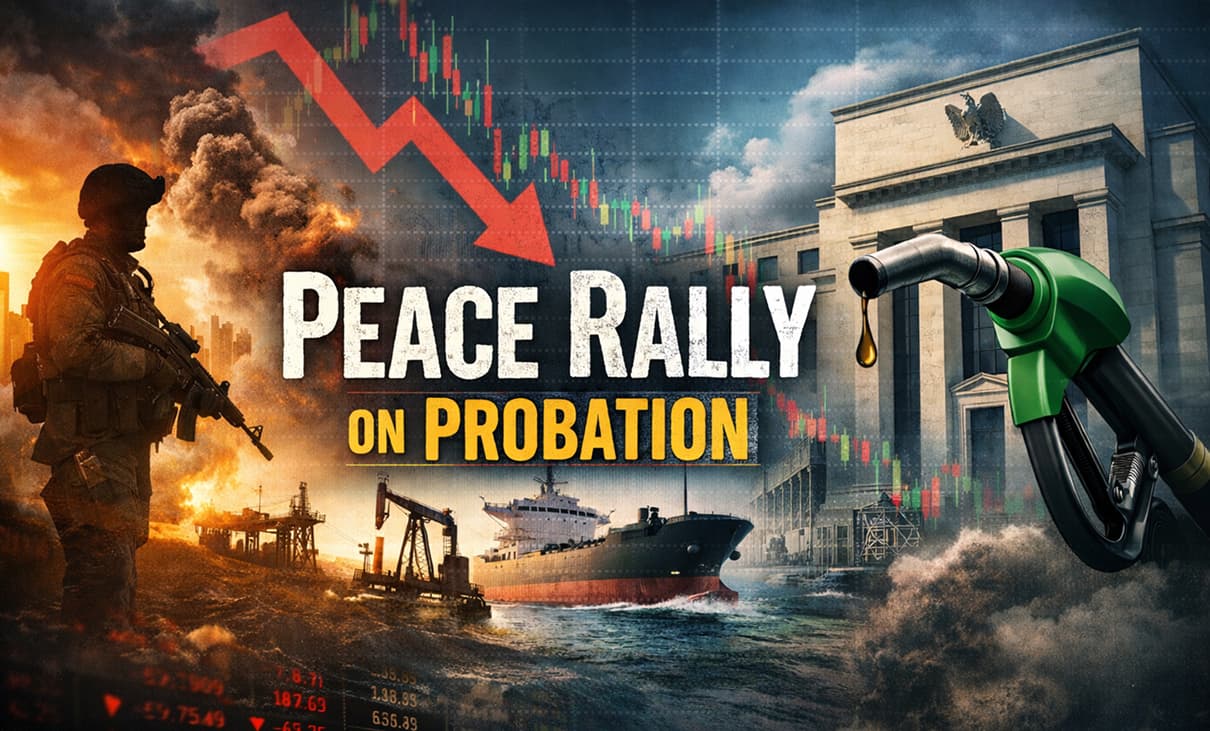
Wednesday’s surge looked like a clean vote for de-escalation. Stocks jumped, crude tumbled, and investors briefly embraced a simple idea: if the U.S.-Iran cease-fire held long enough to reopen Hormuz and reduce the energy shock, the market could start repricing a less hostile inflation backdrop. That logic was easy to understand. Lower oil would ease pressure on consumers, transport-heavy businesses, and the Fed all at once.
This morning has been far more restrained. Once trading actually got underway, the big follow-through never arrived. Instead, the market opened around flat and then drifted lower, with SPY, QQQ, and DIA all slipping below their prior closes as oil moved higher again. In other words, investors did not reverse Wednesday’s optimism, but they did start marking it down.
That makes today more useful than yesterday. Relief rallies tell you what the market wants to believe. The next session tells you what it is actually willing to keep paying for. Right now, traders are still leaving room for de-escalation to matter, but they are demanding harder proof that the cease-fire changes the real path of oil, inflation, and rates. Today’s economic data did not make that proof any easier to find, with February PCE inflation still running too warm for comfort, fourth-quarter GDP revised lower, and weekly jobless claims ticking up.
Stock of Interest Today: Dave (DAVE)
Dave stands out because it is offering something this market still rewards even when the macro picture gets noisy: a visible execution story. In its latest full-year results, the digital banking platform reported 60% revenue growth to $554.2 million, 162% growth in adjusted EBITDA to $226.7 million, and a 2026 outlook that still points to strong revenue growth with expanding EBITDA margins. Management also tied better credit performance to its CashAI underwriting system, saying the model helped reduce delinquencies even as originations continued to climb.
What makes that especially relevant today is the broader shift happening in growth stocks. Investors are getting less patient with stories built only on narrative and more interested in companies that can show real operating leverage. Dave’s latest report had several signs of that. ARPU rose 36%, monthly transacting members grew 19% to 2.93 million, ExtraCash originations climbed 50% to $2.2 billion, and the company increased its share repurchase authorization to $300 million. Those are not just growth metrics. They suggest a business becoming more efficient, more monetizable, and more confident in its own cash-generation profile.
There is also a valuation angle here. Dave is not being priced like a distressed lender, but it is still trading at a multiple that leaves room for continued upside if the fundamentals hold. The stock’s current P/E is about 18.3, and both Yahoo Finance and MarketWatch list a 12-month analyst target of $318. That does not make the stock risk-free, but it does tell you analysts still see a substantial gap between current performance and what the market may eventually be willing to pay for it. In a tape where investors are questioning almost every macro assumption, that kind of company-specific execution can matter a lot.
Current price: $176.45Analyst expectation: $318.00
Five Market Themes to Watch
The most important thing happening today is not that markets are down a bit from yesterday’s close. It is that investors are reassessing which parts of the cease-fire rally deserve to stick. Wednesday priced in a fast chain reaction: less war risk, lower crude, easier inflation pressure, and eventually a more flexible Fed. Thursday’s trading says the market is no longer comfortable underwriting that whole sequence in one shot.
That leaves the market in a more interesting place than either panic or euphoria. Traders still want to believe the energy shock can fade, but today’s tape suggests they are no longer willing to assume that outcome. They are asking whether the real constraints have changed, not just whether the headline has.
1) The post-open tape is already fading the easy part of the story
The first and clearest signal is price action after the bell. The broad market did not build on Wednesday’s surge. It opened with little momentum and then softened, leaving major index ETFs modestly below their previous closes while oil moved higher. That is not a washout, but it is a clear sign that traders are trimming the first wave of optimism rather than extending it.
The distinction matters. A market that believed the cease-fire had genuinely reset the macro backdrop would probably still be adding to risk, especially after such a powerful prior session. Instead, investors are treating Wednesday’s rally as provisional. They are keeping part of it, but not all of it. That is what a market looks like when it still likes the direction of the news but doubts the durability of the consequences.
2) Oil remains the quickest way this story reaches everything else
If equities are hesitating, crude is the main reason. AP reported that oil rebounded sharply today, with U.S. crude pushing back toward $100 a barrel as doubts about the cease-fire’s durability spread. The USO ETF is also firmly higher in live trading, reinforcing the point that the market is not yet ready to declare the energy shock over.
That matters because oil is still the fastest transmission channel from geopolitics into the real economy. It flows into airline margins, freight costs, consumer sentiment, and inflation expectations almost immediately. Wednesday’s rally worked because investors thought those pressures might ease quickly. Today’s rebound in crude suggests that easing may arrive slower, or in a more uneven way, than the market first hoped. That is enough to cool the broad rally even without a full collapse in risk appetite.
3) The cease-fire still looks too ambiguous to anchor a durable rerating
A big reason investors are hesitating is that the cease-fire still does not look fully coherent. Reuters reported that Vice President JD Vance said the U.S. did not agree that Lebanon was covered by the truce, while Iranian officials and outside mediators clearly thought otherwise. Reuters also reported that Iran’s president said Israeli strikes on Lebanon rendered negotiations meaningless.
Markets can live with a fragile agreement. They struggle with an agreement whose scope is still being argued in public. That kind of ambiguity keeps the risk premium alive because every new military development can force traders to ask whether the supposed de-escalation was ever operationally real. It is hard for stocks to sustain a broad relief move when the most important geopolitical variable in the market still lacks clear boundaries.
4) The physical oil market is sending a harsher message than the paper one
There is another reason to be careful about assuming yesterday’s move told the whole truth. Reuters reported today that physical crude prices in Europe and Africa hit record levels despite the cease-fire, because actual supply disruptions and shipping bottlenecks have not disappeared. Barclays also warned that delays in restoring Hormuz flows create upside risk to its oil outlook.
That gap between futures enthusiasm and physical tightness is important. Financial markets can react instantly to headlines. Real-world supply chains cannot. If refiners and buyers are still paying steep premiums for barrels outside the Middle East, that suggests the underlying logistics problem remains unresolved. For the broader market, that means margin relief in fuel-sensitive industries may take longer to show up, and inflation pressure could remain stickier than yesterday’s rally implied.
5) The macro data keeps the Fed boxed in
Today’s economic releases did not give investors much help. Reuters reported that February PCE rose 0.4% on the month, with annual headline PCE at 2.8% and core PCE at 3.0%, while consumer spending remained solid. At the same time, fourth-quarter GDP was revised down to a 0.5% annualized pace, and weekly jobless claims rose to 219,000. That is not a recession signal, but it is exactly the kind of mix that complicates the policy outlook.
The problem is simple. If growth is softening but inflation remains sticky and oil is rebounding, the Fed does not get an easy off-ramp. Rate cuts become harder to justify, but tightening into slower growth would also be uncomfortable. That tension matters for equity valuations, especially in the higher-growth parts of the market. It is one reason today’s post-open pullback feels more like a credibility check than a random pause. Investors are being reminded that even if the geopolitical temperature cools, monetary policy may still stay restrictive for longer than they want.
Bottom Line
The market is not rejecting peace. It is questioning how much peace it actually got.
That is the core lesson from today’s post-open action. Wednesday’s surge priced a best-case chain reaction too quickly. Thursday’s softer tape is the market stepping back and asking whether lower oil, easier inflation, and a friendlier Fed are really on the table yet. Maybe they are. But the market clearly no longer thinks that conclusion can be taken for granted.
That is also why Dave is a useful stock to watch here. In a market that is rechecking every macro assumption, the most attractive growth stories are often the ones that can keep improving without needing the outside world to get simpler first. More broadly, the next meaningful move in stocks will probably depend less on another cease-fire headline and more on whether oil actually calms down, shipping conditions actually normalize, and inflation stops threatening to re-accelerate. Until then, the relief rally still looks conditional.
Sources:
- https://apnews.com/article/857ae30b3be4441819b2848fd594a33d
- https://www.reuters.com/business/energy/barclays-delay-hormuz-flow-recovery-poses-upside-risks-85b-brent-forecast-2026-04-09/
- https://www.reuters.com/business/us-weekly-jobless-claims-rise-remain-low-levels-2026-04-09/
- https://www.reuters.com/world/us/us-fourth-quarter-gdp-growth-revised-lower-05-rate-2026-04-09/
- https://www.reuters.com/business/us-pce-inflation-picks-up-february-consumer-spending-solid-2026-04-09/
- https://www.reuters.com/world/asia-pacific/us-did-not-agree-that-ceasefire-would-cover-lebanon-vance-says-2026-04-08/
- https://www.reuters.com/world/middle-east/irans-president-says-israeli-strikes-lebanon-render-negotiations-meaningless-2026-04-09/
- https://www.reuters.com/world/asia-pacific/frances-macron-urges-us-iran-respect-ceasefire-lebanon-2026-04-08/
- https://investors.dave.com/news-releases/news-release-details/dave-reports-fourth-quarter-full-year-2025-financial-results
- https://ca.finance.yahoo.com/quote/DAVE/
- https://www.marketwatch.com/investing/stock/dave/analystestimates
Market Munchies and Mode Mobile communications are for informational purposes only, and are not a recommendation, solicitation, or research report relating to any investment strategy, security, or digital asset. All investments involve risk including the loss of principal and past performance does not guarantee future results.
Any information contained in this commentary does not purport to be a complete description of the securities, markets, or developments referred to in this material. The information has been obtained from sources considered to be reliable, but we do not guarantee that the foregoing material is accurate or complete. There is no guarantee that any statements or opinions provided herein will prove to be correct.