Powell’s First Cut: Lifeline for Growth or Spark for Inflation?
The $ Trillion Question Investors Can’t Ignore 💡 The Federal Reserve just pulled the trigger on its first Fed rate cut of 2025 —a neat 25 basis points that lowered the policy rate to 4.00–4.25 % . Markets applauded, stocks popped, and bonds stirred. But behind the applause…
The $ Trillion Question Investors Can’t Ignore 💡
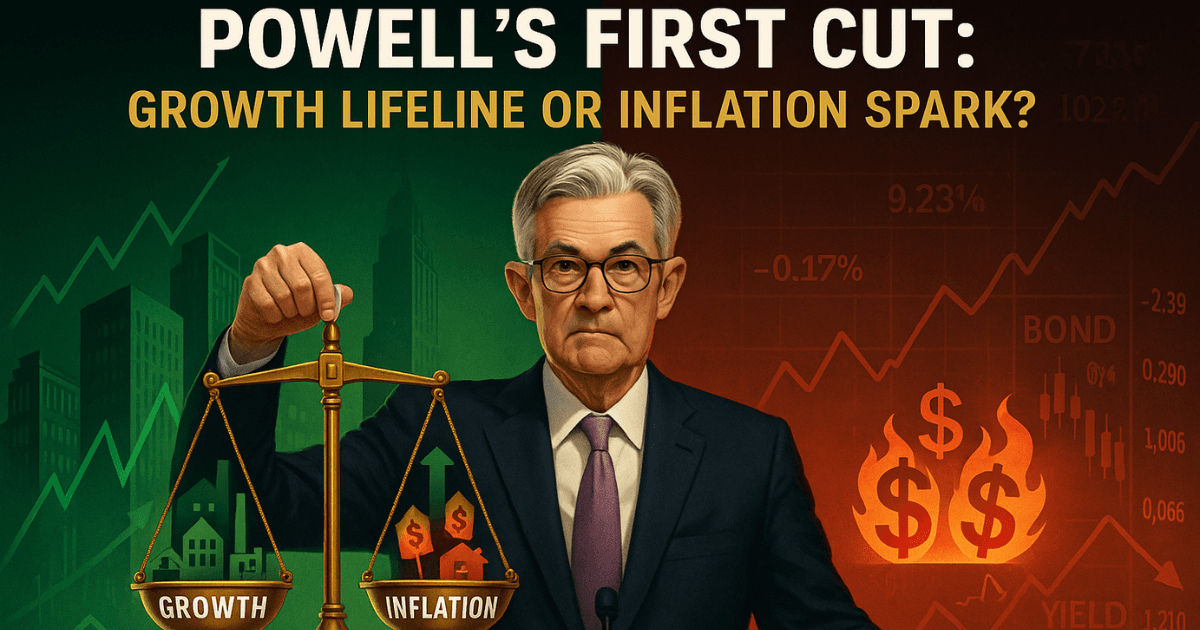
The Federal Reserve just pulled the trigger on its first Fed rate cut of 2025—a neat 25 basis points that lowered the policy rate to 4.00–4.25 %. Markets applauded, stocks popped, and bonds stirred. But behind the applause lies a sharper debate: is this move a lifeline for growth or the opening act of an inflation relapse? Chair Jerome Powell called it “risk management,” but the risk cuts both ways. Think of it as Powell adding water to a simmering pot—not knowing if it cools the heat or splashes back. Investors are left wondering whether this was the start of a gentle easing cycle… or the spark that reignites the very inflation risks of 2025 the Fed has spent years trying to control.
Fed Family Drama: Miran vs. Bostic 🎭
The Fed didn’t speak with one voice. In fact, the split was unusually loud.
- Governor Stephen Miran dissented, calling for a 50 bps cut and later insisting policy is “two points tighter than neutral.” His view? Rates are crushing momentum and need steeper relief.
- Atlanta Fed’s Raphael Bostic, however, doubled down on inflation risk, warning that “inflation risks remain dominant.” He doesn’t expect another cut this year.
- Others, like Cleveland’s Beth Hammack and St. Louis’s Alberto Musalem, also signaled caution: one cut is manageable, but a rapid pivot risks undoing progress on price stability.
This Fed policy split has left investors reading between the lines, pricing in scenarios ranging from aggressive US interest rate cuts to a prolonged pause. Tactical Insight: Don’t anchor on outliers. Powell plus the cautious majority still set the rhythm, even if Miran’s dissent grabs headlines.
Powell’s Reality Check: Stocks Too Pricey 📉
Equity markets had been riding an AI-fueled sugar high. Then Powell dropped a cold scoop of realism: U.S. equities are “fairly highly valued.” That single phrase was enough to rattle investors. The S&P 500, Nasdaq, and Dow all slipped, led by tech names that had been trading as if gravity no longer existed. Valuation signals are hard to ignore. Forward P/E ratios are stretched, CAPE is frothy, and even Bank of America warned 19 out of 20 valuation metrics now flag “overvalued.” Powell’s equity valuation warning struck a nerve. Investor Radar: Treat Powell’s comment as a flashing yellow light. Rally momentum may continue, but valuation risk has a way of pulling excess back to earth.
Yields Edge Higher: Bonds Refuse to Play Along 📈
If the Fed thought a cut would soothe the bond market, the market politely disagreed. The 10-year Treasury yield climbed to about 4.20 %, while the 2-year hovered near 3.60 %. Instead of signaling easy money ahead, yields told a more skeptical story: investors are hedging against inflation expectations and demanding compensation for long-term risk. This shift in bond yields adds pressure to equities, raising discount rates and reshaping the stocks versus bonds equation for portfolios. The yield curve dynamics—positive but fragile—reflect a market that sees growth risks and inflation risks in uneasy balance. Capital Compass: Follow the bond market’s whisper. Rising Treasury yields during an easing cycle indicate that investors aren’t fully convinced that the Fed's monetary easing will tame inflation.
Inflation Shadows: The Fight Isn’t Over 🌡️
Rate cuts typically signal a shift toward growth. But inflation hasn’t left the stage. Sticky rent, wage growth, and tariff-driven costs continue to be in effect. The OECD suggests the Fed has room for up to three more cuts if disinflation holds. Yet many economists warn that credibility could be eroded if inflation were to rebound. Powell himself admitted that the balancing act is delicate: too much easing could undo years of progress, while too little could risk a recession. This ongoing debate—between inflation and growth—is why traders remain split between central bank hawks and doves. Strategic Takeaway: Develop a portfolio strategy that hedges both sides: growth-friendly equities on one side, and fixed income outlook positions that cushion against sticky inflation on the other.
Closing Bell: Relief or Regret? 🎬
Powell’s first cut was not an open bar for risk assets. It was a cautious gesture, meant to calm nerves—not ignite a stampede. Yet his equity valuation warning and the internal Fed policy split remind us this isn’t a smooth runway. For investors, the message is clear: celebrate the cut if you like, but don’t confuse it with certainty. The Fed may refer to it as risk management. The market may experience it as a risky gamble. The winners will be those who remain diversified, skeptical of excess, and attentive to the subtle signals hidden in market reactions to rate cuts and inflation expectations. In today’s market kitchen, the recipe is balance, not indulgence.
Sources
- Federal Reserve Statement, Sept 17, 2025
- Reuters – Fed lowers rates, Miran dissents
- AP – Fed delivers first cut of 2025
- Barron’s – Powell speech highlights valuation risks
- Reuters – Stocks slip after Powell’s valuation warning
- Advisor Perspectives – Treasury Yields Snapshot, Sept 26, 2025
- FRED – 10-Year Treasury Constant Maturity (DGS10)
- Investing.com – Fed divisions over rate cuts
- Financial Times – OECD sees room for more Fed cuts
Market Munchies and Mode Mobile communications are for informational purposes only, and are not a recommendation, solicitation, or research report relating to any investment strategy, security, or digital asset. All investments involve risk including the loss of principal and past performance does not guarantee future results.
Any information contained in this commentary does not purport to be a complete description of the securities, markets, or developments referred to in this material. The information has been obtained from sources considered to be reliable, but we do not guarantee that the foregoing material is accurate or complete. There is no guarantee that any statements or opinions provided herein will prove to be correct.