Records, Missiles, and Meme Stocks: What's Actually Moving Markets Today
Wall Street came into the week riding one of the most remarkable rally streaks in recent memory. The S&P 500 and Nasdaq both closed at record highs on Friday, capping the index's strongest monthly performance since 2020 after a first-quarter earnings season that delivered…
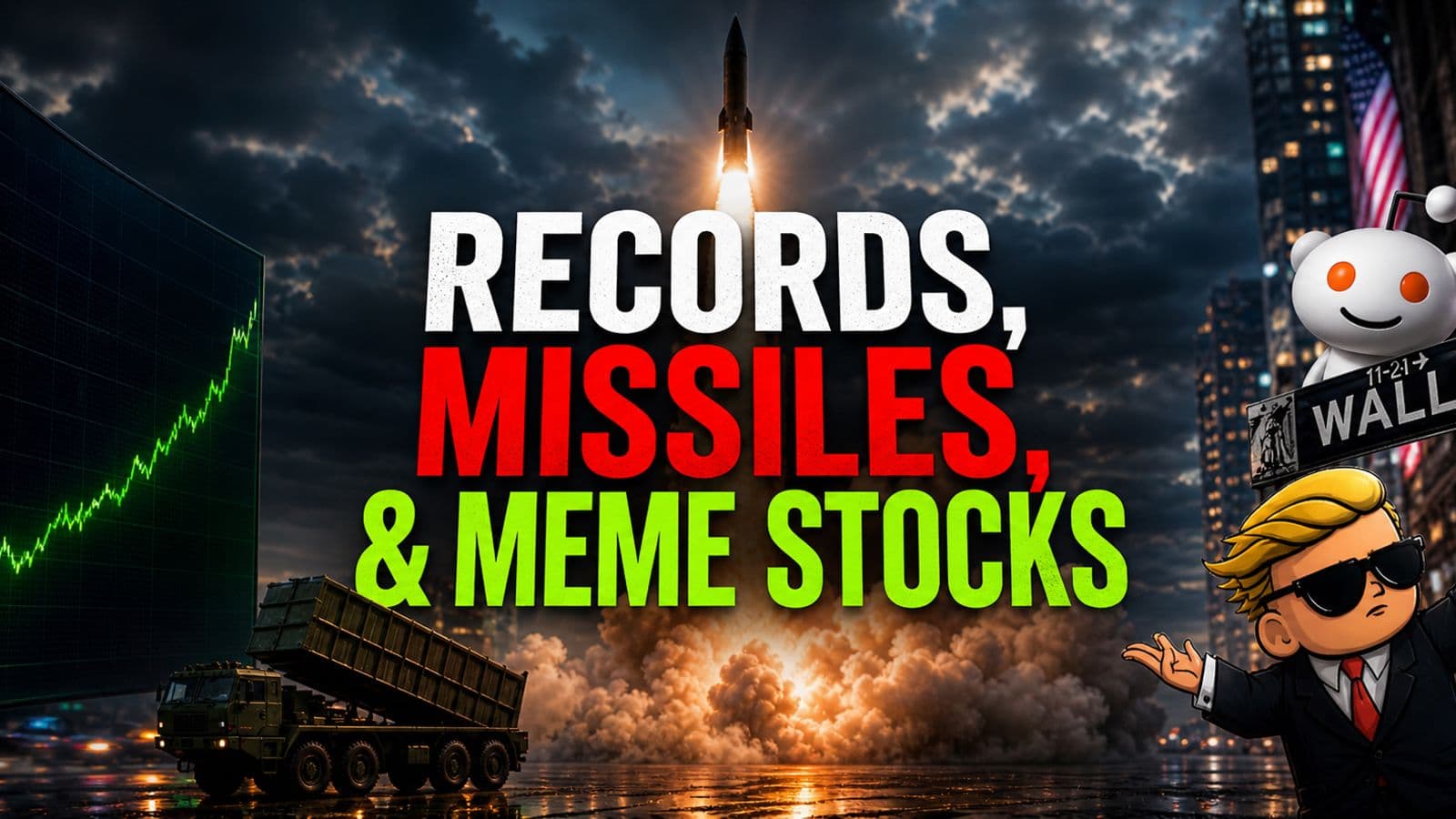
Wall Street came into the week riding one of the most remarkable rally streaks in recent memory. The S&P 500 and Nasdaq both closed at record highs on Friday, capping the index's strongest monthly performance since 2020 after a first-quarter earnings season that delivered broadly better-than-expected results. Bank earnings were a particular bright spot, with several major institutions posting their strongest quarterly numbers in years, a signal that the underlying financial system remains in robust health even as geopolitical turbulence has kept investors on edge. Before we get to today's live market action, it is worth examining one of those standout reports up close.
A disputed report of a missile strike on a U.S. vessel in the Gulf rattled futures markets in the early hours of Monday morning, briefly sending crude oil surging and stocks sharply lower before an official American denial steadied the session. As of mid-morning, the major averages have recovered most of those losses, with the Nasdaq holding modest gains, though trading remains choppy as investors continue to parse conflicting reports out of the region. That tension sets the stage for a session packed with consequential storylines beyond the Gulf.
Stock of Interest Today: Bank of America (BAC)
Bank of America's first-quarter results, reported on April 15, were among the most impressive of the season, and they tell an important story about the underlying health of the U.S. financial system heading into a volatile stretch.
The bank posted net income of $8.6 billion for the quarter, a 17% increase from the same period a year ago. Diluted earnings per share came in at $1.11, up 25% year-over-year, which CNBC reported was the highest earnings-per-share figure the company had generated in nearly two decades. Both figures beat Wall Street consensus estimates, with LSEG analysts having forecast $1.01 per share. Total revenue, net of interest expense, reached $30.3 billion, up 7% from a year earlier, driven by higher net interest income, trading revenue, asset management fees, and investment banking fees.
Net interest income, the core measure of how well a bank earns on its loan book relative to its deposit costs, rose 9% year-over-year to $15.7 billion. Every major business segment contributed: Consumer Banking posted net income up 21%, Global Wealth and Investment Management rose 32%, Global Banking climbed 8%, and Global Markets advanced 3%. The bank returned $9.3 billion to shareholders in the quarter through buybacks and dividends, while its Common Equity Tier 1 capital ratio held at 11.2%, well above regulatory minimums.
One particularly noteworthy detail for income investors: preferred dividends required just $429 million against $8.5 billion-plus in net profit, implying a preferred dividend coverage ratio of roughly 20x. That is an exceptionally safe yield profile. The bank's Series L preferred shares, which have traded at a discount historically, currently yield approximately 5.9% and carry potential for capital appreciation given the company's strong financial trajectory and analyst consensus that the common stock remains modestly undervalued.
Current price: $53.24 Analyst expectation: $56.00
Five Market Signals To Watch
Markets are never just one story, and Monday is a reminder of that. Even setting aside the Gulf, today's session is unusually crowded with market-moving developments: a meme stock CEO attempting the most structurally implausible takeover bid in recent memory, a cryptocurrency reclaiming a key psychological level for the first time in months, a record-breaking surge in Asian semiconductor stocks that says something important about where the global AI trade is actually flowing, and one of the highest-stakes earnings reports of the year due after the bell. Each of these stories is worth understanding on its own terms.
What connects them is the same thread that has run through 2026 from the start: a market that keeps finding reasons to rally even as the macro backdrop refuses to fully cooperate. Earnings have been strong. Corporate balance sheets are healthy. Institutional capital continues to flow into AI infrastructure at a pace that is rewriting the semiconductor industry's geography. And yet the Strait of Hormuz remains a live wire, oil prices sit well above where they began the year, and at least one major AI software company is heading into its most consequential earnings report trading nearly 20% below its recent highs. Below are the five developments most worth understanding today, and what they mean for the weeks and months ahead.
1) Iran Claims a Hit. The U.S. Says No. Markets Aren't Sure What to Believe.
The morning's most disruptive headline came from Iran's Fars news agency, which reported that two missiles had struck a U.S. Navy frigate near Jask Island after the vessel allegedly ignored warnings from the Iranian navy. The claim, though quickly and flatly denied by U.S. Central Command, was enough to temporarily send S&P 500 and Nasdaq 100 futures down roughly half a percentage point each, and briefly push Brent crude above $113 a barrel, before both reversed course once CENTCOM weighed in.
The episode is a window into just how fragile market sentiment around the Strait of Hormuz remains. The strait has been effectively closed to most commercial traffic since late February, when the U.S. and Israel launched coordinated strikes against Iran and Iran retaliated by blockading the waterway. According to Wikipedia's running account of the crisis, an estimated 25% of the world's seaborne oil trade and 20% of global LNG once flowed through the strait each year. That supply chain has been largely severed for more than two months. On Sunday evening, President Trump announced "Project Freedom," a mission using guided-missile destroyers, over 100 aircraft, and some 15,000 military personnel to escort neutral commercial vessels through the strait beginning Monday. Two U.S.-flagged vessels successfully transited Monday morning, according to CENTCOM, though Iran condemned the operation as a violation of the existing ceasefire, and the UAE issued missile alerts across multiple emirates. The all-clear was issued shortly afterward.
For investors, the lesson from this morning is that the market has largely learned to absorb bad Hormuz headlines, but it has not yet priced in the possibility that this conflict escalates meaningfully beyond its current state. Raymond James institutional equity strategist Tavis McCourt noted over the weekend that investors have been surprised by how well equities have held up, citing strong early-2026 economic momentum and an oil futures curve that remains "backwardated," suggesting the market expects prices to fall as the conflict eventually resolves. That calm could prove justified. It could also prove complacent if Monday's disputed incident proves to be more than a war of words.
2) GameStop Bids $56 Billion for eBay. Yes, Really.
In what may be the most audacious corporate maneuver of 2026, GameStop announced Sunday that it has submitted a non-binding proposal to acquire 100% of eBay at $125 per share, split evenly between cash and GameStop common stock, in a deal that values the e-commerce giant at roughly $55.5 billion. The offer represents a 20% premium to eBay's Friday closing price and a 46% premium to the price on February 4, the day GameStop began quietly accumulating a roughly 5% stake in the company. eBay shares jumped sharply on the news in premarket trading, while GameStop shares were more volatile, reflecting the market's skepticism about execution.
The deal, if it were to close, would be one of the most dramatic David-versus-Goliath acquisitions in corporate history. GameStop, the brick-and-mortar video game retailer turned meme stock icon, has a market capitalization of roughly $12 billion. It is proposing to acquire a company nearly four times its size. True to form, CEO Ryan Cohen — who is famously allergic to traditional financial media and communicates almost exclusively through SEC filings and cryptic posts on X — announced the TD Bank financing commitment not via a press conference or analyst call, but through an 8-K filing, accompanied by a post on X consisting of an image of an eBay logo taped over a Blockbuster sign. Cohen's written statement argued that eBay's earnings power could increase materially under tighter cost management and that the combination could allow the company to better compete against Amazon in the secondhand goods market.
The math, however, borders on fantasy. The deal is structured as 50% cash and 50% GameStop stock, meaning the equity portion alone is worth roughly $28 billion. GameStop's entire market capitalization is approximately $12 billion. To fund that stock component at current prices, GameStop would need to issue more than double its entire existing share count, a dilution so severe it effectively turns the transaction into a reverse merger rather than an acquisition. eBay shareholders being asked to accept newly printed GameStop equity as consideration for their shares would need a compelling answer to the question of why that stock is worth anything close to what it trades at today. The $20 billion TD Bank debt commitment, meanwhile, covers only about a third of the total deal value, leaving a yawning financing gap that Cohen has not convincingly bridged. eBay's board has not yet responded publicly, and most analysts expect it will treat this proposal the way boards typically treat structurally implausible unsolicited bids: with a polite but firm rejection. Whether or not the deal has any real chance of closing, the story has already given the market one of its most entertaining narratives of the year.
3) Bitcoin Tops $80,000 for the First Time in Three Months
Bitcoin climbed back above $80,000 on Monday for the first time since early 2026, extending a recovery from lows near $60,000 hit in February in the aftermath of the U.S.-Iran conflict's outbreak. The move was supported by a combination of factors: improving risk appetite as Asian equities surged, strong institutional demand reflected in Friday's U.S. spot Bitcoin ETF inflows of roughly $630 million according to market reports, optimism around potential crypto market-structure legislation, and what analysts described as a short squeeze as sellers found thin resistance above the $80,000 level.
The return to this psychological threshold matters for more than just crypto traders. Bitcoin's recovery is a meaningful signal about the broader risk environment. The cryptocurrency tends to function as a high-beta expression of investor confidence, falling sharply when fear rises and bouncing hard when sentiment shifts. Its move above $80,000 this morning, in the same session where geopolitical headlines initially hammered futures, is a reminder that the market continues to assign a relatively low probability to catastrophic escalation in the Middle East conflict. Alongside Bitcoin, crypto-adjacent equities like Coinbase, MicroStrategy, and Robinhood have all moved higher. Coinbase separately disclosed Monday that a deal had been reached on a key provision of pending crypto market-structure legislation, potentially clearing a Senate logjam that has stalled broader digital asset regulation for months.
Some caution is warranted. Stablecoin reserves on exchanges have reportedly reached record levels, suggesting substantial investor capital sitting on the sidelines rather than committing aggressively to Bitcoin. Analysts note this pattern could indicate a defensive posture among traders waiting for clearer signals before adding meaningfully to risk positions. The broader market-structure legislation still faces uncertainty, and prominent crypto strategists have warned that the current bounce could fade if macro conditions shift. Bitcoin's brief October 2025 all-time high above $126,000 still looms as a distant ceiling.
4) Asian AI Chipmakers Hit Records as Capital Flows East
While U.S. markets have wrestled with Iran-related volatility through much of 2026, Asian equity markets have been on a tear, and Monday was no exception. The MSCI Asia Pacific Index jumped as much as 2.3% to an all-time high, with South Korean and Taiwanese tech-heavy benchmarks each surging more than 4%. SK Hynix soared to a fresh record, TSMC climbed to an all-time high, and Samsung advanced sharply as well. The South Korean benchmark, the Kospi, is now up roughly 44% in 2026, a run that has pushed the country's total stock market capitalization past both Germany's and France's.
The driver is well understood but easy to underestimate. While the U.S. market has been navigating concerns that AI could disrupt large swaths of the software and services economy, creating what analysts call the "AI Scare Trade," Asian semiconductor manufacturers are on the other side of that equation. They make the physical infrastructure that every AI application depends on. SK Hynix dominates high-bandwidth memory, which is essential to modern AI data centers, and commands operating margins around 72%. TSMC, which manufactures the chips for virtually every major AI hardware platform, is approaching a 45% weighting in Taiwan's benchmark Taiex index. Bloomberg noted in February that correlations between Asian and U.S. equities have fallen to their weakest levels since mid-2022, a sign that global money managers are actively rotating capital across the Pacific.
The longer-term question is how durable this divergence can be. The AI infrastructure buildout that is driving semiconductor demand is largely funded by U.S. hyperscalers, whose own stocks have come under pressure from the disruption concerns. If enterprise AI spending were to slow, the ripple effects would eventually reach Seoul and Taipei. For now, however, the semiconductor demand pipeline looks robust, and Asia's role as the essential hardware supplier to the global AI economy appears structurally intact.
5) Palantir Reports After the Bell: AI's Most Consequential Earnings Event of the Week
Few earnings reports carry as much symbolic weight for the AI investment narrative as Palantir Technologies' quarterly results. The data analytics and AI platform company is scheduled to report its first-quarter 2026 results after markets close tonight, and the setup is unusually high-stakes. Wall Street expects revenue of approximately $1.54 billion for the quarter, which would represent 74% growth from the same period a year ago, alongside earnings per share of $0.28, more than double Q1 2025's figure. Those are extraordinary growth numbers for a company trading at more than 200 times trailing earnings, and they come after Palantir has beaten analyst estimates for ten consecutive quarters.
The central question tonight is not just whether Palantir beats. It is whether the company's guidance justifies a valuation that prices in near-perfection for years to come. Palantir has committed to at least 115% growth in U.S. commercial revenue for the full year, driven by adoption of its Artificial Intelligence Platform, known as AIP. The company also has meaningful government contract momentum, including a $2.3 billion Department of Defense budget allocation for its Maven Smart System. Wedbush analyst Dan Ives, one of the most consistently bullish voices on Palantir, reiterated an Outperform rating and a $230 price target ahead of the report, calling Q1 estimates "beatable" and describing Palantir as a potential trillion-dollar company.
The risks are real, however. The stock is down roughly 19% year-to-date even after a modest pre-earnings bounce, reflecting investor anxiety about whether an AI-driven software company can sustain hypergrowth at its current scale. Options traders are pricing in a move of about 10% in either direction following the report. A clean "beat and raise," where the company surpasses estimates and lifts its full-year outlook, could be the catalyst that breaks the stock out of its recent range. A miss, or even an in-line result with muted guidance, could send shares significantly lower. Tonight's Palantir report will be a real-time test of how much the market is willing to pay for AI growth at a premium valuation.
Bottom Line
Monday's market action is a compressed version of the larger tension that has defined 2026: a world where the underlying economic and corporate fundamentals have rarely been stronger, but where geopolitical uncertainty and elevated valuations keep the rally from feeling entirely comfortable. Bank of America's blowout quarter, the AI-driven surge in Asian chipmakers, and Bitcoin's return to $80,000 are all consistent with an economy that is absorbing the Strait of Hormuz crisis better than most observers feared. GameStop's audacious bid for eBay and Palantir's after-hours earnings report inject genuine uncertainty into the day's narrative. The warship claim, quickly denied but still unsettling, is a reminder that the Hormuz situation remains capable of delivering shock headlines on short notice.
The investors best positioned for the weeks ahead are those who can hold two ideas in mind simultaneously: that the fundamentals of this market, from bank earnings to semiconductor demand to institutional crypto adoption, genuinely support the rally that has brought major indices to record territory, and that the geopolitical situation in the Middle East has not been resolved, only managed. Project Freedom may successfully shepherd more ships through the strait. The ceasefire talks may bear fruit. Or they may not. The market has so far chosen optimism. Monday is a test of how deep that optimism runs.
Sources:
- https://www.cnbc.com/2026/04/15/bank-of-america-bac-earnings-q1-2026.html
- https://finance.yahoo.com/markets/stocks/articles/bank-america-q1-2026-earnings-120335022.html
- https://www.sec.gov/Archives/edgar/data/70858/000007085826000222/bac03312026ex991.htm
- https://www.cnn.com/2026/05/04/world/live-news/iran-war-hormuz-trump
- https://www.aljazeera.com/news/liveblog/2026/5/4/iran-war-live-tehran-says-trumps-hormuz-mission-violates-ceasefire
- https://english.alarabiya.net/News/middle-east/2026/05/04/iran-s-fars-news-agency-reports-incident-with-us-warship-in-strait-of-hormuz
- https://en.wikipedia.org/wiki/2026_Strait_of_Hormuz_crisis
- https://www.cnbc.com/2026/05/03/stock-market-today-live-updates.html
- https://www.bloomberg.com/news/articles/2026-05-04/asian-stocks-outside-of-japan-hit-record-high-as-tech-rallies
- https://investor.gamestop.com/news-releases/news-details/2026/GameStop-Proposes-to-Acquire-eBay-at-125-00-Per-Share/
- https://www.cnbc.com/2026/05/04/gamestop-ebay-takeover-bid-ryan-cohen-gaming-retail-ecommerce.html
- https://www.bloomberg.com/news/articles/2026-05-03/gamestop-making-56-billion-offer-to-acquire-ebay-wsj-says
- https://www.cnn.com/2026/05/04/business/gamestop-buys-ebay-intl
- https://www.ccn.com/news/crypto/bitcoin-may-80k-strategy-fed-consensus-rally/
- https://www.cryptotimes.io/2026/05/04/bitcoin-surges-past-80000-as-trumps-project-freedom-lifts-markets/
- https://www.reelfinancial.com/archives/96843
- https://finance.yahoo.com/news/top-us-crypto-bills-watch-100215687.html
- https://finance.yahoo.com/news/ai-angst-us-stocks-sends-015556780.html
- https://247wallst.com/investing/2026/05/01/the-memory-supercycle-is-back-in-motion-and-samsung-and-sk-hynix-may-be-the-stocks-with-the-most-torque/
- https://www.tipranks.com/news/palantir-pltr-q1-earnings-monday-3-things-investors-should-watch-closely
- https://www.foreignpolicyjournal.com/2026/05/03/palantir-pltr-stock-price-heads-into-q1-earnings-with-options-pointing-lower-despite-analyst-upside-consensus/
- https://www.thestreet.com/latest-news/stock-market-today-may-4-2026-updates
- https://www.bloomberg.com/news/articles/2026-05-03/us-futures-gain-oil-falls-on-signs-of-iran-talks-markets-wrap
- https://seekingalpha.com/article/4897501-bank-of-america-how-i-double-the-average-dividend-yield
Share
Market Munchies and Mode Mobile communications are for informational purposes only, and are not a recommendation, solicitation, or research report relating to any investment strategy, security, or digital asset. All investments involve risk including the loss of principal and past performance does not guarantee future results.
Any information contained in this commentary does not purport to be a complete description of the securities, markets, or developments referred to in this material. The information has been obtained from sources considered to be reliable, but we do not guarantee that the foregoing material is accurate or complete. There is no guarantee that any statements or opinions provided herein will prove to be correct.