Samsung Just Hit $1 Trillion. The KOSPI Just Broke 7,000. Here's the AI Story Behind Both Numbers.
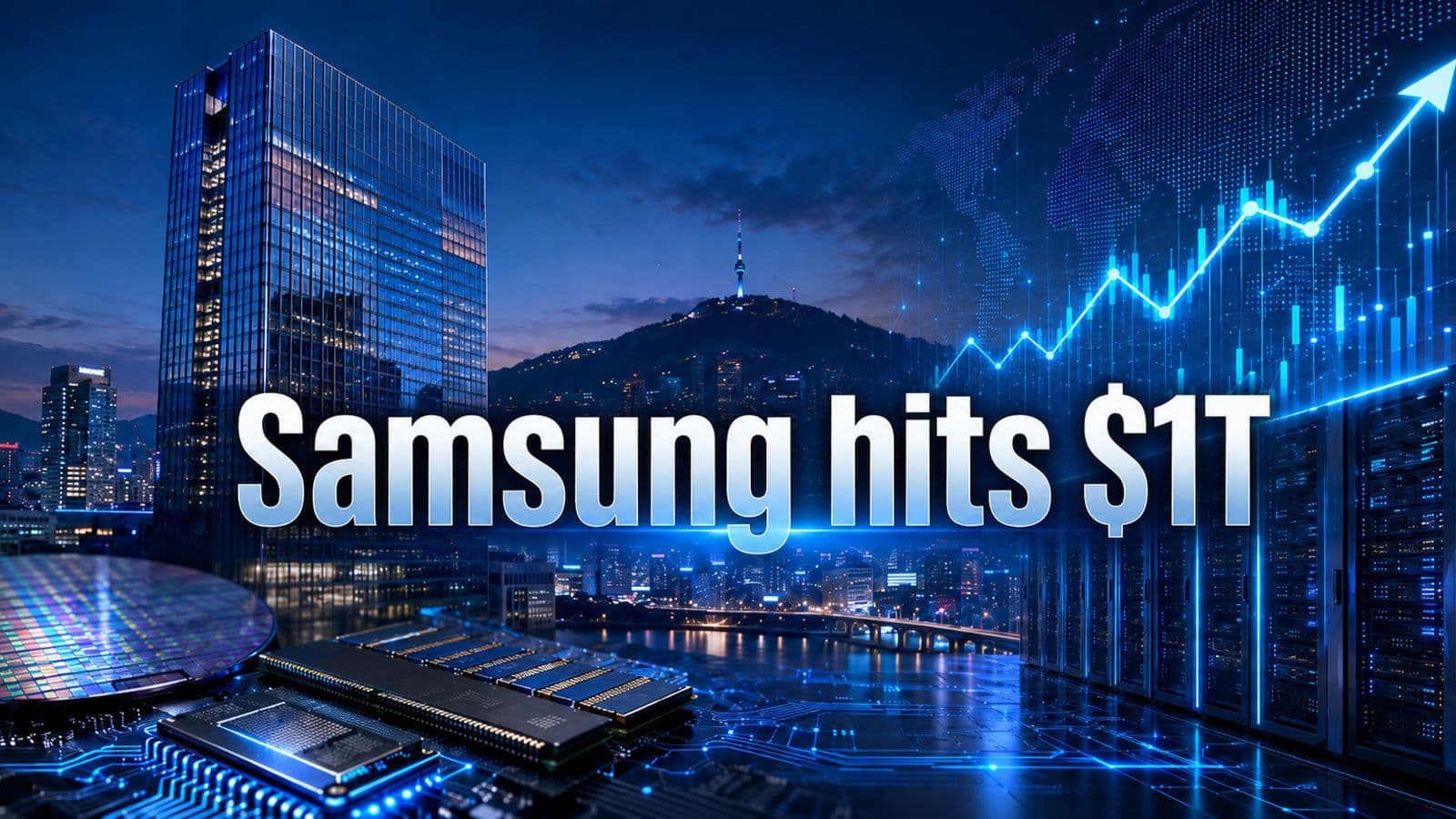
The Most Important Market Event of the Day Happened in Seoul, Not New York. Samsung Electronics surged 15% this morning, crossing a $1 trillion market capitalization for the first time and becoming only the second Asian company — after TSMC — to reach that threshold.…
The Most Important Market Event of the Day Happened in Seoul, Not New York.
Samsung Electronics surged 15% this morning, crossing a $1 trillion market capitalization for the first time and becoming only the second Asian company — after TSMC — to reach that threshold. Simultaneously, South Korea's benchmark KOSPI index broke 7,000 for the first time in its history, briefly triggering a rare "sidecar" trading curb after a sharp open.
This is not a Korea story. This is a global AI infrastructure story — and it is the most unambiguously positive market signal of an otherwise tense week.
📈 The Numbers
Samsung share price: Up 15% today. Up more than 400% from a year ago. Q1 2026 operating profit: 57.2 trillion won — an eightfold year-on-year increase, the highest quarterly profit in company history.
KOSPI index: Broke 7,000 for the first time ever. Up approximately 76% year-to-date, following a 76% gain in 2025. The best two-year run for the Korean benchmark since 1999.
SK Hynix: Also up more than 10% today, hitting its own all-time high alongside Samsung.
Foreign investor flows: Global investors added a near-record 2.9 trillion won ($2 billion) worth of KOSPI shares on Monday alone, and resumed buying today after the holiday. A new tie-up between Interactive Brokers and Samsung Securities now gives U.S. investors direct access to Korean stocks — a structural change in how American capital can flow into this market.
🧠 Why This Is Happening Today
Two catalysts converged this week.
The first is Samsung's own earnings. Last week's Q1 2026 results confirmed that Samsung's semiconductor business posted a nearly 50-fold increase in profit year-on-year, driven by insatiable demand from AI data centers for High Bandwidth Memory chips. Samsung also became the world's first company to begin mass production of HBM4 — the sixth and latest generation of the technology — which is expected to play a central role in Nvidia's upcoming Vera Rubin AI architecture. Customer feedback on HBM4 has been positive, analysts said, helping narrow Samsung's technology gap with market leader SK Hynix.
The second is what happened in U.S. markets overnight. AMD surged 12% in after-hours trading after forecasting Q2 revenue above expectations, driven by robust AI chip demand. The Philadelphia Semiconductor Index jumped 4.2%. When U.S. chip stocks surge, Korean chip stocks open higher the next morning — the correlation between the two markets is now among the tightest in global equities.
🏭 What the $1 Trillion Means Beyond the Headline
"The trillion dollar threshold carries material weight beyond the symbolism," said Dave Mazza, chief executive of Roundhill Investments. "More broadly, it reflects a market judgment that memory's role in the AI infrastructure stack is structural, not cyclical."
That sentence is the key distinction for investors. Chip cycles have historically been boom-bust affairs — periods of oversupply following periods of undersupply, with manufacturers' profits swinging wildly as a result. The working hypothesis behind Samsung's valuation today is that AI has broken the cycle.
Here is why that case is being made. Samsung's chief financial officer told analysts that the demand-fulfillment rate is at a record low — customers are actively pulling forward their 2027 demand into 2026 to lock in supply. The company is guiding to a tighter supply-demand balance in 2027 than in 2026, not a looser one. Memory pricing is not softening. It is firming further out on the demand curve.
Sam Konrad, investment manager at Jupiter Asset Management, made the bull case succinctly: "The memory market is currently undersupplied, and Samsung said that 2027 will see tighter supply and demand than 2026, so prices for NAND and DRAM are likely to continue rising."
If that forecast holds, Samsung's $1 trillion valuation is not the ceiling. It is a waypoint.
⚖️ The Bear Case Is Real Too
The same operating leverage that produced an eightfold profit jump works in reverse with comparable speed.
Samsung still trails SK Hynix in the HBM market — SK Hynix holds an estimated 55% market share versus Samsung's roughly 25%. The article's framing of Samsung "closing the gap" deserves a harder look. SK Hynix reported Q1 2026 operating profit of 37.61 trillion won at a 72% operating margin — numbers that reflect a company operating at the absolute frontier of its industry, not one about to be overtaken. The 2026 Memory War is not decided. Samsung has HBM4 mass production. SK Hynix has dominant market share, superior margins, and a customer base that has spent two years optimizing its AI infrastructure around SK Hynix supply chains. Switching costs are real. Qualification cycles for new memory in production AI systems take months. Samsung's Q1 semiconductor profit jumped nearly 50-fold year-on-year — but that was from a very low base, and SK Hynix was already generating record profits in the same period. Both companies are winning. The question of which one is winning more is still genuinely open.
The broader risk is macro. South Korea's KOSPI is currently trading at approximately 9x this year's earnings forecasts — cheap by global standards — but the range of outcomes is extreme. Seo Sang-young, an analyst at Mirae Asset Securities, put the bull and bear case bluntly: "If the demand for AI chips continues at this level, the KOSPI could reach 10,000 points by the end of this year — but if the demand collapses with worries over inflation and weak growth due to the Iran war, it could plummet to as low as 4,500 points."
That is not a narrow range. It reflects genuine uncertainty about whether the AI demand cycle that has driven Samsung and SK Hynix to record profits can sustain itself against a global macro backdrop of $120 oil, rising inflation, and slowing consumer spending.
One additional domestic risk: Samsung's 85,000-person workforce has threatened an 18-day general strike over wage disputes. A prolonged strike at Samsung's memory fabrication facilities would constrain output at the worst possible moment — when demand-fulfillment rates are already at record lows.
🌏 What It Means for Korea's Place in the World
Something has shifted in how Korea is positioned within the global AI economy, and today's KOSPI milestone captures it.
Eighteen months ago, Korea was a significant but secondary player in the AI infrastructure story — a supplier of components in a hierarchy dominated by U.S. software and Taiwanese logic chips. Today, Samsung and SK Hynix together control the memory layer of every AI accelerator on earth. There is no AI without HBM. There is no HBM at scale without these two companies.
That makes Korea a structural chokepoint of the global AI economy — not a supplier hoping to capture some of the spending, but a gatekeeper that determines how fast the rest of the AI economy can deploy. That changes Korea's diplomatic and industrial policy posture. It changes how other governments approach Korean export control questions, particularly around HBM technology transfer to non-aligned customers. And it changes how foreign institutional investors think about Korea's political stability as a risk factor.
A country that controls a chokepoint in the global AI supply chain has leverage it did not have before. Today's $1 trillion Samsung valuation is, in part, the market pricing that leverage in.
💼 For Investors
EWY (iShares MSCI South Korea ETF) remains the most practical U.S. entry point for retail investors seeking Korean equity exposure. But the concentration caveat stands: Samsung and SK Hynix together represent more than 43% of the KOSPI weight. Buying EWY is effectively a two-stock bet on HBM demand with a side of Hyundai and KB Financial.
Direct positions in Samsung or SK Hynix are now more accessible than ever via the new Interactive Brokers / Samsung Securities tie-up — though currency risk, settlement complexity, and the strike risk at Samsung make the ETF a more practical entry point for most.
The 9x earnings multiple on the KOSPI is the most compelling valuation argument for international investors comparing Korean exposure to U.S. tech at 25-30x. The bull case is straightforward: same AI demand, much cheaper entry. The bear case is equally clear: the same concentrated exposure that produced 400% gains in a year can produce comparable losses if the cycle turns.
Today is a good day to understand the opportunity. It is also a good day to understand the risks.
Sources
- CNBC — "Samsung crosses $1 trillion valuation as AI frenzy drives historic rally": https://www.cnbc.com/2026/05/06/samsung-electronics-ai-chip-rally-kospi-record-1-trillion.html
- Reuters / Yahoo Finance — "Korea's KOSPI breaks 7,000 as AI chip rally lifts Samsung into $1 trillion club": https://finance.yahoo.com/markets/world-indices/articles/south-koreas-kospi-share-index-001611351.html
- Bloomberg — "Samsung Hits $1 Trillion Market Valuation as Stock More Than Quadruples on AI": https://www.bloomberg.com/news/articles/2026-05-06/samsung-hits-1-trillion-valuation-joining-tsmc-in-elite-club
- The National — "Samsung hits $1 trillion valuation milestone": https://www.thenationalnews.com/business/2026/05/06/samsung-hits-1-trillion-valuation/
- TNW — "Samsung Electronics crosses $1tn, joining TSMC": https://thenextweb.com/news/samsung-electronics-1-trillion-market-cap-ai-memory
- MarketScreener / Reuters — "S.Korea's KOSPI breaks 7,000 as AI chip rally lifts Samsung": https://www.marketscreener.com/news/s-korea-s-kospi-breaks-7-000-as-ai-chip-rally-lifts-samsung-into-1-trillion-club-ce7f58ddda88f520
- Kaohoon International — "Samsung Hits $1 Trillion Market Cap, Lifts KOSPI to Record": https://www.kaohooninternational.com/markets/582096
- iShares — EWY iShares MSCI South Korea ETF: https://www.ishares.com/us/products/239681/ISHARES-MSCI-SOUTH-KOREA-ETF
Market Munchies and Mode Mobile communications are for informational purposes only, and are not a recommendation, solicitation, or research report relating to any investment strategy, security, or digital asset. All investments involve risk including the loss of principal and past performance does not guarantee future results.
Any information contained in this commentary does not purport to be a complete description of the securities, markets, or developments referred to in this material. The information has been obtained from sources considered to be reliable, but we do not guarantee that the foregoing material is accurate or complete. There is no guarantee that any statements or opinions provided herein will prove to be correct.