SEC and CFTC Are Writing the Rules Together — Here's What That Means for Crypto
📄 A New Agreement Is Taking Shape Between America's Top Market Watchdogs The two most powerful financial regulators in the United States are formalizing a working relationship that could reshape how crypto businesses operate for years to come. SEC Chairman Paul Atkins has…
📄 A New Agreement Is Taking Shape Between America's Top Market Watchdogs
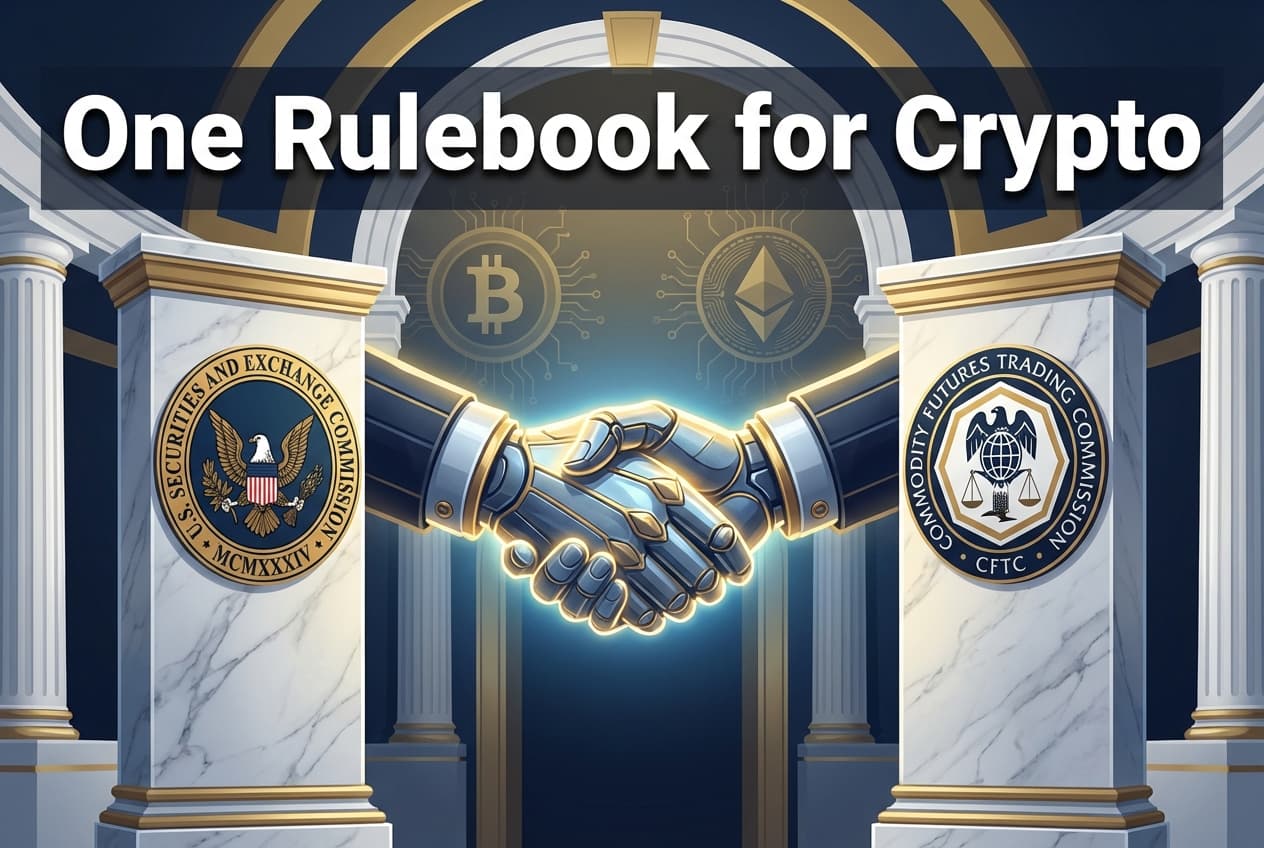
The two most powerful financial regulators in the United States are formalizing a working relationship that could reshape how crypto businesses operate for years to come. SEC Chairman Paul Atkins has confirmed that the Securities and Exchange Commission and the Commodity Futures Trading Commission are drafting a memorandum of understanding, commonly known as an MOU, to coordinate their oversight of digital asset markets. The agreement will cover joint product approvals, rule interpretations, coordinated examinations of dually regulated firms, and shared enforcement decisions. For an industry that has spent years caught between two agencies with overlapping and often conflicting mandates, this signals a meaningful shift toward cleaner, more predictable regulation. Atkins also announced plans for a shared harmonization website where firms can request coordinated discussions with both agencies simultaneously, instead of bouncing between two separate bureaucracies.
⚔️ Why These Two Agencies Were Never on the Same Page
To understand why this MOU matters, it helps to know why the SEC and CFTC have historically clashed over crypto jurisdiction. The SEC oversees securities and the exchanges on which they trade, while the CFTC regulates derivatives markets including futures, options, and swaps. Both agencies have long agreed that Bitcoin and Ether are commodities under the CFTC's purview, but thousands of other tokens occupy a murky gray zone. A newer token issued through a fundraise often looks like a security under the SEC's Howey Test, but once it becomes widely used, it may transition toward commodity-like status. That classification gap created a compliance nightmare for exchanges, issuers, and investors. Competing agency claims led to inconsistent enforcement, duplicative filings, and a general atmosphere of regulatory unpredictability that pushed some crypto firms offshore. The rivalry was real, and the industry bore the cost.
🤝 One Front Door: Joint Meetings and Combined Exams
The practical details of the MOU represent the most immediate relief for regulated firms. According to Atkins, "coordinated exam planning for dually regulated entities should become standard practice," and "shared supervisory findings, subject to assurances of confidentiality, should be the norm rather than the exception." In plain terms, that means crypto companies regulated by both agencies will no longer face redundant audits and examinations conducted independently by each regulator. The MOU also calls for combined meetings with firms pitching new products, eliminating the current burden of separate pitches to the SEC and CFTC. For exchanges and asset managers seeking product approval, this could significantly shorten launch timelines. A company building a crypto derivatives product that touches both securities and commodities law will now have a single coordinated process rather than two parallel regulatory conversations.
🗂️ Project Crypto: Building a Shared Rulebook
The MOU is the operational layer of a broader initiative called Project Crypto. On January 30, 2026, SEC Chair Atkins and CFTC Chair Michael Selig jointly announced that Project Crypto, previously an SEC-only effort, would become a unified interagency initiative. The joint statement committed both agencies to reducing regulatory uncertainty, eliminating duplicative compliance obligations, and developing a formal token taxonomy to clarify jurisdictional boundaries. That taxonomy is significant. Chair Selig stated that many crypto assets currently trading in secondary markets are not securities, including tools, commodities, and collectibles, even when they were originally sold under an investment contract. CFTC staff have been instructed to jointly codify that taxonomy with SEC staff as an interim measure while Congress works on statutory definitions.
🏗️ What Crypto Businesses and Developers Can Expect
For firms building in crypto, the shift from dueling regulators to coordinated oversight has real operational consequences. Compliance teams that maintained separate workflows for SEC and CFTC reporting may eventually consolidate those processes. Product developers working on instruments that blend securities and derivatives characteristics, such as tokenized equities or perpetual swaps, will benefit from clear joint guidance rather than conflicting agency signals. The late 2025 joint harmonization initiative already allowed registered exchanges to facilitate trading in certain crypto products and permitted clearing organizations to collaborate with third-party custodians to hold customer crypto assets. The MOU deepens that framework. The regulatory fragmentation that once made product development difficult is starting to give way to structured, interoperable oversight.
🎯 What Investors and Traders Should Watch
For retail investors and traders, the SEC-CFTC MOU is not a short-term price catalyst, but it is a meaningful indicator of where the market is headed. Clearer regulatory structure tends to attract institutional capital, which drives liquidity and reduces volatility over time. A well-defined token taxonomy would also reduce the legal risk that has kept large financial institutions from fully engaging with many altcoins. The process is still in motion. The MOU is being written, not yet signed. The token taxonomy remains an interim measure while Congress deliberates. But the direction is unmistakable: the two most influential crypto regulators in the world are now working together instead of against each other. For investors watching macro regulatory trends as indicators of the next growth phase, this cooperation is worth tracking closely. The foundations being laid now will determine which assets and platforms operate legally and confidently in the U.S. market for the next decade.
Sources
https://www.coindesk.com/policy/2026/03/10/u-s-sec-chief-atkins-said-bond-with-sister-agency-cftc-to-include-joint-meetings-exams https://www.mofo.com/resources/insights/260130-sec-and-cftc-announce-joint-project-crypto-initiative https://www.huschblackwell.com/newsandinsights/sec-cftc-harmonization-and-digital-asset-regulation-what-stakeholders-need-to-know https://www.jdsupra.com/legalnews/sec-cftc-harmonization-and-digital-4629676/ https://www.merklescience.com/blog/cftc-vs-sec-navigating-regulatory-overlap-in-the-crypto-market
Market Munchies and Mode Mobile communications are for informational purposes only, and are not a recommendation, solicitation, or research report relating to any investment strategy, security, or digital asset. All investments involve risk including the loss of principal and past performance does not guarantee future results.
Any information contained in this commentary does not purport to be a complete description of the securities, markets, or developments referred to in this material. The information has been obtained from sources considered to be reliable, but we do not guarantee that the foregoing material is accurate or complete. There is no guarantee that any statements or opinions provided herein will prove to be correct.
Get fresh insights, breaking news, and hidden gems in the world of crypto—delivered straight to your inbox with our Crypto Cookies newsletter. Don't miss out—sign up now and get your first bite of insider knowledge!