SEC and CFTC Declare Most Digital Assets Are Not Securities
📜 A Decade of Regulatory Fog Finally Lifts For years, the single most paralyzing question in crypto was deceptively simple: is this token a security? The answer determined whether a project needed to register with the SEC, whether an exchange could legally list the asset, and…
📜 A Decade of Regulatory Fog Finally Lifts
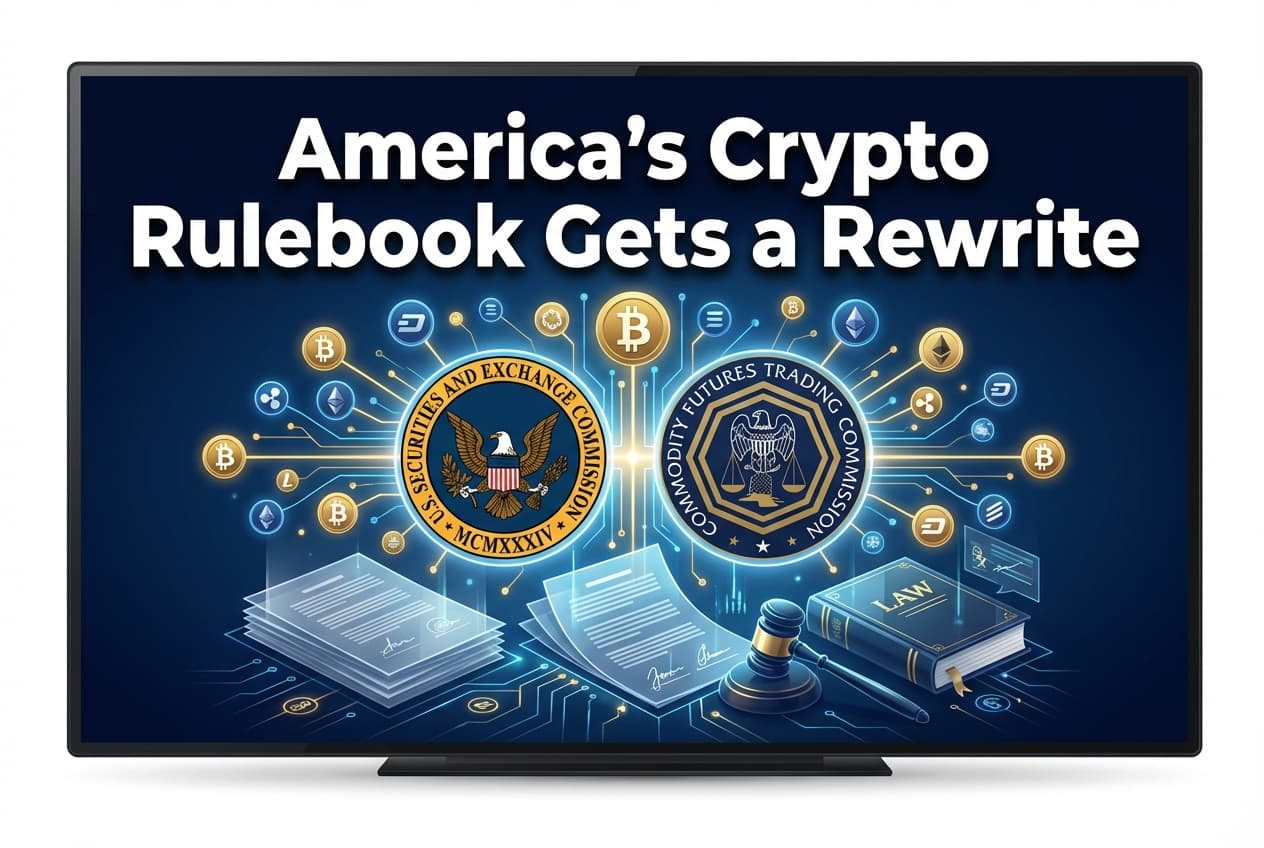
For years, the single most paralyzing question in crypto was deceptively simple: is this token a security? The answer determined whether a project needed to register with the SEC, whether an exchange could legally list the asset, and whether U.S. builders could even operate without facing enforcement action. On March 17, 2026, that fog began to clear. The SEC and CFTC jointly released landmark guidance confirming that most crypto assets do not qualify as securities under federal law. SEC Chair Paul Atkins put it plainly at the DC Blockchain Summit in Washington, D.C.: "We're not the 'securities and everything commission' anymore." The statement signaled the most significant shift in U.S. crypto regulatory posture since Bitcoin was first scrutinized by regulators, and it arrived after more than a decade of enforcement-first policy that pushed innovation offshore and stifled domestic development.
🗂️ Five Categories That Will Reshape the Industry
At the heart of the new guidance is a five-part token taxonomy that gives market participants a concrete framework for classifying digital assets. The categories are: digital commodities, digital collectibles, digital tools, stablecoins, and digital securities. Digital commodities, which include Bitcoin and Ethereum, are assets whose value derives from the programmatic operation of a crypto system and market supply and demand, not from the managerial efforts of a central team. Digital collectibles cover NFTs, meme coins, art, music, and in-game items. Digital tools encompass memberships, event tickets, credentials, and identity badges. Stablecoins issued under the forthcoming GENIUS Act framework are treated as non-securities, while others will depend on specific facts. Only digital securities, which represent tokenized stocks, bonds, or treasuries, fall squarely within SEC jurisdiction. This five-category framework gives builders, lawyers, and investors a starting point that has simply not existed before.
⛏️ Mining, Staking, and Airdrops Get the Green Light
Beyond asset classification, the guidance addressed specific activities that have been sources of legal anxiety across the industry. Protocol mining, including Bitcoin mining, does not constitute a securities offering when operators perform administrative functions in exchange for payment. Staking, another perennial regulatory gray zone, is similarly excluded from securities treatment. Certain airdrops of non-security assets also do not require registration, provided recipients provide nothing of value in exchange for receiving tokens. Wrapped tokens that represent non-security assets will not themselves be reclassified as securities. For validators, node operators, protocol developers, and DeFi participants, these clarifications remove years of accumulated legal uncertainty that forced many to operate cautiously, structure products awkwardly, or avoid U.S. users entirely. The guidance also introduced the concept that investment contracts can expire: once a project's founders have ceased essential managerial efforts, assets can transition out of securities classification.
🤝 The SEC-CFTC Coordination Pact Changes the Oversight Landscape
Alongside the interpretive guidance, the SEC and CFTC signed a memorandum of understanding formalizing their commitment to coordinated oversight. The agencies launched a "Joint Harmonization Initiative" covering product definitions, clearing and margin rules, reporting standards, trading venue oversight, and frameworks for tokenization. The CFTC committed to administering the Commodity Exchange Act "consistent with the SEC's interpretation," an unusually direct statement of inter-agency alignment. SEC Chair Atkins acknowledged that past regulatory conflicts had forced market participants to relocate operations overseas, noting that "different registrations and inconsistent regulations complicated compliance for companies operating across securities and commodities markets." Steven Wu, COO at Clearpool, noted the pact could move the system toward substituted compliance, where satisfying one regulator's requirements satisfies both. That outcome would dramatically reduce the compliance burden for firms operating across spot and derivatives markets.
🛡️ Safe Harbors, Congress, and What Comes Next
The guidance also previewed a set of proposed safe harbor provisions that could further protect early-stage crypto projects. The SEC indicated plans to propose exemptions for startups raising under $5 million in their first four years, and for entrepreneurs raising up to $75 million via investment contracts, provided certain conditions are met. These proposals are not yet final and will require formal rulemaking. On the legislative side, Congress is working on a broader crypto market structure bill, but Senate Majority Leader John Thune indicated the legislation would not advance before April, as the Easter recess limits near-term movement. The guidance is designed to complement that congressional work rather than replace it. Critics of the new framework caution that gaps remain, particularly for DeFi protocols, perpetual swap products, and event contracts where regulatory coverage is still unclear. Enforcement risk has not disappeared, but the boundaries of that risk are now meaningfully narrower for most market participants.
🎯 What This Means for Traders and Investors
For everyday traders and investors, the practical takeaway is that the legal landscape for holding and transacting in most cryptocurrencies has become substantially less fraught. Assets like Bitcoin and Ethereum now sit firmly in the digital commodity category, with regulatory oversight flowing primarily through the CFTC. Token projects that previously faced uncertain legal status will now have a clearer classification path, which could reduce the risk of sudden delistings or enforcement-driven market disruptions. Exchanges and custodians operating in the U.S. will have greater confidence in listing decisions. The coordinated SEC-CFTC framework also means that firms facing dual oversight may eventually benefit from harmonized compliance requirements. For investors evaluating crypto projects, understanding which category an asset falls into now carries real practical significance. Digital securities remain subject to the full weight of securities law, while digital commodities and tools operate in a lighter-touch environment. This is not a blank check for the industry, but it is the clearest set of rules American crypto has ever had.
Sources
https://decrypt.co/361446/sec-most-crypto-assets-not-securities-staking-airdrops-bitcoin-mining https://watcher.guru/news/sec-cftc-confirm-most-crypto-assets-arent-securities https://www.cryptotimes.io/2026/03/18/sec-and-cftc-gives-crypto-industry-what-it-wanted-new-crypto-rules/ https://www.coindesk.com/policy/2026/03/15/the-sec-and-cftc-join-hands-state-of-crypto https://www.analyticsinsight.net/amp/story/news/crypto-market-update-sec-and-cftc-sign-pact-to-align-us-digital-asset-oversight
Market Munchies and Mode Mobile communications are for informational purposes only, and are not a recommendation, solicitation, or research report relating to any investment strategy, security, or digital asset. All investments involve risk including the loss of principal and past performance does not guarantee future results.
Any information contained in this commentary does not purport to be a complete description of the securities, markets, or developments referred to in this material. The information has been obtained from sources considered to be reliable, but we do not guarantee that the foregoing material is accurate or complete. There is no guarantee that any statements or opinions provided herein will prove to be correct.
Get fresh insights, breaking news, and hidden gems in the world of crypto—delivered straight to your inbox with our Crypto Cookies newsletter. Don't miss out—sign up now and get your first bite of insider knowledge!