SEC Cuts Stablecoin Capital Penalty for Broker-Dealers from 100% to Just 2%
📋 What the SEC Just Changed for Regulated Firms In a move that could reshape how Wall Street engages with digital dollars, the Securities and Exchange Commission's Division of Trading and Markets issued new guidance on February 19, 2026, reducing the capital "haircut" applied…
📋 What the SEC Just Changed for Regulated Firms
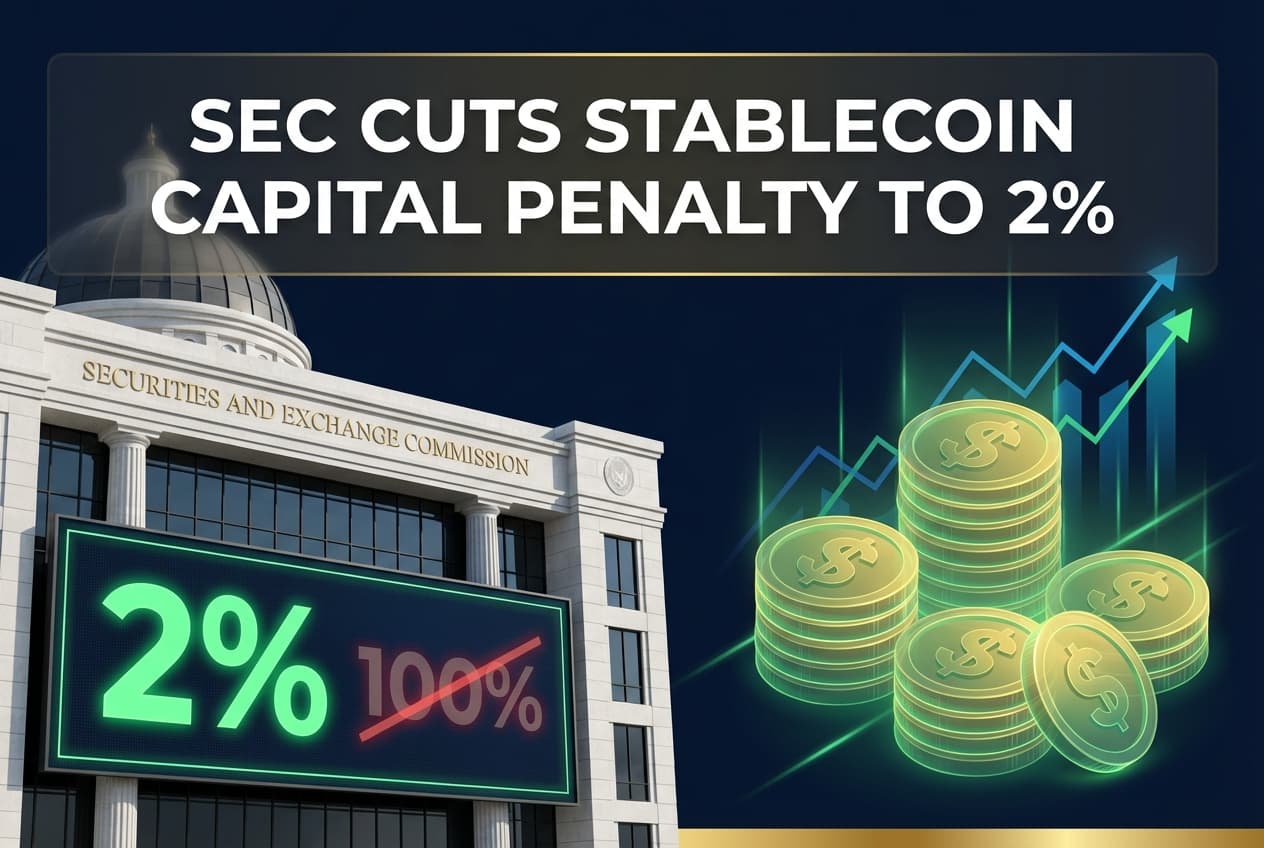
In a move that could reshape how Wall Street engages with digital dollars, the Securities and Exchange Commission's Division of Trading and Markets issued new guidance on February 19, 2026, reducing the capital "haircut" applied to qualifying payment stablecoins for broker-dealers from 100% down to just 2%. In plain terms, a haircut is the percentage of an asset's value that a regulated firm must subtract when calculating its net capital. Before this change, stablecoins were treated as essentially worthless for capital purposes. Now, $100 worth of an approved payment stablecoin counts as $98 on a broker-dealer's balance sheet. The SEC stated it "would not object" to firms applying this treatment when calculating net capital under Exchange Act Rule 15c3-1. For anyone watching the intersection of traditional finance and crypto, this is a significant policy shift.
🚧 Why the Old 100% Haircut Was a Major Barrier
To understand why this matters, consider what a 100% haircut actually meant in practice. If a broker-dealer held $1 million in stablecoins to facilitate rapid, on-chain settlement, the firm had to treat that entire million as worthless from a regulatory capital standpoint. That forced firms to lock up additional capital elsewhere just to cover the stablecoin position, making on-chain settlement economically unviable for regulated institutions. SEC Commissioner Hester Peirce acknowledged the old rule was problematic, noting that stablecoin balances were effectively worthless for net capital purposes, and that this made engaging in blockchain-based settlement systems nearly impossible for compliant firms. For institutional players watching this space, the old rule was less a guardrail and more a wall.
🏛️ The GENIUS Act: The Law That Made This Possible
This guidance did not arrive in a vacuum. The shift is directly anchored to the GENIUS Act, signed into law by President Trump on July 18, 2025. GENIUS stands for Guiding and Establishing National Innovation for U.S. Stablecoins, and it passed with bipartisan support: 68-30 in the Senate and 308-122 in the House. The law requires stablecoin issuers to maintain 1:1 reserves backed by assets such as cash deposits, short-dated Treasury bills, and other government-issued instruments. By establishing a formal, regulated framework for payment stablecoin issuers, the GENIUS Act gave the SEC the basis it needed to treat compliant stablecoins more like cash equivalents rather than speculative digital assets. Only stablecoins issued by "permitted payment stablecoin issuers" under the act qualify for the new treatment.
🏦 What This Means for Broker-Dealers and Institutional Players
For broker-dealers, the practical implications are substantial. Firms can now hold stablecoins in proprietary positions without those holdings creating an outsized drag on their net capital calculations. This means regulated institutions can more readily use stablecoins to provide liquidity, facilitate settlement, and participate in tokenized securities markets without a punishing capital cost. SEC Chairman Paul Atkins has said that payment stablecoins will play a significant role in the securities industry moving forward. Law professor Tonya Evans put it more directly, noting on X that stablecoins are now treated like money market funds on a firm's balance sheet. That comparison carries real weight: money market funds have long been a cornerstone of short-term institutional cash management.
⛓️ On-Chain Settlement Gets a Path Forward
One of the most meaningful downstream effects of this change is what it could mean for on-chain settlement. Traditional securities settlement typically takes one to two business days to finalize. Blockchain-based settlement promises near-instant finality. The barrier has never been the technology; it has been the regulatory economics. With stablecoins now carrying only a 2% haircut, broker-dealers have a viable path to using digital dollars as the settlement layer for tokenized securities and other crypto assets. This could accelerate adoption of tokenized Treasuries, tokenized equities, and other real-world assets being moved onto public or permissioned blockchains. Commissioner Peirce noted that using stablecoins in settlement will make it feasible for broker-dealers to engage in a broader range of business activities relating to tokenized securities and other crypto assets.
🎯 What Investors Should Be Watching Now
This guidance is a meaningful milestone, but it is still staff-level guidance rather than a formal rulemaking. That distinction matters: formal rules go through a public comment period and carry more durable legal weight. The SEC's guidance could still be revisited, supplemented, or replaced by legislation. That said, the current direction is clearly accommodative toward stablecoins in regulated finance. Investors tracking this space should watch for further rulemaking around the GENIUS Act's implementation, as additional federal agency guidance is expected through 2026. The CLARITY Act and related crypto market-structure legislation are also in play and could further define the boundaries of what qualifies. For retail and institutional investors alike, the key takeaway is straightforward: regulated Wall Street is now more equipped to use stablecoins, and the regulatory framework to support it is actively taking shape.
Sources
https://crypto.news/sec-slashes-stablecoin-haircut-from-100-to-just-2/ https://www.coindesk.com/policy/2026/02/20/sec-makes-quiet-shift-to-brokers-stablecoin-holdings-that-may-pack-big-results https://www.sidley.com/en/insights/newsupdates/2025/07/the-genius-act-a-framework-for-us-stablecoin-issuance https://www.unlock-bc.com/156774/sec-cuts-haircut-to-2-for-broker-dealers https://coinpedia.org/news/sec-now-allows-broker-dealers-to-count-stablecoins-toward-regulatory-capital/
Market Munchies and Mode Mobile communications are for informational purposes only, and are not a recommendation, solicitation, or research report relating to any investment strategy, security, or digital asset. All investments involve risk including the loss of principal and past performance does not guarantee future results.
Any information contained in this commentary does not purport to be a complete description of the securities, markets, or developments referred to in this material. The information has been obtained from sources considered to be reliable, but we do not guarantee that the foregoing material is accurate or complete. There is no guarantee that any statements or opinions provided herein will prove to be correct.
Get fresh insights, breaking news, and hidden gems in the world of crypto—delivered straight to your inbox with our Crypto Cookies newsletter. Don't miss out—sign up now and get your first bite of insider knowledge!