Seven Presidents Who Left a Real Market Footprint
Presidents’ Day is one of those calendar quirks where the market is closed, your inbox is quieter, and you suddenly have space to ask the big question: do presidents actually “move the market” or do we just pin the blame (or the glory) on whoever’s in the Oval Office when the…
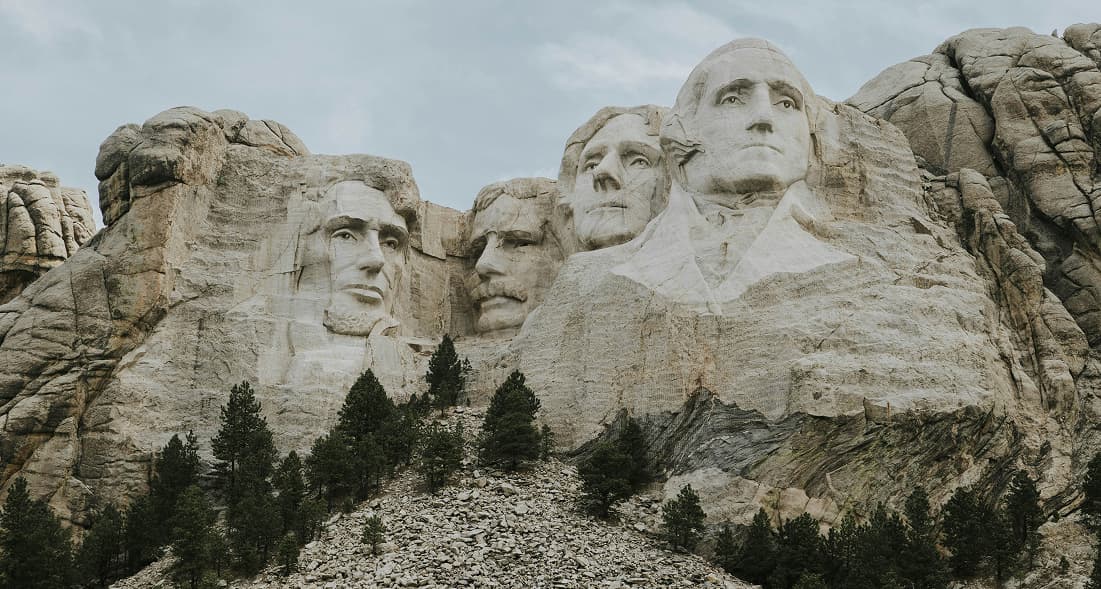
Presidents’ Day is one of those calendar quirks where the market is closed, your inbox is quieter, and you suddenly have space to ask the big question: do presidents actually “move the market” or do we just pin the blame (or the glory) on whoever’s in the Oval Office when the chart gets dramatic?
The honest answer is unsatisfying in the way most honest answers are: presidents rarely control outcomes directly, but they can absolutely change the rules of the game. They appoint key officials, sign (or veto) laws, steer fiscal priorities, and sometimes make a single decision that resets the entire economic regime. And markets, being markets, respond less to vibes than to policy constraints, liquidity conditions, and credibility.
So here are seven administrations, spanning the life of the U.S. stock market, that produced unusually memorable “market eras” that investors still reference, consciously or not.
George Washington (April 30, 1789 – March 4, 1797)
The “public credit” era, plus America’s first Wall Street crash
Before there was a Dow or a ticker tape, the U.S. was basically a startup with debt and a dream. The foundational investing story of Washington’s presidency is credibility: would anyone treat U.S. obligations as real money, or as polite fiction?
Washington’s own framing was blunt. In his Farewell Address, he urged Americans: “As a very important source of strength and security, cherish public credit.”
Then came the inevitable stress test: the Panic of 1792, often described as Wall Street’s first crash. In the thick of it, U.S. 6% bonds dropped to 95 on March 20, a 25% decline in two weeks.
What’s fascinating (and weirdly modern) is the response. Alexander Hamilton effectively ran an early playbook for crisis containment, leaning on “lend against good collateral” logic and targeted market support. The New York Fed’s historical recap argues the episode was managed with little long-term spillover, and notes how Hamilton’s moves predate classic central-bank crisis rules by almost a century.
Investor takeaway: The first big market lesson in American history wasn’t “stonks go up.” It was: credit is an asset, and credibility is policy. Once a government earns trust, markets can survive shocks without becoming existential.
Andrew Jackson (March 4, 1829 – March 4, 1837)
The Bank War: When “anti-elite” politics collided with the plumbing of money
If Washington’s era was about establishing credit, Jackson’s was about fighting over who gets to control it.
The signature moment is Jackson’s 1832 veto of the bill to recharter the Second Bank of the United States. His language is still startlingly current. He warned: “It is to be regretted that the rich and powerful too often bend the acts of government to their selfish purposes.”
The Second Bank’s charter was set to expire in 1836, and the fight over it wasn’t just political theater. It was a battle over the financial system’s stabilizer. The National Archives’ exhibit on the “Bank War” points to the institution’s role as a repository for federal funds and a lightning rod for distrust of paper money and concentrated credit.
Jackson also issued the Specie Circular (1836), which required payment for public lands in gold and silver, aimed at curbing land speculation and credit excess.
Investor takeaway: You can be “right” about resentment and still trigger a policy regime that tightens financial conditions. Jackson’s era is a reminder that markets don’t just price growth. They price the reliability of institutions that make credit work.
Ulysses S. Grant (March 4, 1869 – March 5, 1877)
Black Friday (1869): The gold corner that crashed stocks 20%
Grant’s presidency is a perfect example of why investors should never ignore market structure. The Civil War left the country with greenbacks, gold politics, and a speculator’s playground.
Grant came in with a “sound money” instinct. In his first inaugural, he argued: “To protect the national honor, every dollar of Government indebtedness should be paid in gold…”
Then, in September 1869, Jay Gould and Jim Fisk tried to corner the gold market. The New York Fed’s “Crisis Chronicles” describes the blow-by-blow like a financial thriller with worse haircuts: gold opened around $145, spiked to $160, then collapsed toward $133 as the Treasury moved to break the corner. It notes the Treasury sale was $4 million in gold, huge relative to a market of roughly $15 million. And the spillover was brutal: the stock market fell 20% as traders fire-sold securities to cover positions.
Investor takeaway: Markets don’t just crash from “bad fundamentals.” They crash from forced unwinds. When leverage, insider access, and crowded positioning meet a policy reversal, the selling becomes mechanical.
Theodore Roosevelt (September 14, 1901 – March 4, 1909)
Panic of 1907: When liquidity vanished and the “Fed” didn’t exist yet
TR’s market legacy isn’t a single index print. It’s the realization that the U.S. needed a lender of last resort that wasn’t… J.P. Morgan.
During the Panic of 1907, the system seized up. The Federal Reserve’s historical essay describes trust companies as operating with far lower reserve requirements than national banks, leaving them fragile under stress. It details a run on the Knickerbocker Trust, and then the real nightmare fuel: the cost of money. Call money rates jumped from 9.5% to 70%, and then to 100%.
Roosevelt’s public language in this period often emphasized confidence and normalcy. In his Seventh Annual Message (1907), he criticized the psychology of panic, writing that people often “hoard money rather than keep it in circulation” during “financial stringency.”
The longer-term economic hit was severe. The same Fed history essay notes industrial production fell 17% in 1908 and real GNP fell 12%.
Investor takeaway: The Panic of 1907 is the purest illustration of what markets fear most: a sudden disappearance of liquidity. It also shows why modern investors obsess over the Fed, funding markets, and “backstops.” That obsession has a lineage.
Franklin D. Roosevelt (March 4, 1933 – April 12, 1945)
Bank holiday, confidence reset, and the birth of modern market rules
To understand FDR’s market era, you have to start with the crater. The Federal Reserve’s 1929 crash history notes the Dow ultimately closed at 41.22 in 1932, 89% below its peak.
FDR’s first move wasn’t a stimulus slogan. It was operational: a national bank holiday. The Fed’s history of the Bank Holiday of 1933 notes Roosevelt issued the proclamation suspending banking transactions at 1:00 a.m. on March 6, just 36 hours after taking office.
Then came the persuasion campaign. In his first Fireside Chat (March 12, 1933), he delivered a line that still reads like crisis PR perfected: “I can assure you that it is safer to keep your money in a reopened bank than under the mattress.”
Markets responded hard. A Reuters factbox notes the Dow’s biggest one-day percentage gain was 15.34% on March 15, 1933, right in that early recovery window.
And FDR’s era also built the rulebook investors now take for granted. The Securities Exchange Act of 1934 created the SEC, formalizing federal securities regulation.
Investor takeaway: FDR’s superpower wasn’t predicting earnings. It was understanding that markets are a confidence machine, and confidence needs functioning institutions plus credible rules.
Richard Nixon (January 20, 1969 – August 9, 1974)
The Nixon Shock: when the monetary regime snapped in half
If you want one presidential weekend that still echoes through modern macro debates, it’s August 15, 1971.
In his televised address, Nixon announced: “I am today ordering a freeze on all prices and wages… for a period of 90 days.”That same speech is tied to the broader “Nixon Shock” shift away from the Bretton Woods constraints (including the gold convertibility framework), which reshaped global finance.
Then the market had to live in the consequences: inflation, oil shocks, and policy whiplash. A Reuters recap of major bear markets notes the S&P 500 fell nearly 50% between January 1973 and September 1974.
Investor takeaway: regime changes matter more than speeches. Once the monetary framework changes, everything reprices: currencies, real rates, risk premiums, and the narrative investors use to justify valuations.
George W. Bush (January 20, 2001 – January 20, 2009)
The Bush-era market story is dominated by the financial crisis response, because the downturn wasn’t a normal recession. It was a balance-sheet shock.
In a September 24, 2008 address, Bush framed the moment plainly: “Our entire economy is in danger.”
The Federal Reserve’s Great Recession history captures the scale in numbers investors still quote like scars: home prices fell about 30% (mid-2006 to mid-2009), the S&P 500 fell 57% (October 2007 peak to March 2009 trough), and household net worth dropped from roughly $69T to $55T.
And because this was also a tech-heavy era, it’s worth remembering how the NASDAQ functioned as a risk barometer. The FRED series for the NASDAQ Composite is a clean way to see the drawdown and recovery arc investors lived through in real time.
Investor takeaway: in true systemic events, correlations converge and diversification feels like a rumor. Policy response becomes the catalyst, not just the backdrop.
Closing Thoughts
Presidents don’t control markets the way a CEO controls guidance. But the best investing stories are often about constraints: what’s allowed, what’s protected, what’s credible, and what breaks when pressure rises.
Washington’s lesson is that “public credit” is a real asset. Jackson’s is that financial plumbing is political whether we admit it or not. Grant’s is that leverage and corners can turn a niche market into a broad crash. TR’s is that liquidity is oxygen. FDR’s is that rules and trust are part of the same system. Nixon’s is that monetary regimes can change suddenly, and the market will spend years repricing the consequences. Bush’s is that when the system wobbles, policy becomes the plot.
And for a 2026 lens: this is why investors keep one eye on fundamentals and the other on the regime. AI capex is colliding with power constraints and infrastructure buildouts, rate expectations can flip on a single inflation print, and election-year policy noise can change trade, taxes, and regulation faster than a quarterly model can adapt. The presidents above weren’t “market wizards.” They were regime-shifters, sometimes intentionally, sometimes by being the person holding the pen when the world forced change.
If there’s a Presidents’ Day moral for broad retail investors, it’s this: markets are a story about growth, but investing is a story about rules. When rules change, the chart changes.
What to Read Next
Sources
- https://millercenter.org/president/washington
- https://millercenter.org/the-presidency/presidential-speeches/september-19-1796-farewell-address
- https://libertystreeteconomics.newyorkfed.org/2014/05/crisis-chronicles-central-bank-crisis-management-during-wall-streets-first-crash-1792/
- https://w4.stern.nyu.edu/research/alexander_hamilton_central_banker.pdf
- https://millercenter.org/president/jackson
- https://avalon.law.yale.edu/19th_century/ajveto01.asp
- https://www.archives.gov/exhibits/treasures_of_congress/text/page9_text.html
- https://www.britannica.com/event/Specie-Circular
- https://millercenter.org/president/grant
- https://avalon.law.yale.edu/19th_century/grant1.asp
- https://libertystreeteconomics.newyorkfed.org/2016/01/crisis-chronicles-the-gold-panic-of-1869-americas-first-black-friday/
- https://millercenter.org/president/roosevelt
- https://www.federalreservehistory.org/essays/panic-of-1907
- https://www.presidency.ucsb.edu/documents/seventh-annual-message-9
- https://millercenter.org/president/fdroosevelt
- https://www.federalreservehistory.org/essays/stock-market-crash-of-1929
- https://www.federalreservehistory.org/essays/bank-holiday-of-1933
- https://www.federalreservehistory.org/essays/emergency-banking-act-of-1933
- https://millercenter.org/the-presidency/presidential-speeches/march-12-1933-fireside-chat-1-banking-crisis
- https://www.reuters.com/article/business/factbox-dow-eclipses-20-000-historical-facts-figures-idUSKBN15920Q/
- https://www.congress.gov/crs-product/IF11714
- https://guides.loc.gov/securities-exchange-act/sec
- https://millercenter.org/president/nixon
- https://www.presidency.ucsb.edu/documents/address-the-nation-outlining-new-economic-policy-the-challenge-peace
- https://subscribe.emailmarketing.com/important-disclosures?ip_address=149.248.103.138
- https://insights.som.yale.edu/insights/how-the-nixon-shock-remade-the-world-economy
- https://www.reuters.com/article/us-usa-stocks-bearmarkets-factbox/factbox-two-year-bear-market-longest-since-great-depression-idUSKBN1YF1Z8/
- https://millercenter.org/president/gwbush
- https://georgewbush-whitehouse.archives.gov/news/releases/2008/09/20080924-4.html
- https://www.federalreservehistory.org/essays/great-recession-of-200709
- https://fred.stlouisfed.org/series/NASDAQCOM
Market Munchies and Mode Mobile communications are for informational purposes only, and are not a recommendation, solicitation, or research report relating to any investment strategy, security, or digital asset. All investments involve risk including the loss of principal and past performance does not guarantee future results.
Any information contained in this commentary does not purport to be a complete description of the securities, markets, or developments referred to in this material. The information has been obtained from sources considered to be reliable, but we do not guarantee that the foregoing material is accurate or complete. There is no guarantee that any statements or opinions provided herein will prove to be correct.