Sluggish Growth, Tax Whispers, and Fiscal Firestorms—Where Should Investors Look Twice?
📌 A Market Moment That Feels Restless Economic stories rarely line up neatly, but when they do, they paint an uncomfortable picture. Across the U.S. economy , sluggish hiring and cautious consumers are now front and centre in the latest U.S. Beige Book 2025 report. In London,…
📌 A Market Moment That Feels Restless
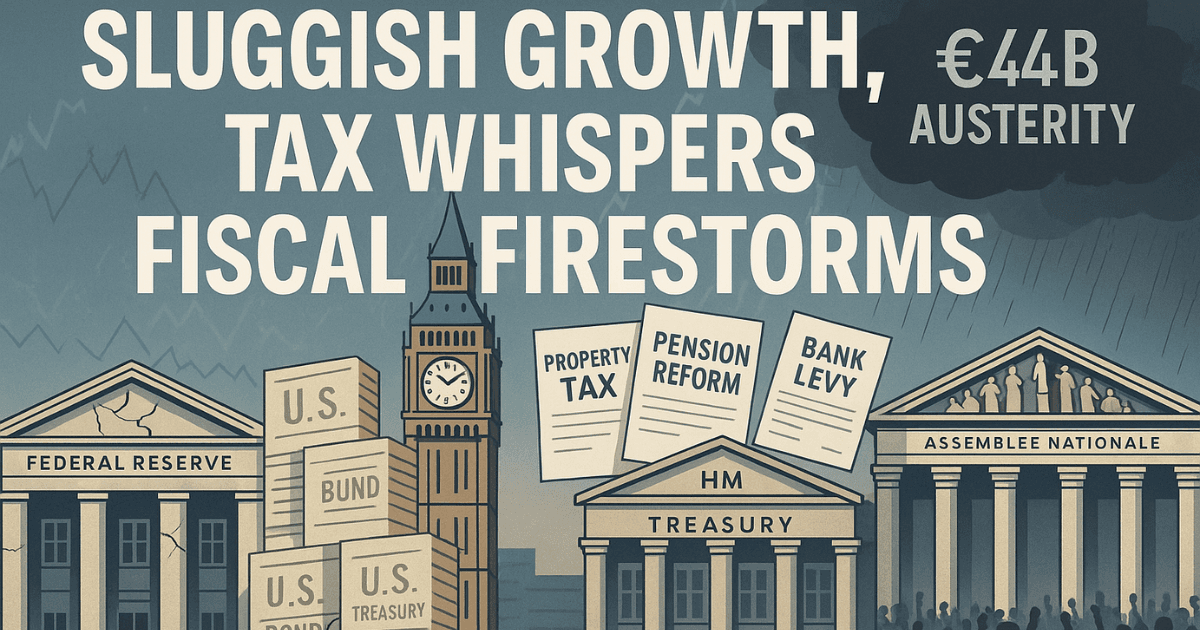
Economic stories rarely line up neatly, but when they do, they paint an uncomfortable picture. Across the U.S. economy, sluggish hiring and cautious consumers are now front and centre in the latest U.S. Beige Book 2025 report. In London, Chancellor Rachel Reeves is testing how far she can push the UK's 2025 budget tax changes without rattling confidence. And Paris? It’s juggling a looming no-confidence vote and a €44 billion austerity plan. Meanwhile, U.S. Treasury bond supply is flooding markets with issuance levels not seen in years, leaving yields as tempting as a bakery shelf at closing time. The question is: how should investors process all this noise without being overwhelmed by it? Let’s slice through.
🇺🇸 Beige Book Blues—Flat Lines in U.S. Growth
The Federal Reserve’s Beige Book sounded less like a rallying anthem and more like background elevator music. Most districts described activity as “little or no change,” with job markets looking stalled. Only a handful reported modest expansion, and inflation was noted as “moderate at best.” Boston’s snapshot was telling: consumer spending remained flat, tourism was cooling, and manufacturing was only propped up by demand related to AI. Even staffing services were “barely inching forward.” Investors are now circling the September 16–17 FOMC meeting. With signs of a U.S. economic slowdown, markets are leaning toward a potential interest rate cut by the Federal Reserve. 👉 Smart Capital Signal: Rate-sensitive assets—such as equities and housing—could benefit if cuts materialize. However, bond yields may prove trickier to navigate, especially as global macro investing strategies for 2025 hinge on the Fed's policy.
🇬🇧 Reeves and the Rising Tax Talk
In the UK, Chancellor Rachel Reeves is floating a series of ideas that sound like a shopping list nobody wants to pay for: higher taxes on home sales, pension relief reforms, and levies on banks. The Guardian has flagged a new UK property tax change that could raise £10 billion, allowing older homeowners to defer payments. Reuters noted potential adjustments to UK pension tax reform and additional charges on gambling and banking. The official Autumn Budget 2025 lands on November 26, but speculation alone is enough to spook investors. Business leaders fear the measures could dent already fragile sentiment. 👉 Tactical Insight: For investors in UK financials and property markets, this isn’t just noise. Any credible plan to squeeze banks and homeowners could make REITs and bank equities harder to price with confidence. Exposure to global market outlook 2025 themes, instead of domestically tethered assets, may be a smarter hedge.
🇫🇷 Paris: Budget Crisis Meets Political Poker
France’s Finance Minister Éric Lombard admitted he could soften the France austerity plan 2025—but only if Prime Minister François Bayrou loses a no-confidence vote. The package, designed to plug deficits, includes cuts to healthcare, pensions, and even national holidays. Markets reacted fast. The CAC 40 dropped nearly 1.7%, banks fell over 4%, and French 10-year yields jumped to 3.53%. The French government crisis spooked investors, and Lombard even warned about IMF-style oversight if political chaos persists. 👉 Investor Radar: European political risk investing is no longer a theoretical concept. For those holding French bonds or bank assets, recalibrating risk is crucial. Any compromise could calm markets, but for now, political risk and market volatility are dancing in lockstep.
💵 Treasury Flood—When Supply Tests Appetite
Bond traders have their hands full. The U.S. Treasury bond supply for September 2025 is 6tdexpected to reach $150–180 billion in investment-grade bond issuance—one of the heaviest waves in recent memory. In Q3 alone, Treasury borrowing topped $1.007 trillion, nearly half a trillion higher than earlier estimates. Analysts warn that the mix of global bond issuance in 2025 and U.S. borrowing needs will likely push yields higher. Longer maturities are being favoured, which adds duration risk. At the same time, unconventional buyers—such as those seeking safe reserves in stablecoins—are emerging. 👉 Portfolio Compass: Elevated U.S. bond market yields create opportunities, but oversupply risks sharp repricing. The smart move? Laddering maturities to maintain flexibility. In a market this crowded, investor strategy in volatile markets is about agility, not heroics.
🍷 Closing Thought: Fiscal Whispers and Investor Filters
What ties these stories together isn’t just geography—it’s the theme of constraint. The U.S. is constrained by growth that refuses to accelerate. The UK is constrained by fiscal shortfalls that are being patched with budget speculation. France is constrained by political standoffs threatening its government stability. And the Treasury? Constrained by mathematics—too much debt, too little room. 👉 Premium Investor Insights: Markets today aren’t offering free lunches. But they are offering choices. The investors who thrive will be those who can read the fiscal whispers, sidestep the political storms, and stay ahead of both the best investments during fiscal uncertainty and long-term opportunities.
🔗 Sources
Market Munchies and Mode Mobile communications are for informational purposes only, and are not a recommendation, solicitation, or research report relating to any investment strategy, security, or digital asset. All investments involve risk including the loss of principal and past performance does not guarantee future results.
Any information contained in this commentary does not purport to be a complete description of the securities, markets, or developments referred to in this material. The information has been obtained from sources considered to be reliable, but we do not guarantee that the foregoing material is accurate or complete. There is no guarantee that any statements or opinions provided herein will prove to be correct.