South Korea's Stock Market Is the Best Performing in the World This Year. Here's the Surprising Reason Why.
South Korea imports nearly all of its crude oil. The majority of that oil comes from the Middle East. The Strait of Hormuz has been effectively closed for 65 days. Gas prices in Seoul have surged. Household energy bills are climbing. The Korean won has weakened significantly.…
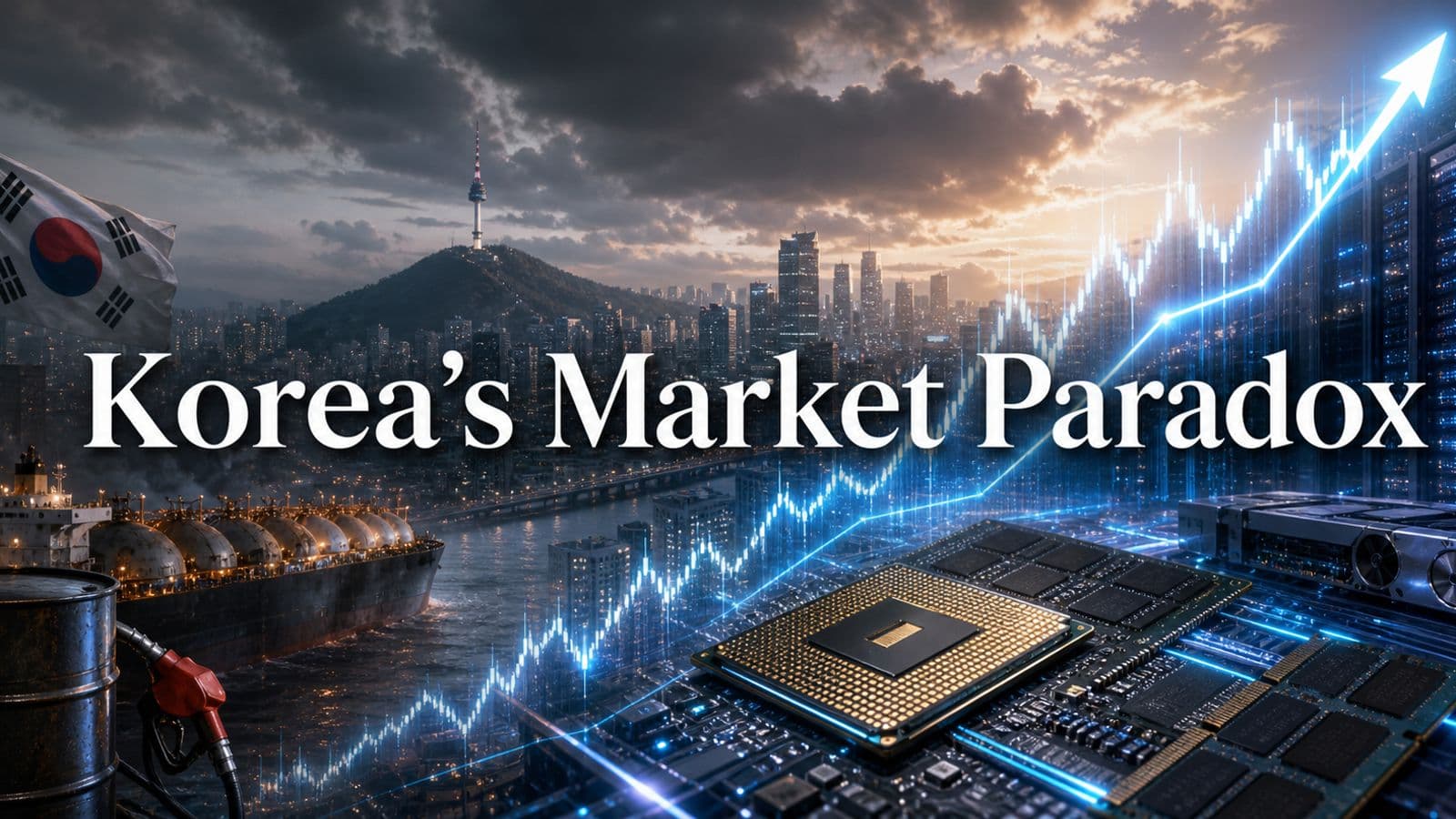
South Korea imports nearly all of its crude oil. The majority of that oil comes from the Middle East. The Strait of Hormuz has been effectively closed for 65 days. Gas prices in Seoul have surged. Household energy bills are climbing. The Korean won has weakened significantly.
And yet the KOSPI — South Korea's benchmark equity index — just hit a fresh record high this morning, extending a gain of more than 75% over the past year. It is the best-performing major equity index in the world in 2026.
If that sounds paradoxical, it is. Understanding why requires separating two stories that happen to be occurring simultaneously in the same country: one about a consumer economy absorbing an acute energy shock, and one about two companies that are quietly printing the most money in Korean corporate history.
The Two Companies Running the Show
The KOSPI's record run is not a broad-based reflection of South Korean economic health. It is, to an almost uncomfortable degree, a story about two stocks.
Samsung Electronics and SK Hynix together comprise roughly 45% of the iShares MSCI South Korea ETF's weight — a concentration that means the index effectively tracks their fortunes more than anything else. This morning, Samsung was trading up nearly 4% from the previous session, with multiple Korean brokerages raising their target prices to between 300,000 and 390,000 won, while SK Hynix's market capitalization surpassed 1,000 trillion won, with its share price breaking through 1.4 million won.
The numbers behind those price targets are extraordinary — and need a moment of context before being absorbed.
SK Hynix reported Q1 2026 operating profit of 37.61 trillion won, at a 72% operating margin. Translated at current exchange rates, that is approximately $26.7 billion in operating profit in a single quarter. That figure is genuine — confirmed by SK Hynix's official earnings release — and it is genuinely staggering. For context: Q1 2026 alone generated more operating profit than SK Hynix's entire fiscal year 2024, and nearly matched the company's full-year 2025 operating profit total in just three months. The 72% operating margin puts it in the company of the most profitable businesses in the world, in any industry, in any quarter. This is not an annualized figure. It is a single quarter.
Samsung delivered the strongest quarterly performance in South Korean corporate history in the same period. Both achievements were driven by the same force: the global AI infrastructure buildout has created an insatiable and structurally undersupplied demand for High Bandwidth Memory.
What HBM Is and Why It Matters
Most people who have heard of semiconductors think of chips in terms of processing power — the Nvidia GPUs that run AI models. HBM is a different layer of the equation. It is the memory architecture that determines how fast a processor can access the data it needs to compute.
Traditional DRAM memory passes data through a relatively narrow channel. HBM stacks memory chips vertically and connects them with thousands of tiny wires called through-silicon vias, creating a much wider data pipeline. The result is data transfer speeds up to 15 times faster than conventional DRAM, at considerably lower power consumption. For AI models that require constant, massive data throughput, HBM is not a luxury component. It is a prerequisite.
The AI memory supercycle, fueled by AI data center spending projected to reach $655 billion by 2026, has transformed Samsung and SK Hynix into the primary beneficiaries of surging demand. As AI models grow larger and more complex, demand for HBM has exploded, creating supply constraints that have driven prices and profit margins to levels that would have seemed implausible eighteen months ago.
The Iran war has, counterintuitively, added to this dynamic. The energy shock has accelerated the pace at which global governments, utilities, and corporations are investing in energy-efficient AI infrastructure as a long-term alternative to fossil fuel dependency. That acceleration flows directly into HBM demand. The war that is devastating South Korea's consumer energy costs is simultaneously turbocharging demand for its most profitable export.
The Paradox in Numbers
The split between South Korea's macro economic pain and its equity market performance is about as stark as any divergence visible in global markets right now.
On the macro side: the Korean won has weakened materially against the dollar as energy import costs surge. The Bank of Korea faces the same stagflation challenge as the ECB and the Fed — energy-driven inflation running hot while growth slows. Korean households are absorbing fuel cost increases that represent a meaningful share of disposable income. Korean airlines have rerouted flights around the Middle East. Korean manufacturers dependent on Gulf petrochemical inputs are facing margin pressure. And sectors that would normally provide ballast — LG Energy Solution in EV batteries, Hyundai and Kia in automotive, the major Korean shipbuilders — are all navigating either direct energy cost headwinds or softening demand from an energy-shocked global consumer.
On the equity side: the KOSPI has surged over 75% in the past year, and the EWY ETF has gained 36% year-to-date in 2026, making it the top-performing equity ETF globally. Macquarie projects earnings growth across the Korean market of an extraordinary 48% for 2026.
The reconciliation is sector concentration. Korea's equity index is dominated by two companies whose revenues are denominated primarily in U.S. dollars, whose customers are American and European hyperscalers, and whose product is in structural short supply globally. The energy shock hurts Korean consumers, manufacturers, airlines, and automakers. It does not hurt Samsung or SK Hynix, because neither company's primary cost input is oil, and neither company's primary market is the Korean domestic consumer. The index's record highs reflect the two companies near the top of the cap table, not the broader economy beneath them.
Investors who bought the KOSPI as a play on South Korea's economic fundamentals got a very different outcome than those who recognized it as a leveraged bet on the global AI memory supercycle. Both descriptions are accurate. Only one of them made money.
The Risks Underneath the Rally
The record-setting performance of Korean equities comes with three specific risks that investors considering EWY or direct Korean exposure need to price in carefully.
The first is concentration. With Samsung and SK Hynix representing nearly half the ETF's weight, buying EWY is not diversified exposure to South Korea's economy. It is effectively a two-stock bet on HBM demand, with positions in Hyundai, KB Financial, LG Energy Solution, and others providing limited balance. When Samsung fell 12% in a single day in early March on geopolitical concerns, EWY followed. The ETF's record run is real. Its top-heavy concentration risk is equally real.
The second is labor. Samsung is bracing for a potential strike by unionized workers in May. Samsung's union relationship has been contentious throughout its record earnings run, as workers seek a share of profits that have never been larger. A sustained strike at Samsung's memory fabrication facilities would constrain HBM output at the worst possible time — when demand is at peak and competitors are years behind on capacity.
The third is geopolitical. South Korea's semiconductor dominance depends on a global trade architecture that the Iran war is actively reshaping. TSMC in Taiwan manufactures the logic chips that go alongside Samsung and SK Hynix's memory products. Disruption to Taiwan, or to the global shipping routes that move components between Korea, Taiwan, and the U.S., could interrupt the supply chain that underlies the entire AI memory supercycle narrative.
What This Means for Investors
For U.S. investors seeking exposure to the AI infrastructure theme, Korean equities offer something that domestic options do not: the memory layer of the AI stack, at valuations that remain approximately 30% below comparable U.S. peers, with earnings growth projections that dwarf anything available in the S&P 500.
EWY has surged 36% year-to-date, making it the top-performing equity ETF in 2026. For investors who want more targeted exposure, direct positions in Samsung Electronics or SK Hynix are available through international brokerage accounts with access to the Korea Exchange — though currency risk, settlement complexity, and the Samsung strike risk make the ETF a more practical entry point for most retail investors.
The South Korea paradox — best-performing major index in the world, in a country absorbing one of the most severe energy shocks since the 1970s — is a lesson in the difference between a country's economic fundamentals and its equity market composition. The KOSPI is not a bet on South Korea. It is a bet on Samsung and SK Hynix. And right now, Samsung and SK Hynix are betting on AI.
So far, that bet is winning.
Sources
- SK Hynix — Q1 2026 Earnings Release (PRNewswire): https://www.prnewswire.com/news-releases/sk-hynix-announces-1q26-financial-results-302750959.html
- CNBC — "SK Hynix posts record first-quarter profit, in line with estimates as memory prices climb": https://www.cnbc.com/2026/04/23/sk-hynix-earnings-ai-memory-shortage-hbm-demand.html
- Storage Newsletter — "SK Hynix Fiscal 1Q26 Financial Results": https://www.storagenewsletter.com/2026/04/29/sk-hynix-fiscal-1q26-financial-results/
- Seoul Economic Daily — "Top-Performing Investors Buy Samsung, SK Hynix as AI Cycle Takes Off": https://en.sedaily.com/finance/2026/05/04/top-performing-investors-buy-samsung-sk-hynix-as-ai-cycle
- Seoul Economic Daily — "SK Hynix Market Cap Tops 1,000 Trillion Won as Stock Surges 9%": https://en.sedaily.com/finance/2026/05/04/sk-hynix-market-cap-tops-1000-trillion-won-as-stock-surges
- KED Global — "SK Hynix hits 72% operating margin; HBM4 demand exceeds capacity for next 3 years": https://www.kedglobal.com/earnings/newsView/ked202604230001
- Bloomberg — "South Korea Stocks Rebound as Samsung, SK Hynix Lead Rally": https://www.bloomberg.com/news/articles/2026-02-03/south-korean-stocks-roar-back-as-chipmakers-rebound-from-selloff
- Intellectia.AI — "Best South Korea Stock to Buy 2026: KOSPI's Record Rally": https://intellectia.ai/blog/best-south-korea-stock-to-buy-2026
- Reuters / Yahoo Finance — "SK Hynix shares rally 7% to a record high": https://finance.yahoo.com/markets/stocks/articles/sk-hynix-shares-rally-7-041228895.html
- Wikipedia — "2026 Iran war fuel crisis": https://en.wikipedia.org/wiki/2026_Iran_war_fuel_crisis
Market Munchies and Mode Mobile communications are for informational purposes only, and are not a recommendation, solicitation, or research report relating to any investment strategy, security, or digital asset. All investments involve risk including the loss of principal and past performance does not guarantee future results.
Any information contained in this commentary does not purport to be a complete description of the securities, markets, or developments referred to in this material. The information has been obtained from sources considered to be reliable, but we do not guarantee that the foregoing material is accurate or complete. There is no guarantee that any statements or opinions provided herein will prove to be correct.