Spirit Airlines Is Dead. Here's the Full Story of What Went Wrong.
At 3:00 a.m. Eastern Time on Saturday, May 2, 2026, a dispatcher named Wes Egan — 23 years with Spirit Airlines — sent a text message through the cockpit alert system to a pilot in the air. He had just learned, minutes earlier, that the company was done. Senior managers had…
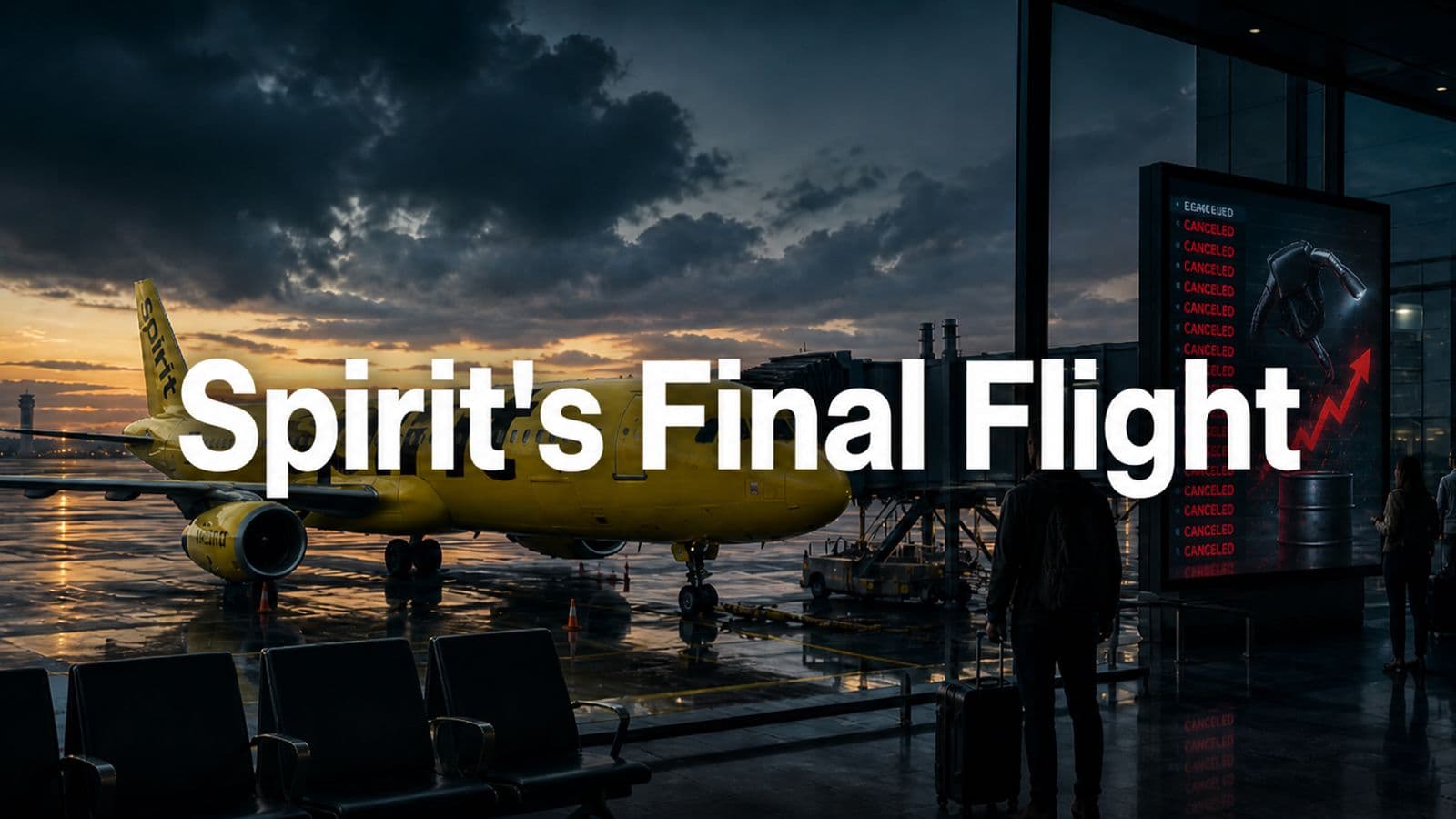
At 3:00 a.m. Eastern Time on Saturday, May 2, 2026, a dispatcher named Wes Egan — 23 years with Spirit Airlines — sent a text message through the cockpit alert system to a pilot in the air. He had just learned, minutes earlier, that the company was done. Senior managers had informed staff in Spirit's Orlando operations center around 11:30 p.m. Friday that operations were about to cease.
The message he sent the pilot has not been reported. What the pilot sent back, through the same system, was two words: "Godspeed, friend."
By dawn, Spirit's website and app displayed a single message: "To our Guests: all flights have been cancelled, and customer service is no longer available." The kiosks at airports across the country showed: "We regret to inform you that Spirit Airlines has ceased global operations." At LaGuardia's Marine Air Terminal — an Art Deco facility that opened in 1940 and had housed Pan Am's Clippers before Spirit made it its New York home — a TSA officer was sent home early. There were no passengers left to screen.
Spirit Airlines, the pioneering budget carrier that reshaped American air travel for 34 years, was gone. It is the largest U.S. airline liquidation in decades.
How It Ended
The collapse came after a final 72-hour drama that combined bankruptcy court hearings, a White House that couldn't close a deal, and a creditor group that wouldn't accept the terms on offer.
In the weeks before the shutdown, Spirit had been in "very advanced discussions" with the Trump administration on a rescue package — a $500 million cash infusion in exchange for the government taking a controlling equity stake. Trump signaled his approval publicly. Transportation Secretary Sean Duffy was involved. The deal appeared close enough that Spirit's bankruptcy attorneys told a federal court last week that negotiations were in their final stages.
Then the creditors said no.
A key group of Spirit's secured bondholders rejected the bailout plan, according to a source familiar with the negotiations. The structure would have given the government a superseding position in the debt stack, effectively subordinating the existing bondholders below a new government loan. The creditors' calculation was blunt: they believed they could recover more capital through a fire-sale liquidation of Spirit's physical assets — its aircraft, slots, and ground equipment — than by taking junior positions in a reorganized airline still flying into $4.50 per gallon jet fuel. Without their agreement, there was no deal. Without the deal, there was no cash. Without cash, the airline had hours.
Trump acknowledged Friday that a deal might not be possible: "Well, we're looking at it — but if we can't make a good deal, no institution's been able to do it. I'd like to save the jobs, but we'll have an announcement sometime today." The announcement came at 3:00 a.m.
The decision put 17,000 workers out of a job — 14,000 Spirit employees and thousands of contractors — the majority of whom learned about it less than an hour before the official announcement.
The Long Road Down
Spirit's collapse did not happen because of one bad decision or one bad year. It happened because of an accumulation of structural disadvantages that the Iran war's fuel shock finally made insurmountable.
The airline's model was built on a simple premise: charge the lowest possible base fare, then charge separately for everything else — carry-on bags, seat selection, printed boarding passes, even water. The strategy worked brilliantly for a decade. Spirit's load factors were among the highest in the industry. Its routes were profitable. Its cost structure, built around a single-fleet type and maximum seat density, gave it a genuine and durable price advantage over legacy carriers.
The model began to crack when legacy airlines and larger low-cost carriers responded. Delta, United, and American all launched "basic economy" fares that stripped out amenities and matched Spirit's base prices on overlapping routes, while offering the network advantages — frequent flyer programs, connections, lounges — that Spirit could not. Spirit was squeezed from both directions: budget travelers could now get basic fares from major carriers, while travelers who wanted even the most modest premium had no reason to choose Spirit.
The JetBlue merger attempt — a $3.8 billion all-cash offer that Spirit's board accepted in 2022 — was supposed to be the escape hatch. The Biden DOJ challenged it on antitrust grounds. A federal court blocked it in January 2024. JetBlue and Spirit walked away in March. Spirit filed for Chapter 11 bankruptcy in November 2024.
It emerged from that first bankruptcy in March 2025, with a restructuring plan built around a fuel cost projection of $2.24 per gallon. When the Iran war started on February 28, 2026, jet fuel climbed toward $4.32 per gallon — nearly double the projection the entire plan was built on. The math became impossible within weeks.
"When you're a low-cost carrier, by definition, you're relying on having a cost advantage," said Shye Gilad, a former airline pilot and professor at Georgetown's McDonough School of Business. "And they just don't have that anymore. They just don't have a lot of options left."
The Human Toll
The shutdown stranded thousands of passengers at airports across the country on Saturday morning. An average of 300 Spirit flights per day — approximately 60,000 potential passengers — had been scheduled through the end of May. All of them now need to rebook.
Spirit had about 9,000 flights scheduled from May 2 through the end of the month, according to aviation analytics firm Cirium. United said about 14,000 Spirit customers booked tickets on United on Saturday alone. Southwest flew more than 20,000 stranded Spirit passengers in a single day.
Most major carriers capped rescue fares at around $200 for stranded Spirit passengers. The Department of Transportation coordinated the response, with Secretary Duffy reminding customers that Spirit will issue automatic refunds for tickets purchased with credit or debit cards. Passengers who booked with vouchers, Spirit credits, or Free Spirit points face a harder road — those payment methods will be determined in the bankruptcy court process, and companies that go out of business typically stop honoring rewards and vouchers immediately.
Captain Jon Jackson was supposed to fly his retirement flight on Saturday. His airline shut down before he could.
The crew of Spirit's last arriving flight — NK1833 from Detroit to Dallas Fort Worth International, touching down shortly before midnight Friday — had 175 passengers on board. As the pilots approached Dallas, one asked the tower: "Is there any other Spirit flight coming in after us?" The controller checked. "I don't see anything. So you might be the last one." He then added: "Well, it was a pleasure working with you guys and I wish you the best." "Thank you very much," the pilot replied.
What It Means for the Industry
Spirit's death is not simply a cautionary tale about one airline. It carries consequences for every American who buys a plane ticket.
Spirit held a 3.9% market share of U.S. passengers in February 2026. That share was poised to fall further, to just 1.8% by May, which would have made it the country's ninth-largest airline. Even at that diminished scale, the airline's presence on specific routes kept fares lower across the board.
"You do not have to fly a small carrier in order to benefit from its presence, because they will bring down the big guys' fares," said William McGee, a senior fellow at the American Economic Liberties Project. "Without Spirit flying those routes, everyone will be paying more."
The beneficiaries of Spirit's routes are already maneuvering. JetBlue announced expansion at Fort Lauderdale — Spirit's largest hub — immediately after the shutdown. Frontier, which had been Spirit's most direct competitor on the ultra-low-cost model, will absorb some of the demand. But neither JetBlue nor Frontier has the cost structure to replace what Spirit provided. The routes Spirit abandoned will either be served at higher prices or not served at all.
For investors in airline equities, the implications are sector-wide. Spirit's collapse demonstrates that the ultra-low-cost model — already strained by legacy carrier "basic economy" competition and a shrinking cost advantage — cannot survive a sustained energy shock at current fuel prices. The question now is whether Frontier, the only remaining major ultra-low-cost carrier, has enough financial resilience to outlast the Hormuz closure without facing the same terminal math that broke Spirit.
Spirit's IPO attorney once described the airline as "the 2006 Nissan Altima of airlines." The Altima eventually became a classic. Spirit just became a warning.
Sources
- CNBC — "Spirit Airlines' final hours: 'Godspeed my friend' as terminals go dark": https://www.cnbc.com/2026/05/02/spirit-airlines-shutdown-inside-the-final-hours.html
- CNN Business — "Spirit Airlines canceled all flights and is going out of business": https://www.cnn.com/2026/05/02/business/spirit-to-halt-all-flights
- CNN — "Travel plans upended as Spirit Airlines shuts down": https://www.cnn.com/2026/05/02/us/travel-disruption-spirit-airlines
- CNN — "Here's what to know about Spirit Airlines shutting down": https://www.cnn.com/2026/05/03/us/spirit-airlines-shutdown-what-to-know
- NPR — "Spirit Airlines ceases operations after escalating financial struggles": https://www.npr.org/2026/05/02/nx-s1-5807933/spirit-airlines-ceases-operations-folds
- Wikipedia — "2026 Iran war fuel crisis": https://en.wikipedia.org/wiki/2026_Iran_war_fuel_crisis
- CNBC — "Spirit Airlines could liquidate as early as this week, sources say": https://www.cnbc.com/2026/04/15/spirit-airlines-could-liquidate-as-early-as-this-week-sources-say.html
- NPR — "If Spirit Airlines is liquidated, here's what might happen to the industry": https://www.npr.org/2026/04/22/nx-s1-5789050/spirit-airlines-liquidation-bankruptcy-impact
- Fortune — "Spirit Airlines looked like it was in the clear of reemerging from bankruptcy, but rising fuel costs threaten its exit": https://fortune.com/2026/04/20/spirit-airlines-bankruptcy-exit-jet-fuel-liquidation/
- CNN Business — "Spirit Airlines is gone. Here's what happens now to flights, refunds and jobs": https://www.cnn.com/2026/05/03/business/spirit-airlines-shutdown-refunds-jobs-future
Market Munchies and Mode Mobile communications are for informational purposes only, and are not a recommendation, solicitation, or research report relating to any investment strategy, security, or digital asset. All investments involve risk including the loss of principal and past performance does not guarantee future results.
Any information contained in this commentary does not purport to be a complete description of the securities, markets, or developments referred to in this material. The information has been obtained from sources considered to be reliable, but we do not guarantee that the foregoing material is accurate or complete. There is no guarantee that any statements or opinions provided herein will prove to be correct.