Stablecoin Market Faces First Monthly Decline Since FTX Collapse
📉 Market Contraction Signals Shift After Two-Year Growth Streak The stablecoin market experienced its first monthly decline in over two years, with total market capitalization falling 1.48% to $303 billion as of November 24, 2025. This represents a $4.54 billion decrease,…
📉 Market Contraction Signals Shift After Two-Year Growth Streak
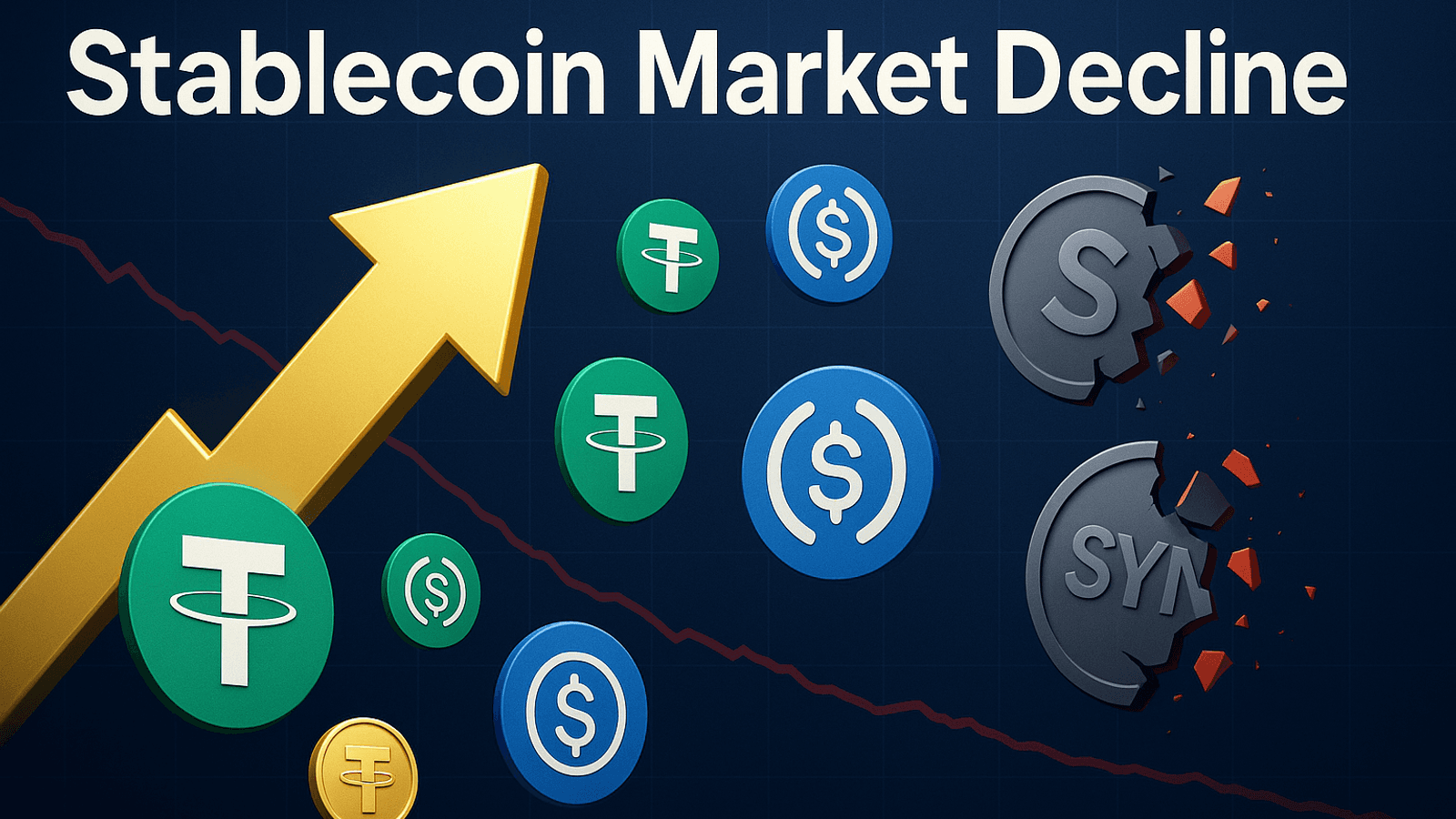
The stablecoin market experienced its first monthly decline in over two years, with total market capitalization falling 1.48% to $303 billion as of November 24, 2025. This represents a $4.54 billion decrease, marking the steepest drop since November 2022 when the FTX exchange collapsed and sent shockwaves through the crypto industry. The contraction comes after an extended period of steady growth that saw stablecoins become a critical infrastructure layer for cryptocurrency trading and decentralized finance applications. For investors who have come to view stablecoins as a stable store of value within the volatile crypto ecosystem, this decline raises questions about whether market saturation, regulatory shifts, or changing demand patterns are driving the pullback. The timing is particularly notable as it coincides with broader crypto market weakness that has sent major cryptocurrencies to multi-month lows.
👑 Tether's Dominance Grows Despite Broader Market Headwinds
While the overall stablecoin market contracted, Tether's USDT continued its remarkable expansion streak. USDT grew 0.56% to reach $184 billion in market capitalization, achieving its 27th consecutive month of growth. This steady expansion pushed Tether's market dominance to 60.9%, representing a multi-month high and solidifying its position as the undisputed leader in the stablecoin ecosystem. For traders, USDT's dominance has practical implications, as it accounted for 75.8% of stablecoin trading volume on centralized exchanges during November. This concentration means that traders increasingly rely on a single stablecoin for liquidity and trading pairs, which creates both efficiency and potential systemic risk. The divergence between Tether's growth and the broader market's contraction suggests that investors are consolidating their stablecoin holdings into the most liquid and widely accepted option, even as institutional adoption of stablecoin payments infrastructure accelerates.
🔻 Synthetic Stablecoins Face Severe Pressure and Depegging Risks
The November decline was particularly brutal for synthetic and algorithmic stablecoins. Ethena's USDe, a synthetic dollar protocol, experienced a severe 22.5% drop in market capitalization to $7.39 billion. This sharp contraction reflects broader concerns about the stability mechanisms of non-traditional stablecoin designs. The risks became even more apparent in early November when multiple DeFi-native stablecoins lost their dollar pegs, with Stream Finance's xUSD plummeting from $1 to as low as $0.10 after the protocol disclosed a $93 million loss. Elixir's deUSD crashed to $0.015, and Stable Labs' USDX fell to $0.113. These depegging events exposed approximately $285 million in systemic risk across interconnected protocols. For investors holding synthetic stablecoins, these events serve as a stark reminder that not all stablecoins offer the same risk profile, and that yield-generating mechanisms often come with substantial downside risks during market turbulence.
🌟 Bright Spots: Ripple's RLUSD Hits $1 Billion Milestone
Despite the overall market contraction, several segments showed positive momentum. Ripple's newly launched RLUSD stablecoin achieved $1 billion in market capitalization, a significant milestone that demonstrates institutional confidence in regulated stablecoin offerings. The achievement came as Ripple announced a $500 million investment from Fortress and Citadel Securities to bolster its expansion into custody, stablecoins, and prime brokerage services. This institutional backing signals that traditional financial players see opportunity in compliant, regulated stablecoin infrastructure. Additionally, euro-pegged stablecoins reached a three-year high of $638 million, suggesting that non-dollar stablecoins are gaining traction as users seek diversification and regional alternatives. For investors watching the stablecoin space, these bright spots indicate that while the market may be contracting overall, specific segments tied to institutional adoption and regulatory compliance continue to attract capital and user interest.
📊 Trading Volume and Market Share Tell Complex Story
Stablecoin trading volumes reached $1.48 trillion as of November 24, though volumes trended lower month-over-month compared to October's levels. Despite the market cap decline, stablecoin market dominance actually increased to 9.99% from 8.14% in October. This counterintuitive rise in dominance reflects the fact that broader cryptocurrency prices declined even more sharply than stablecoins during November. When Bitcoin, Ethereum, and other major cryptocurrencies fall in price, stablecoins naturally represent a larger percentage of total crypto market capitalization. For traders, this dynamic creates a flight-to-stability pattern where investors move assets into stablecoins during periods of market uncertainty. The pattern mirrors traditional finance behavior during volatile periods, when investors rotate from risky assets into cash equivalents. However, the month-over-month decline in trading volume suggests reduced overall market activity rather than simply a rotation into stablecoins, indicating that some capital may be exiting the crypto ecosystem entirely rather than merely seeking refuge.
🎯 What This Means for Stablecoin Investors and the Crypto Market
The November contraction marks a potential turning point for the stablecoin market after two years of uninterrupted growth. For investors, the key takeaway is differentiation: not all stablecoins carry the same risk profile. Fully-backed, regulated stablecoins like USDT, USDC, and RLUSD demonstrated relative stability, while synthetic and algorithmic designs faced severe pressure and depegging events. The consolidation toward Tether's dominance suggests the market is prioritizing liquidity and established track records over newer alternatives. Looking forward, investors should monitor several factors: whether institutional adoption through platforms like Cross River's new USDC payment system can drive renewed demand, how regulatory frameworks evolve following President Trump's federal stablecoin legislation, and whether the depegging incidents prompt stronger risk management practices across DeFi protocols. The broader macro environment, including Federal Reserve policy and risk appetite for crypto assets, will also play a crucial role in determining whether this marks a temporary correction or the beginning of a more sustained consolidation period in the stablecoin market.
Sources
https://www.coindesk.com/research/stablecoins-and-cbdcs-report-november-2025 https://www.bloomberg.com/news/articles/2025-11-05/ripple-says-fortress-citadel-securities-invest-500-million https://markets.financialcontent.com/wral/article/marketminute-2025-11-9-defi-market-rattled-could-traditional-safe-havens-like-gold-and-silver-benefit https://www.forbes.com/sites/digital-assets/2025/11/20/ether-prices-drop-to-4-month-low-as-continued-fear-drives-losses/ https://www.forbes.com/sites/ronshevlin/2025/12/01/stablecoin-payments-get-real--cross-rivers-blockchain-bet/
Market Munchies and Mode Mobile communications are for informational purposes only, and are not a recommendation, solicitation, or research report relating to any investment strategy, security, or digital asset. All investments involve risk including the loss of principal and past performance does not guarantee future results.
Any information contained in this commentary does not purport to be a complete description of the securities, markets, or developments referred to in this material. The information has been obtained from sources considered to be reliable, but we do not guarantee that the foregoing material is accurate or complete. There is no guarantee that any statements or opinions provided herein will prove to be correct.