Tariff Truces, Tensions, and Trade-Offs—How Global Deals Are Quietly Rewriting Market Risk?
🌍 A New Round of Global Trade Juggling Global trade policy updates are playing out like a high-stakes poker game—every player is bluffing, calling, or folding, but no one wants to flip the table just yet. Washington, Beijing, New Delhi, and Brussels are each trying to protect…
🌍 A New Round of Global Trade Juggling
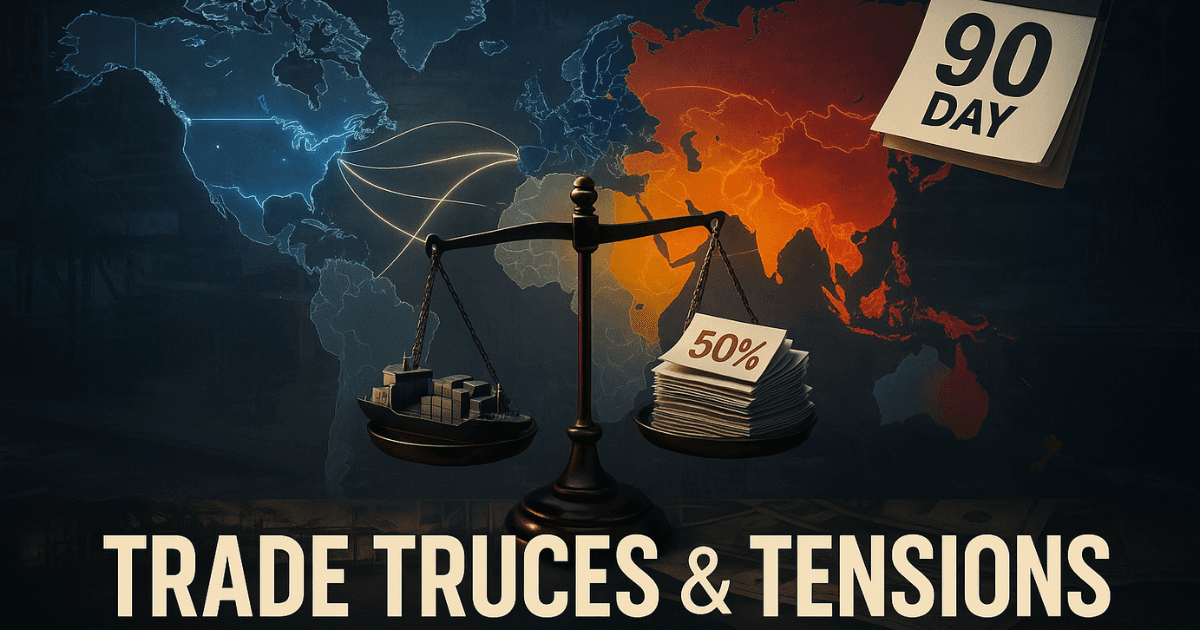
Global trade policy updates are playing out like a high-stakes poker game—every player is bluffing, calling, or folding, but no one wants to flip the table just yet. Washington, Beijing, New Delhi, and Brussels are each trying to protect their interests while containing the risk of recession. The latest moves are telling: a 90-day tariff extension between the U.S. and China, new U.S. tariffs on Indian goods raised to 50%, and a softer-than-feared U.S.–EU trade agreement that capped duties at 15%. For investors, these aren’t just diplomatic footnotes—they are signals shaping global supply chain impact, consumer margins, and equity sector performance. So, let’s take a look at what’s happening beneath the surface—and why smart capital should be paying attention to these international trade developments in 2025.
🇺🇸🤝🇨🇳 US–China: A 90-Day Breather, Not a Cure
The US–China trade war update brought some relief when the administration extended its tariff truce to 2025 for another 90 days, preventing eye-watering duties from snapping back above 100%+ levels. The current tariffs on Chinese goods remain at approximately 30%, while Beijing maintains a tariff of approximately 10% on U.S. imports. That’s immediate relief for global supply chains and retailers, especially as they head into high-demand quarters. As one White House aide told Reuters, “No one wins if tariffs skyrocket before holiday shelves are stocked.” But let’s be clear—this is a pause, not peace. Key friction points remain in semiconductors, rare earths, and clean energy technologies. For investors tracking the global supply chain impact, volatility in tech hardware remains a central theme. Smart Capital Signal: There will be relief for retail and logistics in the short term; however, investors should hedge their exposures to critical minerals and hardware linked to the analysis of the U.S.–China trade deal.
🇺🇸⚡🇮🇳 India–US: Tariffs Bite, Talks Limp On
Washington slapped 50% tariffs on Indian goods, reportedly hitting 55% of India’s exports to the U.S. New Delhi isn’t folding, though—it’s pressing ahead with trade talks despite calls for boycotts of American goods at home. Exporters in textiles, jewelry, and pharmaceuticals are bracing for significant hits, while some consumer-facing brands may attempt to shift their supply chains to Southeast Asia to mitigate the impact. Analysts estimate the tariff surge could shave 60 basis points off India’s GDP growth, sparking concerns in equity markets. Still, dialogue continues. A U.S. delegation is scheduled for fresh trade talks in Delhi, signaling that neither side is yet willing to sever ties. The present scenario remains a critical case study of India–US tariff tensions for global investors. Tactical Insight: Investors with exposure to Indian equities should brace for potential pain in export-heavy sectors while also watching for opportunities in firms pivoting to alternative supply hubs. Domestic consumption, less dependent on India's exports to the US, may become a safer near-term shelter.
🇪🇺🛡️🇺🇸 EU–US: A Softer Landing Than Feared
Europe avoided the doomsday scenario. Instead of punitive 30% tariffs, Washington and Brussels agreed to cap duties at 15% on most EU goods. Automobiles, pharma, and semiconductors all fall under the umbrella, though some sensitive industries remain exempt. The deal doesn’t end disagreements—particularly over digital regulations and data sovereignty, which delayed a joint statement. Still, the EU–US trade agreement significantly reduces the risk of a transatlantic trade war and recession fears. Interestingly, some analysts suggest that the EU could emerge as an advantaged party under this tariff regime, as it now faces lower barriers than Asian exporters caught in the U.S.–China trade war. That could shift trade flows toward Europe, particularly in advanced manufacturing and renewable technologies. Investor Radar: For long-term portfolios, the EU may represent a haven, with European exporters positioned to benefit from the EU's 15% tariff deal with the US, while rivals in Asia and India struggle with steeper barriers.
🥂 Closing Thought: Trade Wars, Served Lukewarm
Tariff headlines often sound fiery, but these latest moves show a preference for delay over escalation. For investors, this implies a reduction in volatility, not its elimination. The chessboard has shifted—China gains breathing room, India faces short-term strain, and Europe secures a smaller bill. Markets thrive on predictability, and these deals—while fragile—offer just enough to steady supply chains. However, investors should remember that tariff truces, such as the 2025 deal, expire, politics intrude, and trade wars have a tendency to resurface. Don’t mistake today’s compromises for tomorrow’s certainty. Smart portfolios stay diversified across regions and sectors, with hedges in place for the next global trade policy update.
📌 Sources
- Reuters—U.S., China extend tariff truce by 90 days
- Washington Post—Trump delays China tariffs again
- Reuters—India pushes ahead with U.S. trade talks despite 50% tariffs
- Reuters – India File: Trump-Modi standoff tests India’s economy
- Reuters—EU-US deal keeps tariffs at 15%
- Reuters—EU-US digital rules delay joint statement
Market Munchies and Mode Mobile communications are for informational purposes only, and are not a recommendation, solicitation, or research report relating to any investment strategy, security, or digital asset. All investments involve risk including the loss of principal and past performance does not guarantee future results.
Any information contained in this commentary does not purport to be a complete description of the securities, markets, or developments referred to in this material. The information has been obtained from sources considered to be reliable, but we do not guarantee that the foregoing material is accurate or complete. There is no guarantee that any statements or opinions provided herein will prove to be correct.