Tariffs, Coffee Splits, and Chips on the Table: What Investors Can’t Ignore
📊 Markets on Edge: Tariffs, Coffee Deals, and a Government Stake in Silicon Valley Global markets thrive on certainty—and lately, certainty has been in short supply. From Washington’s tariff probes shaking up furniture retailers, to Keurig Dr Pepper’s bold $18 billion coffee…
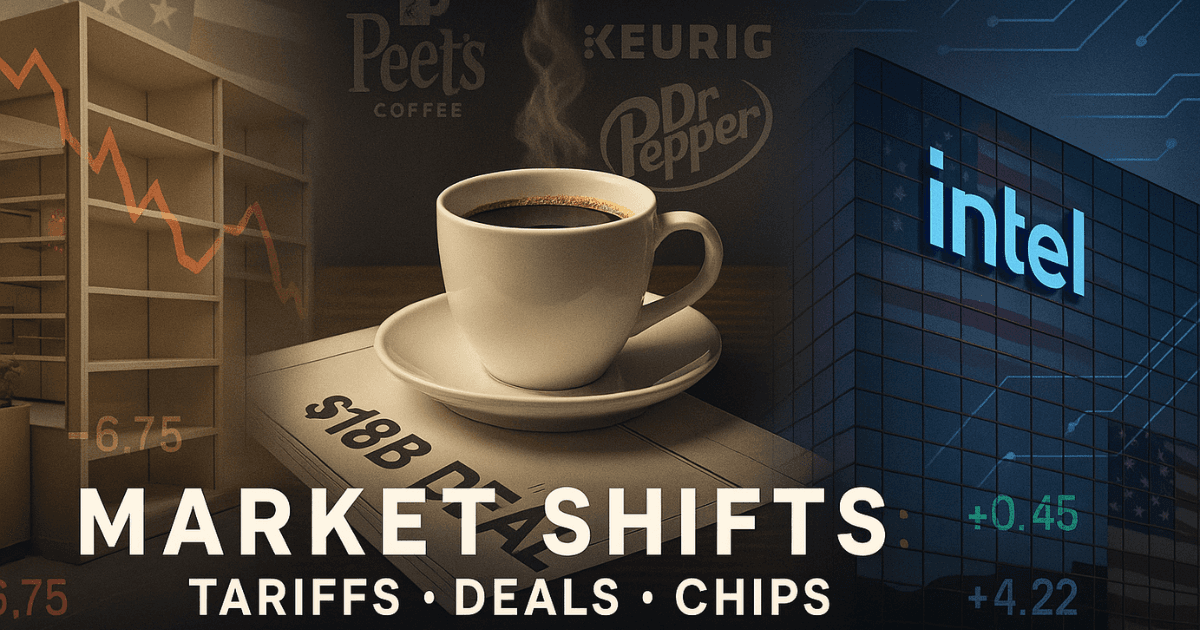
📊 Markets on Edge: Tariffs, Coffee Deals, and a Government Stake in Silicon Valley
Global markets thrive on certainty—and lately, certainty has been in short supply. From Washington’s tariff probes shaking up furniture retailers, to Keurig Dr Pepper’s bold $18 billion coffee takeover, to the U.S. government writing a multi-billion-dollar cheque for a 10% stake in Intel, investors are learning that strategy and politics often move markets faster than quarterly earnings. What connects these stories is not just headlines—it’s the quiet reshaping of competitive landscapes. Retailers are being forced to rethink their supply chains, beverage giants are splitting their bets, and semiconductors have shifted from private sector ventures to national security priorities. For the careful investor, these shifts aren’t noise; they’re signals of where capital and policy are colliding.
🚪 When Trade Wars Knock on the Furniture Store Door
Global trade jitters rarely arrive quietly, and this time they came barging in with a hammer. President Trump’s announcement of a tariff probe on imported furniture rattled investors across the retail sector. Shares of RH dropped about 5%, Wayfair slid nearly 6%, and Williams-Sonoma lost close to 3%—proof that uncertainty is the fastest way to clear out a showroom floor. But here’s the kicker: while import-heavy names took a bruising, the domestically anchored brands found themselves suddenly fashionable again. Ethan Allen and La-Z-Boy ticked higher, buoyed by the possibility of tariffs reshaping consumer demand toward American-made lines. Think of it as the “buy local” trend, but with Wall Street doing the marketing. Smart Capital Signal: Tariff probes don’t guarantee actual tariffs, but they create volatility. Import-reliant retailers face risk, while domestically focused manufacturers may quietly collect the spoils. For investors, it’s less about panic and more about positioning portfolios where policy winds might blow.
☕ Brewing Up a Corporate Shake-Up: Keurig Dr Pepper Buys JDE Peet’s
Not every deal is designed to last. Keurig Dr Pepper (KDP) has inked an $18 billion deal to acquire JDE Peet’s, the global coffee powerhouse behind Peet’s, Marcilla, and Senseo. On paper, it’s one of the boldest consumer-sector transactions in years. But here’s the twist: KDP already plans to split the combined entity into two separate companies—a North American beverage player and a global coffee champion. The deal price—€31.85 per share with a 20–30% premium—sent JDE Peet’s stock frothing upward by 16–17%, while KDP itself suffered a post-announcement headache with shares tumbling 7–10%. It’s the market’s way of saying: great ambition, but execution risk is real. Why split? Although combining coffee and sodas may have once made sense, the strategic landscape has changed. Analysts see $400 million in synergies on the table; yet, the bigger play is clarity—beverages and coffee are chasing separate growth paths. Nestlé, watch your cup. Tactical Insight: The near-term pain in KDP stock reflects skepticism about integration costs. Yet, the long-term split could unlock value, creating a pure-play coffee company with global reach. Patience—and caffeine—will be required.
💻 Uncle Sam Buys a Piece of Intel
Now for a headline no one expected to read: the U.S. government has become Intel’s largest outside shareholder. Roughly $11 billion from the CHIPS Act has been converted into a 10% equity stake, giving Washington a direct slice of Silicon Valley’s once-mighty chip giant. The structure is passive—no board seats, no management control—but the symbolism is anything but subtle. Intel, after years of bleeding red ink (with cumulative losses exceeding $22 billion since 2023), now has a financial lifeline to stabilize its fabs and stay competitive against Asian rivals. The stake, bought at $20.47 a share, was already worth more by announcement, with the stock climbing ~5% in the immediate aftermath. Critics call it industrial policy disguised as investing. Supporters say it’s long overdue for the protection of U.S. semiconductor sovereignty. As one White House official quipped, “We’re not just betting on chips—we’re betting on America’s future tech backbone.” Investor Radar: Intel’s fundamentals remain shaky, but the government’s backing shifts the calculus. Political risk is baked in, yet so is support. For investors, the story is no longer just about chips—it’s about geopolitics stitched into balance sheets.
🥂 The Investor’s Takeaway: Reading Between the Headlines
The latest developments may look unrelated—a tariff probe here, a corporate shake-up there, a government suddenly buying shares in a chipmaker. However, the thread is clear: markets are being reshaped by forces larger than individual companies. Trade policy, corporate restructuring, and state-backed industrial strategy are no longer side plots—they are the main stage. For investors, the premium play isn’t chasing short-term price moves. It’s recognising that furniture, coffee, and chips aren’t just products—they’re barometers of policy, strategy, and shifting global power. Staying ahead now means more than reading earnings reports. It means watching the currents that bend entire industries. And yes, sometimes, the biggest investor at the table is no longer a hedge fund—it’s Uncle Sam.
Sources:
- AP News – Trump turns $11.1B in US government funds into a 10% stake in Intel.
- Tom’s Hardware – Intel confirms $5.7B CHIPS funds, CFO details stake deal
- El País – Keurig Dr Pepper acquires JDE Peet’s for €15.7B
- Investor’s Business Daily – Keurig Dr Pepper to acquire JDE Peet’s, shares tumble
- WSJ – Furniture import probe hits RH, Wayfair, Williams-Sonoma
- Yahoo Finance – Furniture stocks sink on new import tariff threat
Market Munchies and Mode Mobile communications are for informational purposes only, and are not a recommendation, solicitation, or research report relating to any investment strategy, security, or digital asset. All investments involve risk including the loss of principal and past performance does not guarantee future results.
Any information contained in this commentary does not purport to be a complete description of the securities, markets, or developments referred to in this material. The information has been obtained from sources considered to be reliable, but we do not guarantee that the foregoing material is accurate or complete. There is no guarantee that any statements or opinions provided herein will prove to be correct.