Tariffs, Ratings & Growth Projections—The Signals Investors Can’t Ignore
🌍 A Global Economy Balancing on Fine Margins Markets thrive on confidence, but confidence is a fragile thing. When a country’s US credit rating holds steady despite ballooning deficits, or when central bankers gather at the Jackson Hole Symposium to hint at new directions,…
🌍 A Global Economy Balancing on Fine Margins
Markets thrive on confidence, but confidence is a fragile thing. When a country’s US credit rating holds steady despite ballooning deficits, or when central bankers gather at the Jackson Hole Symposium to hint at new directions, investors take note. Add to that a fresh wave of global trade trends reshaping supply chains and institutions upgrading their global growth outlook, and the result is both fragile and surprisingly resilient. The latest macroeconomic update presents a curious mix: tariff revenues are cushioning fiscal risks, monetary policy signals are shifting at Jackson Hole, businesses are showing resilience to tariffs, and the IMF's growth forecast is nudging higher. Let’s slice through the noise.
🇺🇸 S&P Keeps U.S. at AA+—But With Strings Attached
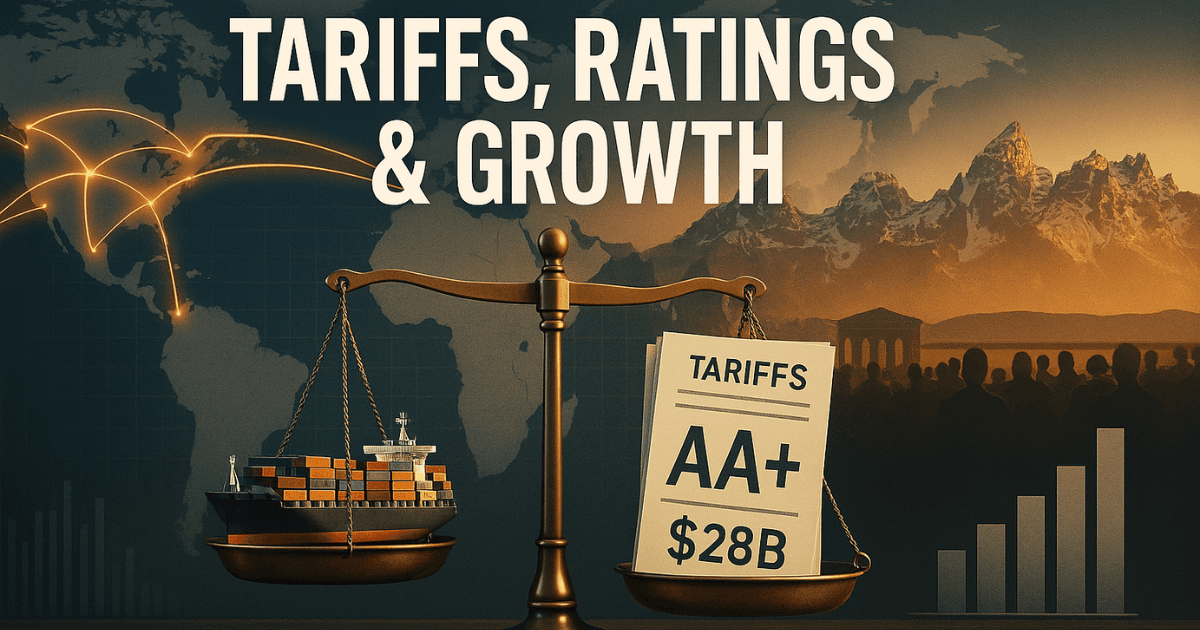
S&P Global Ratings reaffirmed the US credit rating at AA+ with a stable outlook, citing that rising tariff revenues have provided an unexpected fiscal cushion. Collections surged beyond $28 billion, easing pressure from tax cuts and spending hikes. But there’s a catch. Lisa Schineller, S&P’s lead analyst, warned: “It’s the outcomes that matter—budget execution, tariff flows, and their impact on investment.” In plain terms, debt at nearly 100% of GDP and potential erosion of Fed independence could unsettle long-term fiscal resilience. 🔎 Smart Capital Signal: The U.S. rating looks stable now, but financial policy analysis shows that without real reforms, revenues won’t outweigh structural risks.
🎙️ Jackson Hole: Policy Hints in the Mountain Air
Every August, economists and investors focus on the insights from the Jackson Hole Symposium. This year’s theme—“Labor Markets in Transition: Demographics, Productivity, and Macroeconomic Policy”—wasn’t mere theory. Fed Chair Jerome Powell highlighted cracks in the labor market. Rising mismatches in productivity and wages have prompted the Fed to adopt greater flexibility. Investors interpreted it as a dovish monetary policy signal: the Fed's rate cut outlook moved sharply into focus, with cuts possible as soon as September. 💡 Tactical Insight: When Powell talks, investment strategy shifts. Expect volatility in rates, but avoid assuming the Fed will act without considering the impact of inflation.
📦 Tariffs Bite, Trade Deals Soothe
The tariff wave is real. New duties rolled out in August disrupted supply chains, adding costs across various industries. Yet Dun & Bradstreet’s Economy Observer noted business resilience to tariffs, showing adaptability across supply chains. New deals with the EU and Japan have softened the blow. Still, global trade trends remain pressured. The World Economic Forum warns of job risks in Europe and higher international prices. The tension between adaptability and fragility is tightening. 📊 Investor Radar: Tariffs are now a financial policy analysis issue, not just a trade quirk. Positioning in sectors shielded by agreements or with pricing power is a sharper investment strategy than chasing headlines.
📈 IMF Nudges Global Growth Higher
Defying expectations, the IMF growth forecast edged up. Global GDP is projected at 3.0% in 2025 and 3.1% in 2026. Fiscal measures, tariff pre-loading, and surprisingly modest disruptions are boosting confidence in the global growth outlook.
- U.S. growth: 1.9% (2025), 2.0% (2026)
- India: fastest-growing major economy at 6.4%
- China: upgraded thanks to easing U.S. tensions
- Eurozone: steady, avoiding contraction fears
As the IMF put it: “Resilience is the defining characteristic of the global economy in 2025.” Analysts interpret this as cautious optimism in the latest macroeconomic update. 📌 Strategic Cue: Don’t ignore investor takeaways from growth upgrades. The upgrades demonstrate strength, but a long-term investment strategy must still account for tariff risks and debt burdens.
🥂 Final Pour: Stability or Illusion?
The global economy is sending layered messages. US credit ratings remain firm, but debt and fiscal resilience are tested. The Jackson Hole Symposium insights suggest looser monetary policy. Global trade trends show strain, even as business resilience to tariffs keeps supply chains moving. The IMF's growth forecast raises optimism, although risks remain.
🍷 Premium Investor Reflection
For investors, the signals matter more than the noise. Monetary policy signals, macroeconomic updates, and global growth outlooks are valuable guides—but they don’t eliminate risk. A premium investment strategy today isn’t about chasing headlines; it’s about balancing stamina and resilience.
Sources
Market Munchies and Mode Mobile communications are for informational purposes only, and are not a recommendation, solicitation, or research report relating to any investment strategy, security, or digital asset. All investments involve risk including the loss of principal and past performance does not guarantee future results.
Any information contained in this commentary does not purport to be a complete description of the securities, markets, or developments referred to in this material. The information has been obtained from sources considered to be reliable, but we do not guarantee that the foregoing material is accurate or complete. There is no guarantee that any statements or opinions provided herein will prove to be correct.