Tariffs, Shutdowns, and Shifting Power: Is Trump Rewiring the Global Market Playbook?
🧩 The New Age of Economic Power Plays Every once in a while, global markets remind investors that data models can’t capture human unpredictability. The latest episode? Donald Trump’s return as the headline act in U.S.–China trade tensions —and this time, the economic stakes…
🧩 The New Age of Economic Power Plays
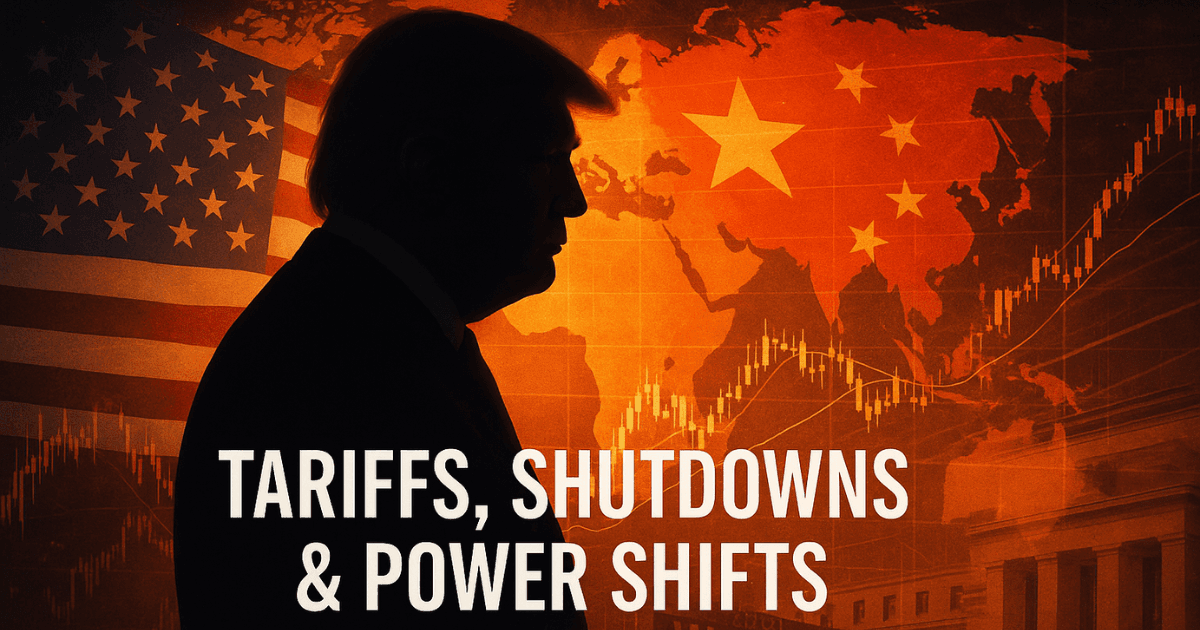
Every once in a while, global markets remind investors that data models can’t capture human unpredictability. The latest episode? Donald Trump’s return as the headline act in U.S.–China trade tensions—and this time, the economic stakes stretch from supply chain disruptions to the Federal Reserve’s independence. From a 100% U.S.–China tariff escalation to a government shutdown with trillion-dollar consequences, Trump is redefining trade policy and market dynamics in real time. Investors across the U.S. and emerging markets are watching closely, trying to read the fine print between political posturing and policy permanence.
💣 Trump’s 100% Tariff Blitz: A Trade War Reheated
If U.S.–China trade wars were a sport, Trump just declared overtime. After Beijing restricted rare-earth exports critical for EV batteries and semiconductors, the U.S. president launched a sweeping 100% tariff on all Chinese goods, shaking investor confidence and global supply chains. According to the Financial Times and Bloomberg, these 2025 Trump tariffs mark the most extensive trade barrier since the 1930s. Trump justified it as “protecting American industry,” while China accused Washington of “economic coercion.” The market reaction was immediate: the Dow Jones plunged nearly 900 points, the S&P 500 dropped 2.7%, and the Nasdaq fell over 3%. Energy, semiconductor, and logistics stocks bore the brunt, while gold surged past $2,580/oz—a classic hedge against geopolitical volatility. Economists estimate these tariffs on China could shave 0.6–0.8% off global GDP in 2026 while raising inflation by up to 0.4 percentage points. The supply chain disruption from China has investors reevaluating positions in technology and manufacturing sectors. 🔎 Tactical Insight: In an era where trade policy drives price action, volatility becomes an asset class of its own. Investors may consider hedging through commodities and domestic industrials as the U.S.–China trade war deepens.
🛑 A Shutdown-Turned Strategy: Rewriting the Federal Rulebook
The ongoing U.S. government shutdown—now the longest in decades—has become a strategic tool. Trump and Russ Vought are reportedly leveraging the impasse to reshape federal programs and consolidate executive control, according to AP News and Politico. With more than 420,000 federal employees furloughed, the shutdown’s economic impact is estimated at $15 billion per day. Beyond halting public services, it threatens to stall economic data releases, delay policy decisions, and drag Q4 GDP growth by 1.2%, as noted by Moody’s and Reuters. Markets are cautiously resilient, but investors recognize that the government shutdown's impact could spread through reduced consumer spending and weaker investor sentiment. 📈 Smart Capital Signal: Short-term volatility from the U.S. shutdown may weigh on equities, but long-term investors should watch sectors that benefit from budget reshuffling—especially infrastructure, defense, and energy.
🌍 Foreign Affairs, Market Flares
🇦🇷 Argentina: Diplomacy Meets Dollar
Trump’s threat to cut U.S. foreign aid to Argentina if President Javier Milei loses legislative backing has added political risk to emerging markets already under pressure. The Guardian reported that the Argentine peso slid nearly 3%, and bonds lost 1.6%, as traders priced in potential funding gaps. This episode highlights a rising trend in U.S. foreign policy in 2025—linking aid and alliances to ideological loyalty. For investors in emerging markets, this introduces a new form of risk: political alignment as a variable in portfolio stability. 💡 Investor Radar: Emerging-market exposure should factor in geopolitical loyalty risk. As trade policy shifts and aid becomes conditional, diversification across politically neutral economies may offer safety.
🕊️ Gaza Peace Talks: Optics or Opportunity?
At Egypt’s Sharm El Sheikh Gaza Peace Summit, Trump co-chaired talks with President Abdel Fattah el-Sisi, outlining a three-point plan for reconstruction and aid distribution. Though symbolic, it signalled a renewed U.S. influence in Middle Eastern markets, especially in infrastructure, logistics, and energy sectors. 🌐 Strategic Note: Peacebuilding often precedes investment. Watch for U.S. contractors and logistics firms eyeing post-conflict reconstruction bids—potentially lucrative for patient investors.
🏦 The Fed Fight: Trump vs. Cook
The latest legal showdown—Trump v. Cook—could redefine Federal Reserve independence. Trump’s attempt to remove Fed Governor Lisa Cook “for cause” is under Supreme Court review, with hearings set for early 2026. As The Wall Street Journal notes, this raises fundamental questions about executive power over the central bank. The 10-year Treasury yield climbed to 4.73%, reflecting heightened uncertainty around monetary policy stability. 🎯 Capital Cue: A politicized Fed is every investor’s nightmare. If Fed independence weakens, expect risk repricing across bonds, equities, and currency markets.
💭 Closing Thoughts: The Politics Premium
Across tariffs, trade policy, and the government shutdown, one theme dominates—power concentration. Trump isn’t merely governing; he’s re-engineering economic policy through political leverage, creating what analysts are calling the “politics premium” in asset pricing. For investors, this means watching not just for earnings or rate cuts—but for executive intent. Markets no longer move only on fundamentals; they move on narratives, negotiations, and national strategy. Because in 2025 and beyond, policy risk isn’t temporary—it’s structural.
📚 Sources
- Reuters – US retailers brace for impact as Trump’s 100% China tariffs loom
- Reuters – Trump’s reignited trade war with China clouds IMF, World Bank meetings
- AP News – China shows no sign of backing down while issuing a call for the US to withdraw the tariff threat
- Reuters – US Supreme Court to hear arguments in Trump bid to fire Fed’s Cook; leaves her in job for now
- AP News – Supreme Court lets Lisa Cook remain as a Federal Reserve governor for now
- Reuters – Wall Street ends higher as investors digest Trump trade
- Politico – Bessent says US in talks with China to prevent new trade war
Market Munchies and Mode Mobile communications are for informational purposes only, and are not a recommendation, solicitation, or research report relating to any investment strategy, security, or digital asset. All investments involve risk including the loss of principal and past performance does not guarantee future results.
Any information contained in this commentary does not purport to be a complete description of the securities, markets, or developments referred to in this material. The information has been obtained from sources considered to be reliable, but we do not guarantee that the foregoing material is accurate or complete. There is no guarantee that any statements or opinions provided herein will prove to be correct.