Tariffs Whiplash Returns, Volatility Jumps, and Nvidia Looms
Friday’s session closed on a constructive note after the U.S. Supreme Court struck down the Trump administration’s sweeping tariffs that had been imposed under the International Emergency Economic Powers Act (IEEPA). Stocks pushed higher into the close as investors initially…
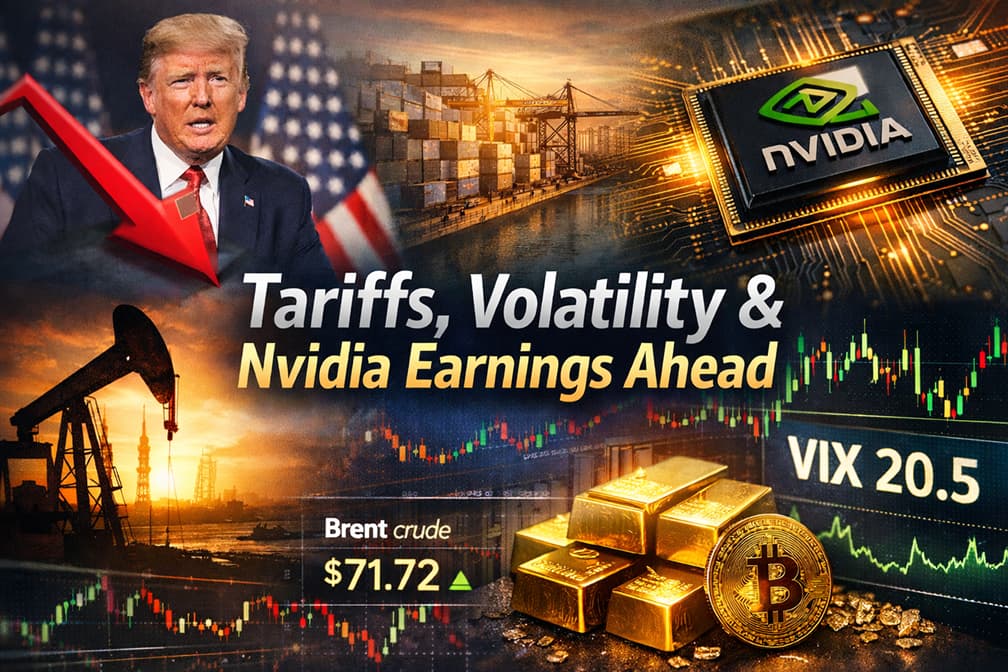
Friday’s session closed on a constructive note after the U.S. Supreme Court struck down the Trump administration’s sweeping tariffs that had been imposed under the International Emergency Economic Powers Act (IEEPA). Stocks pushed higher into the close as investors initially treated the ruling as a pressure-release valve for global trade and corporate margins.
But the relief rally did not get the last word. Over the weekend, the White House pivoted to a different legal tool: Section 122 of the Trade Act of 1974, which allows a temporary import surcharge of up to 15% for no more than 150 days unless Congress extends it. The administration moved from a 10% surcharge to 15%, snapping uncertainty right back into focus and setting up a softer tone for Monday’s open.
By early this morning, markets were re-pricing the same core issue, not just “tariffs up or down,” but “rules in flux.” The U.S. Customs and Border Protection agency also said it will stop collecting the IEEPA-linked tariffs at 12:01 a.m. ET Tuesday, adding yet another operational twist for businesses trying to plan around shifting policy.
Stock of Interest Today: Micron Technology (MU)
Nvidia reports fiscal Q4 results Wednesday, Feb. 25, after the close, and it is still the single most important “tell” for whether the market stays comfortable with the scale and durability of AI infrastructure spending. Reuters notes consensus expectations for roughly 71% EPS growth on about $65.9B in revenue for the quarter, based on LSEG data.
What makes this week especially charged is that the macro backdrop is noisy while the micro stakes are enormous. Nvidia and Meta recently announced an expanded AI infrastructure relationship tied to next-generation systems, including GB300-based deployments and broader use of Nvidia’s Grace CPUs in data center workloads. That matters because the story investors are buying is not just “AI demand exists,” but “AI demand remains large enough to justify relentless capex.”
And the capex bar is high. UBS has estimated hyperscaler capex could run around $770B in 2026, a number that helps explain why Nvidia’s guidance language around supply, margins, and the pace of new platform rollouts can swing sentiment fast.
Options markets are also signaling that traders are braced for a meaningful move. Recent analysis has pointed to an at-the-money earnings straddle implying about a 7% swing around the print, which is elevated versus typical post-earnings moves.
Current price: $189.86
Analyst target: $208
Five Market Signals Worth Watching
The biggest mistake traders make in headline-driven markets is treating every data point as equal. Right now, the market is ranking inputs: policy uncertainty first, volatility second, and the AI earnings pipeline third. That hierarchy can flip quickly, but it explains why defensive assets rallied even while risk assets tried to hold their footing.
Below are the five pressure points that mattered after Friday’s close and into today’s open, plus what they could mean from here.
1) The 15% Section 122 Tariff Reset
The Supreme Court’s IEEPA ruling removed one pillar of tariff policy, but it did not remove tariff risk. The administration’s Section 122 workaround is explicitly temporary: up to 15% for up to 150 days unless Congress extends it. That built-in expiration date is why markets are treating the move less like a single policy decision and more like a rolling negotiation with legal, political, and diplomatic legs.
What to watch: Implementation details, exemptions, and whether major trading partners escalate or attempt to lock in negotiated ceilings.
2) VIX Back Above 20
Volatility is not a headline, it is a tax. This morning, the VIX popped to 20.5, a signal that the market expects wider daily ranges and more fragile risk appetite.
A VIX reading above 20 is commonly treated as a “higher volatility regime” marker, not necessarily panic, but a level where position sizing and hedging discipline tend to matter more.
What to watch: Whether VIX stays above 20 for multiple sessions. If it does, dips can become sharper and rallies can feel more mechanical.
3) Nvidia Earnings as the AI Demand Stress Test
This is the week’s fulcrum for equities. Nvidia is expected to deliver blockbuster year-over-year growth, but the market’s real question is forward-looking: does management reinforce the view that AI infrastructure spending remains durable enough to justify today’s valuations.
The Meta infrastructure expansion adds another data point that hyperscalers are still building aggressively, but it does not eliminate the core risk: a single phrase about “digesting capacity” can move the whole complex.
What to watch: Guidance tone, backlog indicators, and any comment that reframes the pace of deployments.
4) U.S.-Iran Talks and the Oil Risk Premium
Oil is trying to balance two forces: tariff uncertainty that can cloud demand expectations, and diplomacy that can cool the geopolitical premium. Reuters reported Brent around $71.72 and WTI around $66.44 as markets weighed upcoming U.S.-Iran nuclear talks against the broader trade-policy backdrop.
What to watch: Headline risk. If talks appear to progress, energy can lose some of its fear bid. If talks deteriorate, crude can snap back quickly.
5) Gold’s Safe-Haven Bid
Gold moved higher as the dollar softened and tariff policy uncertainty pushed investors toward perceived safety. Reuters reported spot gold around $5,152/oz this morning, framed as a three-week high amid safe-haven demand and policy confusion.
Gold’s signal here is less about inflation in isolation and more about confidence: when rules feel unstable, the market often pays up for insurance.
What to watch: Dollar direction, Fed commentary, and whether policy headlines remain noisy enough to keep safe-haven demand persistent.
Bottom Line
Friday’s close priced in “tariff relief.” The weekend repriced it as “tariff uncertainty with a ticking clock.” With volatility back above 20, safe havens catching a bid, and Nvidia’s earnings about to test the AI capex narrative, this market is less about one headline and more about whether investors can regain confidence in the rules of the game.
Sources:
- https://www.barrons.com/livecoverage/stock-market-news-today-022326/card/markets-drop-after-trump-hikes-tariffs-to-15-stock-futures-falling--ddGM6lIyU3bdXSEG7RGO
- https://www.barrons.com/articles/nvidia-warner-bros-berkshire-hathaway-home-depot-and-more-stocks-to-watch-this-week-87338ad3
- https://www.reuters.com/world/us/tariff-ruling-limits-trumps-leverage-wont-end-uncertainty-trade-partners-2026-02-22/
- https://www.cboe.com/tradable-products/vix/
- https://investor.nvidia.com/events-and-presentations/events-and-presentations/event-details/2026/NVIDIA-4th-Quarter-FY26-Financial-Results-2026-sO6kGS3C2P/default.aspx
- https://www.reuters.com/business/energy/oil-slides-us-tariff-hike-raise-jitters-over-global-economy-2026-02-22/
- https://www.reuters.com/business/gold-rises-dollar-falls-us-supreme-court-tariff-verdict-2026-02-23/
- https://www.reuters.com/business/with-us-tariff-rates-up-air-economic-fog-again-thickens-2026-02-23/
Market Munchies and Mode Mobile communications are for informational purposes only, and are not a recommendation, solicitation, or research report relating to any investment strategy, security, or digital asset. All investments involve risk including the loss of principal and past performance does not guarantee future results.
Any information contained in this commentary does not purport to be a complete description of the securities, markets, or developments referred to in this material. The information has been obtained from sources considered to be reliable, but we do not guarantee that the foregoing material is accurate or complete. There is no guarantee that any statements or opinions provided herein will prove to be correct.