Tech Rebounds, Volatility Spikes, and the New AI Question
Tuesday’s session delivered a small but meaningful shift in tone: major U.S. indexes finished slightly higher, with the Nasdaq managing to snap its four-session losing streak. It did not feel like a “risk-on” celebration so much as a tactical reset after a bruising stretch…
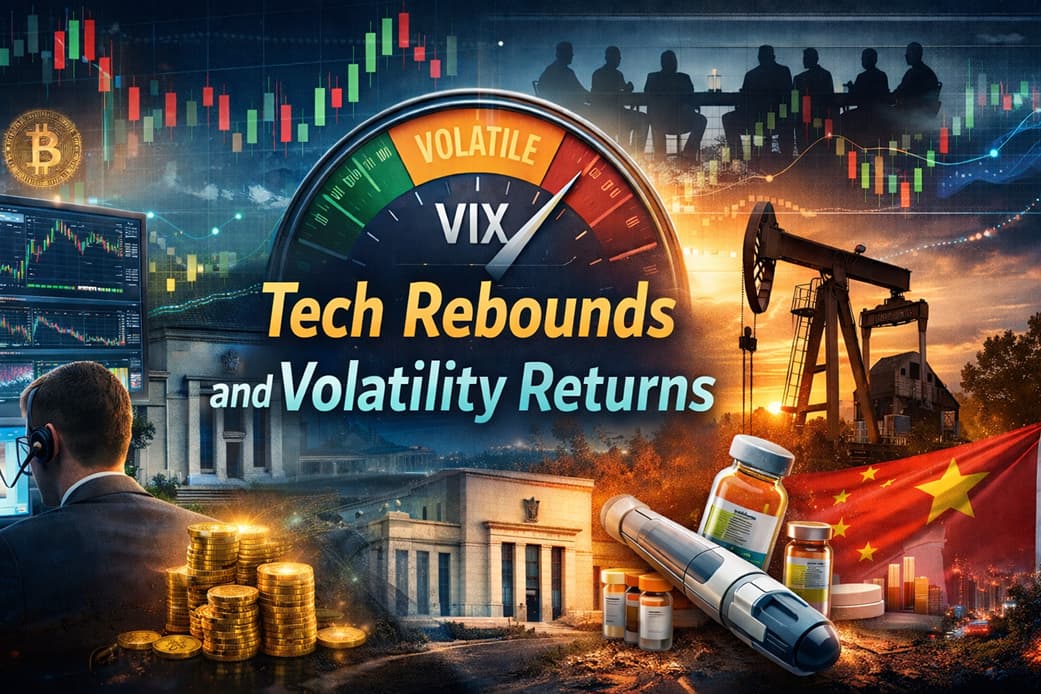
Tuesday’s session delivered a small but meaningful shift in tone: major U.S. indexes finished slightly higher, with the Nasdaq managing to snap its four-session losing streak. It did not feel like a “risk-on” celebration so much as a tactical reset after a bruising stretch where investors have been second-guessing Big Tech’s AI spending plans and what, exactly, the payoff timeline looks like.
The more revealing signal was volatility. The VIX pushed up to an intraday high just under 23 before easing back, a reminder that the market is no longer gliding on autopilot. Even after the late-day cool-down, it was a session where hedging demand and uncertainty had a very real pulse.
That backdrop sets up the core question investors keep circling: is the market repricing because AI is changing business models too fast, or because the spending race is getting so large that returns will struggle to catch up? This week, it has been increasingly the latter.
Stock of Interest Today: Alibaba Group Holding (BABA)
Alibaba is expected to reports earning on February 24, and the setup is unusually clean: the stock has been trading near a widely watched support zone (roughly the mid-$140s), while sentiment has skewed negative enough that any incremental “less-bad-than-feared” signal can matter. Technically, the stock has been hovering around key levels that traders tend to treat as a decision point going into earnings.
Fundamentally, the debate is about growth versus the cost of pursuing it. In the most recently reported quarter (ended Sept. 30, 2025), Cloud Intelligence Group revenue rose 34% year over year, with management pointing to stronger public cloud demand and rising adoption of AI-related products.
But the market is not grading Alibaba on revenue alone right now. In that same quarter, income from operations fell 85% year over year, and free cash flow flipped to an outflow, with Alibaba attributing the swing largely to quick commerce investment and increased cloud infrastructure spending. That is the trade-off investors are trying to price: how much near-term margin and cash flow pain is acceptable to secure durable AI and cloud positioning.
There is also a “numbers gravity” issue. Analysts have been actively revising expectations, and recent estimate changes have leaned pessimistic. One widely circulated analyst note highlighted a heavy imbalance of downward revisions versus upgrades in the past 90 days, which helps explain why the stock can look “cheap” and still struggle to rally without a clear catalyst.
Current price: $155.43
Analyst target: $168
Five Market Themes Worth Watching
Tuesday’s close matters less for the headline points and more for what it revealed underneath: investors are still willing to buy dips, but only while they can plausibly map spending to future earnings. With major macro catalysts ahead, including the Fed’s latest meeting minutes, the next few sessions are likely to be driven by positioning and expectations more than “good news vs bad news.”
Below are five post-close themes that explain where the pressure points are building.
Volatility’s Comeback Is Real (Even If It Softens)
The VIX traded up to roughly 22.96 intraday on Tuesday before easing back, and it remained a live signal that investors are paying for protection again. Even small pullbacks in the VIX can be misleading if the index stays elevated versus the calm regime investors got used to earlier.
Practical takeaway: Watch whether the VIX holds above 20 for more than a day or two. A sustained stay above that zone often changes behavior, from tighter risk limits to more demand for hedges.
The AI Narrative Has Flipped to “Show Me the Returns”
A key shift behind recent tech turbulence is that skepticism is now aimed at ROI on AI capex, not just disruption risk. Reuters and Bank of America survey coverage both point to a growing investor belief that companies may be overinvesting, and that the spending race is getting ahead of near-term monetization.
Practical takeaway: In this environment, markets tend to reward the companies that can tie AI spend to measurable revenue or cost outcomes, and punish the ones that talk in timelines and abstractions.
Fed Minutes: “Wait and See” Can Still Move Markets
The Fed’s January meeting minutes were a near-term focal point because traders are trying to price the true scope of cuts in 2026 while the economy remains resilient. When the Fed signals patience, rate-sensitive areas can wobble, not because rates are rising, but because the “soon and sizable easing” narrative loses momentum.
Practical takeaway: The risk is less about a surprise hike and more about “higher for longer” lasting just long enough to compress multiples in the most duration-sensitive parts of the market.
Geopolitics and Oil: Progress, Then a Reminder of the Tail Risk
Oil’s risk premium remains headline-sensitive. Reports around U.S.-Iran dynamics included signals of negotiation progress, but also hard-edged reminders of escalation risk, including Iranian threats tied to the Strait of Hormuz. Those crosscurrents can swing energy prices quickly, especially when volatility is already elevated.
Practical takeaway: This is an environment where balanced exposure matters. You do not need to be “all-in” energy to benefit from a risk premium, but you also do not want to be structurally underexposed if the tail risk reasserts itself.
China Risk Premium Still Caps “Cheap” Valuations
Alibaba is a useful case study for a broader theme: even when fundamentals improve in pockets (like cloud growth), the market often applies a persistent discount for policy and macro uncertainty. Add heavy investment cycles on top, and “undervalued” can stay undervalued longer than models expect.
Practical takeaway: If you are looking for upside in China large-caps, the catalyst usually needs to be more than “beats estimates.” It needs to clarify durability (cash flow, margins, and spending discipline) enough to reduce the discount rate investors are applying.
Bottom Line
Tuesday’s close looked calm on the surface, but the internals were loud: volatility is back, AI is being judged on returns not potential, and macro catalysts can reprice expectations quickly. Alibaba sits right at the intersection of these forces, showing real cloud momentum while asking investors to tolerate a heavy investment cycle and near-term cash flow strain. If the market is going to stabilize, it likely happens the same way it did Tuesday: not through euphoria, but through incremental clarity on profits, spending discipline, and risk.
Sources:
- https://www.reuters.com/sustainability/sustainable-finance-reporting/us-stock-futures-slip-persistent-ai-disruption-fears-2026-02-17/
- https://www.morningstar.com/news/dow-jones/202602184268/fed-minutes-could-show-higher-bar-for-rate-cuts-as-inflation-lingers
- https://www.sec.gov/Archives/edgar/data/1577552/000110465925115949/tm2532163d1_ex99-1.htm
- https://finance.yahoo.com/calendar/earnings?symbol=BABA
- https://www.reuters.com/legal/legalindustry/investors-chase-cheaper-smaller-companies-risk-aversion-hits-tech-sector-2026-02-08/
- https://www.cboe.com/tradable_products/vix/vix_historical_data
- https://www.reuters.com/business/global-software-data-firms-slide-ai-disruption-fears-compound-jitters-over-600-2026-02-06/
- https://www.federalreserve.gov/monetarypolicy.htm
- https://www.reuters.com/business/energy/oil-prices-lose-ground-hopes-de-escalation-us-iran-tensions-2026-02-18/
- https://www.reuters.com/sustainability/boards-policy-regulation/china-tightens-market-oversight-create-slow-bull-momentum-2026-02-10/
- https://apnews.com/article/f6aa1836a606140c698ac8ab2706d95d
- https://finance.yahoo.com/news/bofa-survey-shows-investor-worry-114425759.html
- https://www.reuters.com/business/fed-minutes-could-highlight-shift-balance-risks-policymakers-put-rates-hold-2026-02-18/
- https://www1.hkexnews.hk/listedco/listconews/sehk/2025/1125/2025112501051.pdf
- https://data.alibabagroup.com/ecms-files/1508664153/51f99f2e-c839-49c1-b975-ace2a09ec5de/September%20Quarter%202025%20Results.pdf
Market Munchies and Mode Mobile communications are for informational purposes only, and are not a recommendation, solicitation, or research report relating to any investment strategy, security, or digital asset. All investments involve risk including the loss of principal and past performance does not guarantee future results.
Any information contained in this commentary does not purport to be a complete description of the securities, markets, or developments referred to in this material. The information has been obtained from sources considered to be reliable, but we do not guarantee that the foregoing material is accurate or complete. There is no guarantee that any statements or opinions provided herein will prove to be correct.