The DOJ Just Indicted a Former FBI Director for a Seashell Photo. The First Amendment Implications Are No Joke.
On May 15, 2025, James Comey walked on a North Carolina beach, found some shells arranged in the shape of "86 47," captioned the photo "Cool shell formation on my beach walk," and posted it to Instagram. On April 28, 2026, the Department of Justice indicted him for it. The…
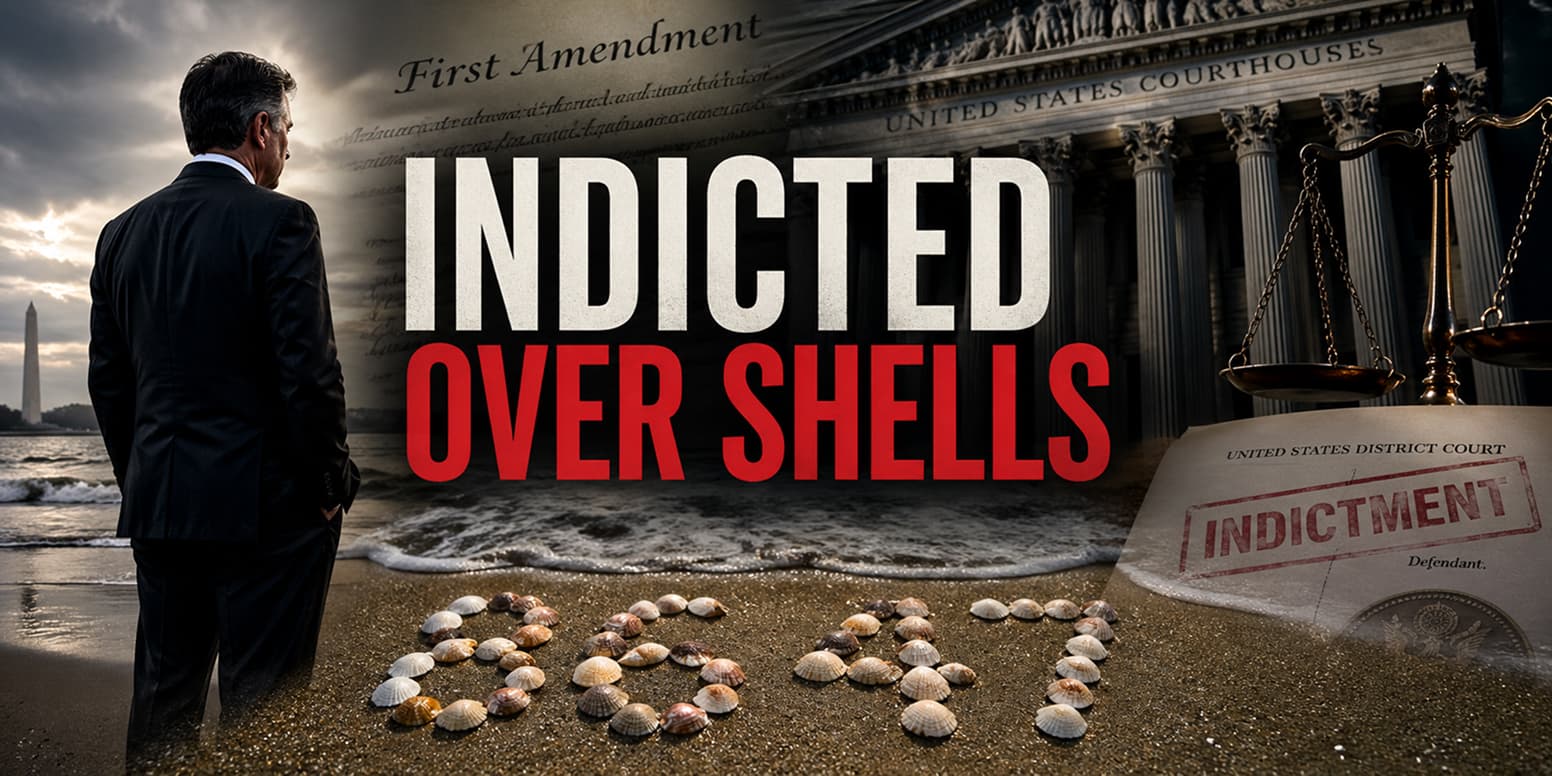
On May 15, 2025, James Comey walked on a North Carolina beach, found some shells arranged in the shape of "86 47," captioned the photo "Cool shell formation on my beach walk," and posted it to Instagram.
On April 28, 2026, the Department of Justice indicted him for it.
The charges — making a threat against the president and transmitting a threat in interstate commerce — carry up to five years in prison each. Acting Attorney General Todd Blanche, who until recently was Donald Trump's personal criminal defense lawyer, announced the indictment at a press conference flanked by FBI Director Kash Patel. It is the second time the Trump administration has indicted Comey. The first indictment was thrown out by a federal judge last November on procedural grounds.
Comey responded in a video posted to his Substack account. "I'm still innocent. I'm still not afraid," he said. "And I still believe in the independent federal judiciary, so let's go."
What "86 47" Actually Means
The government's case rests on a specific interpretation of the numbers in the photo.
"86" is a long-standing piece of American slang. In restaurants, it means an item has been removed from the menu or is no longer available. In broader usage, it means to get rid of, reject, or eject something. In political contexts, it has been used across the ideological spectrum for decades to signal opposition to a sitting president. "86 45" merchandise appeared during Trump's first term. "86 46" was deployed against Biden. "86 47" has been printed on T-shirts, protest signs, and bumper stickers since Trump returned to office in January 2025.
Conservative commentator Jack Posobiec posted "86 46" during Joe Biden's presidency. Democratic Michigan Governor Gretchen Whitmer appeared in a 2020 television interview with a small figurine displaying "86 45" on a table behind her. Neither was indicted.
The DOJ's indictment alleges that "a reasonable recipient who is familiar with the circumstances would interpret" the seashell photo "as a serious expression of an intent to do harm to the President of the United States." Comey says he didn't realize "some folks associate those numbers with violence" and deleted the post after the controversy erupted. The Secret Service interviewed him the following day.
The Legal Problem With This Case
The indictment faces a formidable constitutional obstacle that multiple legal scholars identified within hours of its announcement.
In 2023, the U.S. Supreme Court decided Counterman v. Colorado, clarifying the legal standard for "true threats" under the First Amendment. The Court held that to convict someone of making a threat, the government must prove that the defendant "consciously disregarded a substantial risk that his communications would be viewed as threatening violence." Mere recklessness is the constitutional floor — and below it, the speech is protected.
Applied to Comey's seashell post, the bar is high on two separate dimensions.
First, the objective element: the government must prove that a reasonable recipient familiar with the circumstances would interpret the photo as a serious expression of intent to commit violence — not a political slogan, not hyperbole, not a call to vote. Given that "86 47" has been used so widely by so many people in so many non-violent contexts, that showing will be genuinely difficult.
Second, the subjective element: the government must prove Comey knowingly and willfully made a threat — that he consciously understood his photo would be perceived as a call for violence against Trump. His caption, his immediate deletion of the post upon learning of the controversy, and his stated ignorance of the violent interpretation all cut against that showing.
"Nothing in Comey's statement can be reasonably understood as conveying that he means to kill Trump," wrote Eugene Volokh, a First Amendment scholar at UCLA School of Law, in an analysis published Tuesday. Michael Moore, who served as U.S. Attorney for the Middle District of Georgia under President Obama, told CNN: "This is not Comey saying, 'I am going to kill him.'"
Jimmy Gurulé, a University of Notre Dame law professor and former federal prosecutor, was more direct. He called the indictment "an embarrassment to the American criminal justice system" and said "the damage to the credibility, integrity and reputation of the U.S. Department of Justice may be immeasurable."
Comey's attorney Patrick Fitzgerald — the former special counsel who prosecuted Scooter Libby — said his client "vigorously denies the charges" and that they "look forward to vindicating Mr. Comey and the First Amendment."
The Timing Context
The indictment was announced three days after Cole Tomas Allen allegedly stormed the White House Correspondents' Dinner with a shotgun, handgun, and knives in what authorities described as an attempt to kill members of the Trump administration.
That context cuts in two directions simultaneously, and it is worth being honest about both.
On one hand, an actual armed attack on an event hosting the president and his cabinet — three days before this indictment — creates a threat environment unlike anything the Secret Service and DOJ have operated in for years. In that context, federal authorities reviewing any coded language that could even theoretically incite violence against the president are going to be operating with hair-trigger sensitivity. The indictment does not become legally sound because of that context, but it becomes more comprehensible as an institutional reflex than it might in a quieter moment.
On the other hand, the contrast between the two events is stark. Allen showed up with multiple loaded weapons and ran toward a room containing the president. Comey posted a captioned beach photo on Instagram and deleted it within hours of the first complaint. Charging both as threats against the president, within the same week, is a prosecutorial posture that the courts — and the Supreme Court's Counterman standard — will scrutinize closely.
Why This Goes Beyond Comey
The case's most significant implications are not for Comey personally. They are for anyone who uses the phrase "86 47."
If the DOJ's theory holds — that arranging objects or words into "86 47" constitutes a federal threat against the president — it would effectively criminalize one of the most common expressions of political opposition in the country. Every protest sign, every bumper sticker, every social media post using that phrase becomes potential evidence of a crime. That outcome is almost certainly what the Supreme Court's Counterman standard was designed to prevent.
The phrase's ambiguity is precisely the problem for prosecutors. As established, "86" carries multiple meanings — most of them non-violent — which is exactly what makes the government's subjective intent argument so difficult to sustain. Whether a jury in North Carolina, weighing the specific facts of Comey's post, caption, and subsequent behavior, concludes that the violent interpretation was the intended one is the central question the case will turn on — if it gets that far.
Most legal analysts expect an early First Amendment challenge, and most expect the government to struggle to survive it. The case has been assigned to U.S. District Judge Louise Flanagan, a George W. Bush appointee, in the Eastern District of North Carolina. Comey is expected to self-surrender to federal authorities Wednesday.
His daughter Maurene Comey — a former high-profile Manhattan federal prosecutor who alleges she was fired as retaliation for being his daughter — won a separate court ruling Tuesday allowing her wrongful termination lawsuit to proceed.
The Broader Stakes
The Comey indictment is not a market story in the traditional sense. But it sits at the intersection of two forces that do have genuine implications for institutions, businesses, and civil society: the independence of federal prosecutorial power, and the scope of First Amendment protection for political speech.
On DOJ independence: Blanche said at Tuesday's press conference that "this indictment stands out because of the name of the defendant, his alleged conduct is the same kind of conduct that we will never tolerate." That framing — acknowledging the case is unusual while insisting it reflects neutral enforcement — has been challenged by legal scholars across the political spectrum who argue that the same standard applied consistently would expose millions of Americans to prosecution for using a political slogan. The gap between the stated principle and the actual application is where the DOJ's credibility case is weakest.
On First Amendment scope: the Comey case will test, in a federal courtroom, exactly where the line falls between political hyperbole and criminal threat in the current environment. That line matters for protesters, journalists, political satirists, and anyone who uses language to express opposition to the people in power. The answer a North Carolina federal judge gives will be read closely by civil liberties organizations, legal scholars, and the many people who have "86 47" on a bumper sticker and are now wondering whether that makes them a federal target.
The legal system has tools to handle cases like this. The Counterman standard exists precisely because the Supreme Court recognized the danger of allowing governments to prosecute political speech by labeling it a threat. Whether those tools work as designed is what the Comey case will ultimately determine.
Sources
- CNN — "Exclusive: Former FBI Director James Comey indicted over alleged 'threat' against Trump": https://www.cnn.com/2026/04/28/politics/justice-department-indicts-ex-fbi-director-james-comey-again
- CNBC — "James Comey charged with Trump threat in 8647 seashell post": https://www.cnbc.com/2026/04/28/james-comey-indicted-trump-seashell-8647.html
- NPR — "Grand jury indicts former FBI director James Comey for a second time": https://www.npr.org/2026/04/28/nx-s1-5803167/james-comey-indictment
- NBC News — "James Comey indicted over seashell photo that officials say threatened Trump": https://www.nbcnews.com/politics/justice-department/james-comey-indicted-seashell-photo-officials-said-threatened-trump-rcna247022
- ABC News — "James Comey indicted again, this time over seashell Instagram post": https://abcnews.com/US/grand-jury-indicts-former-fbi-director-james-comey/story?id=132425678
- Washington Post — "James B. Comey has been indicted on allegations that a photo he posted on social media constituted a dangerous threat to the president": https://www.washingtonpost.com/national-security/2026/04/28/james-comey-indicted-second-time-by-justice-department/
- Lawdork — "James Comey posted a picture of seashells by the seashore. Trump's DOJ indicted him for it": https://www.lawdork.com/p/comey-seashells-indictment
- Reason / Volokh Conspiracy — "Analyzing Indictment of James Comey for '86 47' Post": https://reason.com/volokh/2026/04/28/analyzing-indictment-of-james-comey-for-86-47-post/
- MS NOW — "James Comey's '8647' indictment is a threat": https://www.ms.now/opinion/james-comey-second-indictment-8647-trump
- PBS NewsHour — "James Comey indicted over social media post Trump's DOJ says crossed a line": https://www.pbs.org/newshour/show/james-comey-indicted-over-social-media-post-trumps-doj-says-crossed-a-lineindicted-again
Market Munchies and Mode Mobile communications are for informational purposes only, and are not a recommendation, solicitation, or research report relating to any investment strategy, security, or digital asset. All investments involve risk including the loss of principal and past performance does not guarantee future results.
Any information contained in this commentary does not purport to be a complete description of the securities, markets, or developments referred to in this material. The information has been obtained from sources considered to be reliable, but we do not guarantee that the foregoing material is accurate or complete. There is no guarantee that any statements or opinions provided herein will prove to be correct.