The Fed Held Rates. The Vote Was 8-4. Powell Said Goodbye. Here's What It All Means.
The Federal Reserve held rates steady at 3.5% to 3.75% on Wednesday. That part was expected. Everything else about the meeting was not. The vote was 8-4 — the most dissents since 1992. One member voted to cut. Three voted to remove the easing bias from the statement. Kevin…
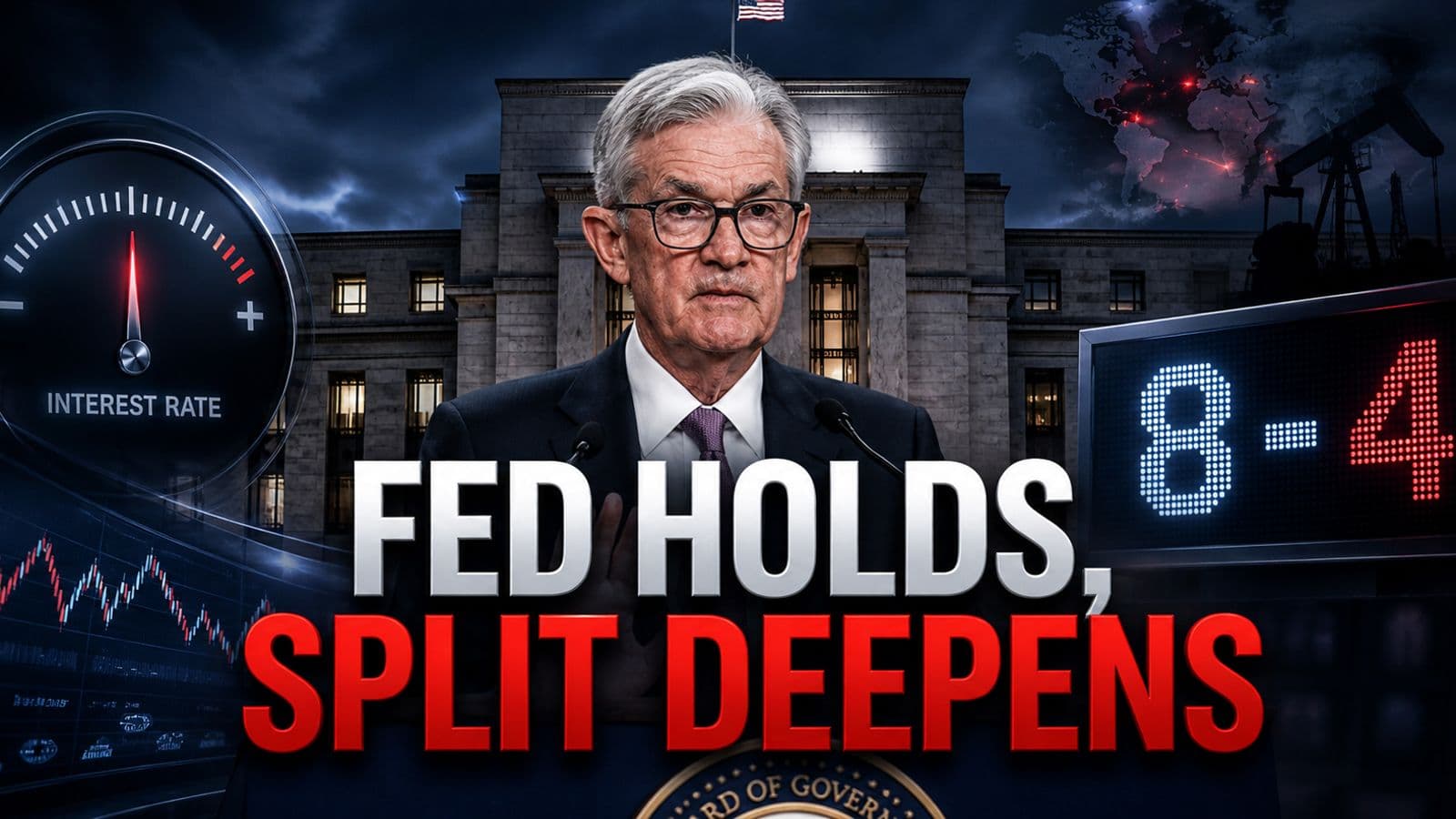
The Federal Reserve held rates steady at 3.5% to 3.75% on Wednesday. That part was expected. Everything else about the meeting was not.
The vote was 8-4 — the most dissents since 1992. One member voted to cut. Three voted to remove the easing bias from the statement. Kevin Warsh's nomination advanced through the Senate Banking Committee the same morning Powell spoke. The DOJ dropped its criminal investigation into Powell hours before the press conference. And at the end of it all, Powell confirmed he will remain on the Fed's Board of Governors for "a period of time to be determined."
For a meeting where nothing moved, an enormous amount happened.
The 8-4 Split: What Each Dissent Means
The breakdown of Wednesday's vote reveals a Federal Reserve pulling in three different directions simultaneously — and one that the incoming Warsh Fed will inherit more divided than any public statements have suggested.
Voting against the decision were Stephen Miran, who preferred to cut rates by 25 basis points at this meeting, and Beth Hammack, Neel Kashkari, and Lorie Logan, who supported maintaining the target range but objected to inclusion of an easing bias in the statement.
A clarifying note on how FOMC dissents work: formal "no" votes are recorded against the overall policy directive, which includes both the rate decision and the statement language. Hammack, Kashkari, and Logan were not voting for an immediate rate hike. Their dissent was a protest against the statement's forward signaling — a way of saying the committee should not be implying future cuts in language, given the current inflation environment. Powell addressed this directly: "There was a difference over whether to do it at this meeting, at which all but one of us agreed that the rate decision was correct."
The three hawkish dissenters are making a coherent argument: with core PCE at 3.2% and moving in the wrong direction, and energy costs feeding through the economy from a $126 oil price, keeping an easing bias in the statement is forward guidance the data no longer supports. Traders moved accordingly. CME Group's FedWatch now shows a 9.1% probability of a higher federal funds rate at the December meeting, compared to 0% a day earlier. That shift in a single session is modest in absolute terms but meaningful as a directional signal.
Powell's Final Press Conference
In his closing remarks as chair, Powell congratulated Kevin Warsh on his advancement out of the Senate Banking Committee and expressed his faith in the Fed's institutional foundations. "This is, and will be, a very normal, standard kind of transition process," he said.
Three things defined the press conference:
What he said about inflation: Powell acknowledged that core inflation is at 3.2% and "moving, albeit just a little bit, in the wrong direction," and said the committee knew "there's headline inflation coming out of the Gulf and we don't know how much that will be." That directness was notable — more candid than Powell's typical framing.
What he said about staying: Powell confirmed he will remain on the Board of Governors after his chairmanship ends — a decision without meaningful precedent since Arthur Burns stayed on for two months after his term ended in the 1970s. The DOJ dropped its criminal investigation into Powell earlier the same day, removing a pressure point Trump had used in efforts to force his departure from the board. Powell's decision to stay appears to be a statement of institutional continuity.
What he left unsaid: He offered no guidance, no hints, no signals about the rate path beyond what the statement already contained. That studied silence was itself a communication: the Fed does not know what comes next, and it will not pretend otherwise until the data clarifies.
The Iran War Overhang
The FOMC statement formally identified the war in the Middle East as a contributor to inflation and ongoing economic uncertainty — the first time a geopolitical conflict has been named in the statement since the early 2022 Russia-Ukraine energy shock.
The formal inclusion matters because it means the Fed has explicitly acknowledged it is managing a policy environment shaped by a shock it cannot control, model precisely, or respond to using conventional tools. Deutsche Bank chief US economist Matthew Luzzetti anticipated this exactly: "With uncertainty still pervasive, we expect Powell will emphasize that officials are unsure of the precise fallout from the war on the economy and monetary policy." That is precisely what the statement and press conference delivered.
What Warsh Inherits — and What to Actually Expect From Him
Kevin Warsh is now one Senate floor vote away from becoming Fed chair. He will inherit a committee sitting at 3.5% to 3.75% with no clear path to either a cut or a hike, internally divided to a degree not seen since 1992, and operating under the explicit shadow of a geopolitical shock whose duration is unknown.
The market narrative around Warsh has produced genuinely conflicting expectations, and it is worth clarifying why. Warsh built his reputation as a hawk — he dissented against the Fed's QE program in 2010, arguing it risked entrenching inflation — and he arrives at a moment when core PCE is accelerating and energy costs are pushing in the wrong direction. In that environment, the historical case for a Warsh-led easing cycle is not obvious.
What market participants who expect cuts from Warsh are actually pricing in is not a change in his inflation views, but a scenario in which the Iran war's energy shock proves transitory and the labor market weakens enough by late 2026 to justify a response. If oil prices fall sharply on a Hormuz resolution, and payroll growth slows materially, even a hawkish Fed chair has room to cut. The rate cut case for a Warsh Fed is entirely conditional on those macro developments. It is not a baseline — it is a scenario.
Three of his future colleagues already signaled, through their dissenting votes, that they want the easing bias removed from the statement before he even sits down. The more relevant question for investors is not whether Warsh is a hawk or a dove, but whether the data over the next 90 days gives him any room to move in either direction.
What This Means for Investors
The immediate takeaway from Wednesday's meeting is that the Fed has removed itself as a near-term market catalyst. There will be no cut at the June meeting unless something breaks dramatically. There will be no hike unless energy costs drive PCE materially above current levels. The Fed is on hold, genuinely uncertain, and mid-transition.
For equity markets, the rate tailwind investors have been waiting for since late 2025 is not arriving this summer. For bond markets, the new 9.1% December hike probability is a variable that did not exist 48 hours ago. For the dollar, a Fed holding steady while the ECB faces pressure to hike creates cross-currency dynamics that will take months to fully resolve.
The most actionable signal from Wednesday is to watch the trajectory of core PCE from here. If it approaches 4% before Warsh takes the chair — driven by oil pass-through to transportation, food, and services — the hawkish dissenters will have their argument validated in the data before the new leadership begins. That is the scenario that makes a 2026 hike, rather than a cut, the actual base case. Powell's farewell was measured and institutional. The environment he is handing to Kevin Warsh is neither.
Sources
- Federal Reserve — FOMC Statement, April 29, 2026: https://www.federalreserve.gov/newsevents/pressreleases/monetary20260429a.htm
- CNBC — "Fed meeting recap: Powell to stay on board — Trump's legal attacks have 'left me no choice'": https://www.cnbc.com/2026/04/29/fed-meeting-today-live-updates-warsh-powell.html
- Yahoo Finance — "Fed live updates: Trump says 'I don't care' that Chair Powell is staying at the Fed": https://finance.yahoo.com/economy/policy/live/fed-meeting-live-updates-federal-reserve-holds-interest-rates-steady-in-powells-final-meeting-as-chair-111906007.html
- CNN Business — "Powell confirms he will step aside at the end of his term as chair but remain on the Fed's board": https://www.cnn.com/2026/04/29/business/live-news/federal-reserve-interest-rate
- Reuters — "Federal Reserve holds rates steady as inflation and war uncertainty cloud outlook": https://www.reuters.com/markets/us/federal-reserve-expected-hold-rates-steady-april-2026-2026-04-29/
- Bloomberg — "Fed Holds Rate, Reveals Deep Split as Powell Says Farewell": https://www.bloomberg.com/news/articles/2026-04-29/fed-holds-rates-as-powell-delivers-farewell-amid-iran-uncertainty
- The Wall Street Journal — "Fed Holds Rates, Signals No Rush to Cut as Oil Shock Clouds Outlook": https://www.wsj.com/economy/central-banking/federal-reserve-rate-decision-april-2026
- CME FedWatch Tool — Rate probability data post-April 29 meeting: https://www.cmegroup.com/markets/interest-rates/cme-fedwatch-tool.html
- Deutsche Bank — Matthew Luzzetti pre-meeting commentary (via CNN Business): https://www.cnn.com/2026/04/29/business/live-news/federal-reserve-interest-rate
- Politico — "Senate Banking Committee advances Warsh nomination for Fed chair": https://www.politico.com/news/2026/04/29/warsh-fed-chair-senate-banking-committee-vote
Market Munchies and Mode Mobile communications are for informational purposes only, and are not a recommendation, solicitation, or research report relating to any investment strategy, security, or digital asset. All investments involve risk including the loss of principal and past performance does not guarantee future results.
Any information contained in this commentary does not purport to be a complete description of the securities, markets, or developments referred to in this material. The information has been obtained from sources considered to be reliable, but we do not guarantee that the foregoing material is accurate or complete. There is no guarantee that any statements or opinions provided herein will prove to be correct.