The GENIUS Act Just Made Yield-Bearing Stablecoins a $200 Billion Opportunity
📜 GENIUS Act Creates Legal Pathway for Third-Party Stablecoin Yields The landmark GENIUS Act passed in mid-2025 fundamentally reshaped stablecoin regulation by drawing a clear line between issuers and third-party protocols. While the legislation prohibits stablecoin issuers…
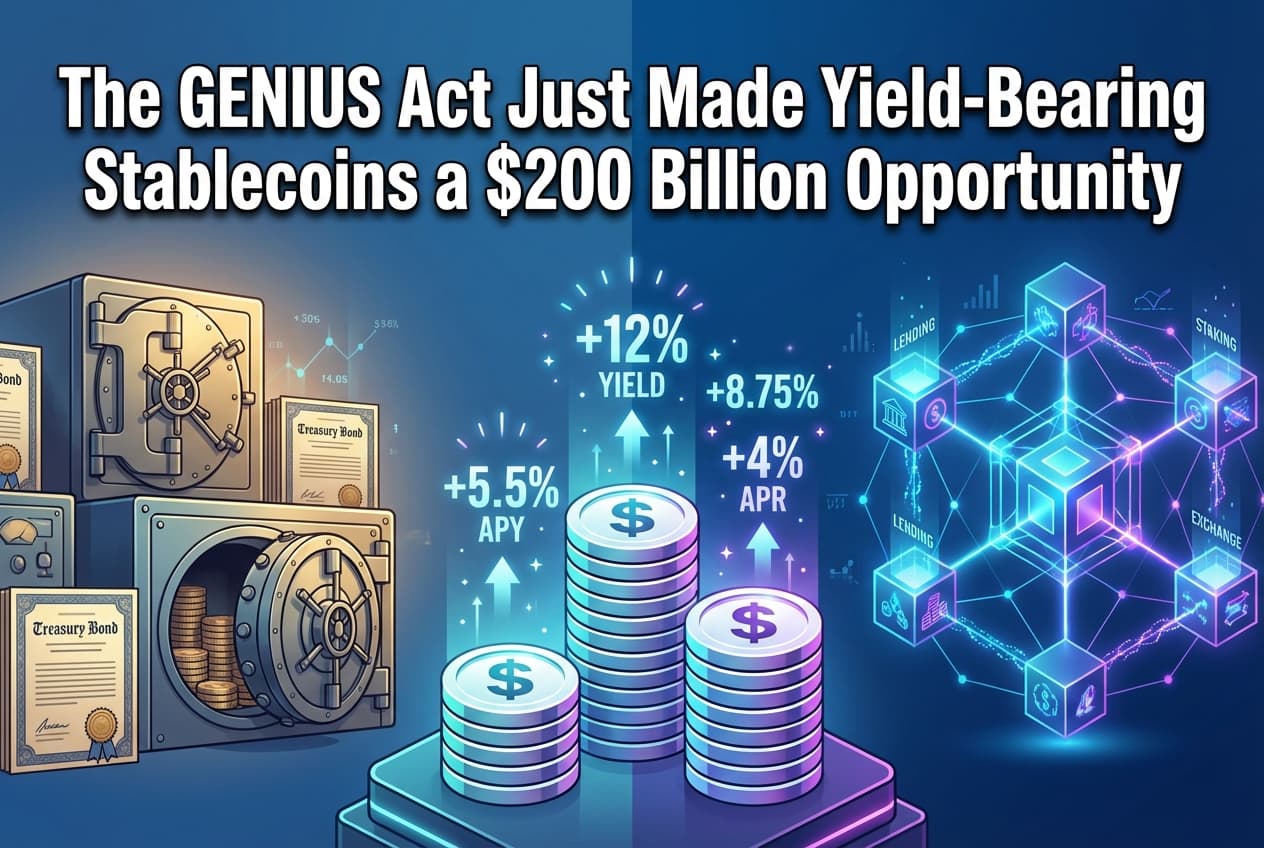
📜 GENIUS Act Creates Legal Pathway for Third-Party Stablecoin Yields
The landmark GENIUS Act passed in mid-2025 fundamentally reshaped stablecoin regulation by drawing a clear line between issuers and third-party protocols. While the legislation prohibits stablecoin issuers from directly paying interest to holders, it permits DeFi protocols and digital asset intermediaries to offer rewards independently. This distinction has unlocked a massive opportunity for yield-bearing variants like USDe and USDY to flourish without regulatory friction. According to Benzinga's analysis, compliant stablecoins now form the backbone of DeFi liquidity, processing more on-chain value than Bitcoin and Ethereum combined. For investors, this regulatory clarity transforms yield-bearing stablecoins from speculative instruments into legitimate financial tools with predictable compliance frameworks. The Senate Banking Committee's recent amendments further clarified that activity-based rewards including liquidity provision, staking, and protocol participation remain fully permissible, provided issuers maintain arm's-length relationships with reward programs.
💰 JPMorgan Predicts 50% Market Share for Yield Variants by Year-End
Wall Street's research divisions are taking notice of the yield-bearing stablecoin sector's explosive trajectory. JPMorgan analysts project that yield-bearing variants could capture 50% of the total stablecoin market by the end of 2026, representing a seismic shift from zero-yield payment tokens to capital-efficient instruments. The High Risk Education analysis shows the yield-bearing segment expanding from $1.5 billion to $11 billion in less than a year. This growth reflects institutional demand for Treasury-linked onchain cash equivalents that offer 4-5% yields from underlying government bonds. Tokenized Treasuries on-chain have doubled to over $18 billion, with major banks like Goldman Sachs and BNY Mellon entering the space through regulated custody and tokenization services. For retail and institutional investors alike, this evolution means stablecoins are no longer just trading pairs but productive assets that compete directly with traditional money market funds while maintaining blockchain composability and 24/7 settlement capabilities.
🏦 USDe and USDY Lead the Stablecoin 2.0 Category Expansion
Two protocols have emerged as category leaders in the yield-bearing stablecoin space. Ethena's USDe employs a delta-neutral strategy that holds staked ETH while simultaneously opening short futures positions, neutralizing price volatility while capturing funding rates paid by derivatives traders. This synthetic dollar approach has proven popular in offshore markets despite facing restrictions in strict jurisdictions like the EU and US. Meanwhile, Ondo Finance's USDY takes a more conservative approach, representing shares in a Special Purpose Vehicle holding Money Market Funds and short-term US Treasuries. The Kanalcoin report highlights how these instruments fundamentally differ from traditional payment stablecoins by passing through actual yield from underlying assets rather than relying on protocol emissions or governance tokens. For investors, the key distinction lies in risk profiles. USDY carries liquidity risk with T+1 redemption windows but benefits from transparent reserve backing, while USDe offers higher yields through derivatives markets but introduces smart contract and counterparty risks inherent to perpetual futures strategies.
⚖️ The Yield Loophole Becomes 2026's Hottest Compliance Debate
Regulatory scrutiny is intensifying around what industry insiders call the yield loophole. While the GENIUS Act explicitly prohibits issuers from paying interest, third-party DeFi protocols continue offering substantial rewards on compliant stablecoins through liquidity mining, governance participation, and lending markets. Regulators at the SEC and CFTC are examining whether these third-party wrapper programs constitute unregistered securities offerings, particularly when protocols use native governance tokens as reward mechanisms. The recent Senate Banking Committee amendments attempt to address this gray area by requiring disclosure of who actually pays yields and prohibiting marketing that suggests stablecoins themselves generate returns. For DeFi platforms like Aave, Compound, and Morpho Vaults that automatically allocate stablecoin deposits into lending markets, compliance teams must navigate the fine line between permissible activity-based rewards and prohibited interest payments. Investors should monitor enforcement actions closely, as regulatory clarification could reshape which yield strategies remain viable and which face restrictions or registration requirements.
🌐 Market Cap Trajectory Points to $400 Billion Milestone This Year
The total stablecoin market is approaching a historic inflection point, with projections showing the market cap breaching $400 billion in 2026 from roughly $250 billion in late 2025. This 60% growth is driven not just by increased trading volume but by fundamental shifts in how institutions and retail users hold dollar-denominated assets. Eight out of ten major US banks now offer cryptocurrency custody or stablecoin services, a dramatic reversal from just two years ago when most legacy financial institutions avoided the sector entirely. Payment rails are evolving rapidly as stablecoins become embedded in Web2 fintech applications, with Stripe and Shopify integrating backend settlement through USDC and PYUSD. For small and medium businesses, cross-border payments via stablecoins have effectively killed traditional SWIFT transfers due to superior speed and cost efficiency. The Stablecoin Insider framework suggests investors should view this expansion not as speculative growth but as stablecoins becoming operational finance infrastructure, replacing inefficient legacy systems with programmable, 24/7 settlement networks that offer superior transparency and auditability compared to correspondent banking arrangements.
🎯 Investor Implications: From Speculation to Infrastructure Allocation
The maturation of yield-bearing stablecoins represents a fundamental shift in how digital assets should be valued and allocated within portfolios. Rather than viewing stablecoins purely as trading instruments or speculative plays, investors increasingly treat them as core infrastructure holdings that generate predictable returns while maintaining dollar stability. The bifurcation between payment rails and hybrid finance instruments creates distinct risk-return profiles. Payment stablecoins like USDC and PYUSD offer zero yield but maximum liquidity and regulatory compliance, suitable for transaction settlements and short-term holdings. Yield-bearing variants like USDY provide Treasury-equivalent returns of 4-5% with T+1 liquidity, competing directly with money market funds but with blockchain composability. Synthetic dollars like USDe offer higher yields through derivatives strategies but require sophisticated risk assessment of funding rate volatility and smart contract security. For institutional allocators, the key decision framework involves balancing regulatory comfort, yield objectives, and liquidity requirements across these categories. As DeFi protocols shift from passive hold-to-earn models toward activity-based incentives, investors must actively manage positions rather than assuming set-and-forget returns. The winners in this environment will be those who understand the nuanced differences between compliant payment stablecoins, Treasury-backed yield instruments, and derivatives-based synthetic dollars, allocating capital appropriately across the risk spectrum while monitoring evolving regulatory guidance from the SEC, CFTC, and banking regulators.
Sources
https://www.benzinga.com/Opinion/26/01/49812170/stablecoin-regulation-after-the-genius-act-what-it-means-for-defi-liquidity-in-2026 https://www.kanalcoin.com/yield-bearing-stablecoins-2025/ https://www.highriskeducation.com/regulatory/stablecoins-in-2026-the-rise-of-stablecoin-20 https://stablecoininsider.org/stablecoin-yield-strategies-2026/ https://www.dwt.com/blogs/financial-services-law-advisor/2026/01/responsible-financial-innovation-act-amendment
Market Munchies and Mode Mobile communications are for informational purposes only, and are not a recommendation, solicitation, or research report relating to any investment strategy, security, or digital asset. All investments involve risk including the loss of principal and past performance does not guarantee future results.
Any information contained in this commentary does not purport to be a complete description of the securities, markets, or developments referred to in this material. The information has been obtained from sources considered to be reliable, but we do not guarantee that the foregoing material is accurate or complete. There is no guarantee that any statements or opinions provided herein will prove to be correct.
Get fresh insights, breaking news, and hidden gems in the world of crypto—delivered straight to your inbox with our Crypto Cookies newsletter. Don't miss out—sign up now and get your first bite of insider knowledge!