The Global Credit Squeeze Investors Keep Underestimating — And Why It Matters Now
Why Funding Friction Is Quietly Redrawing the Next Market Cycle Credit might be invisible, but it behaves a lot like oxygen—markets breathe easier when it flows freely. Lately, though, the global system feels a little short-winded. SME finance gaps , household credit…
Why Funding Friction Is Quietly Redrawing the Next Market Cycle
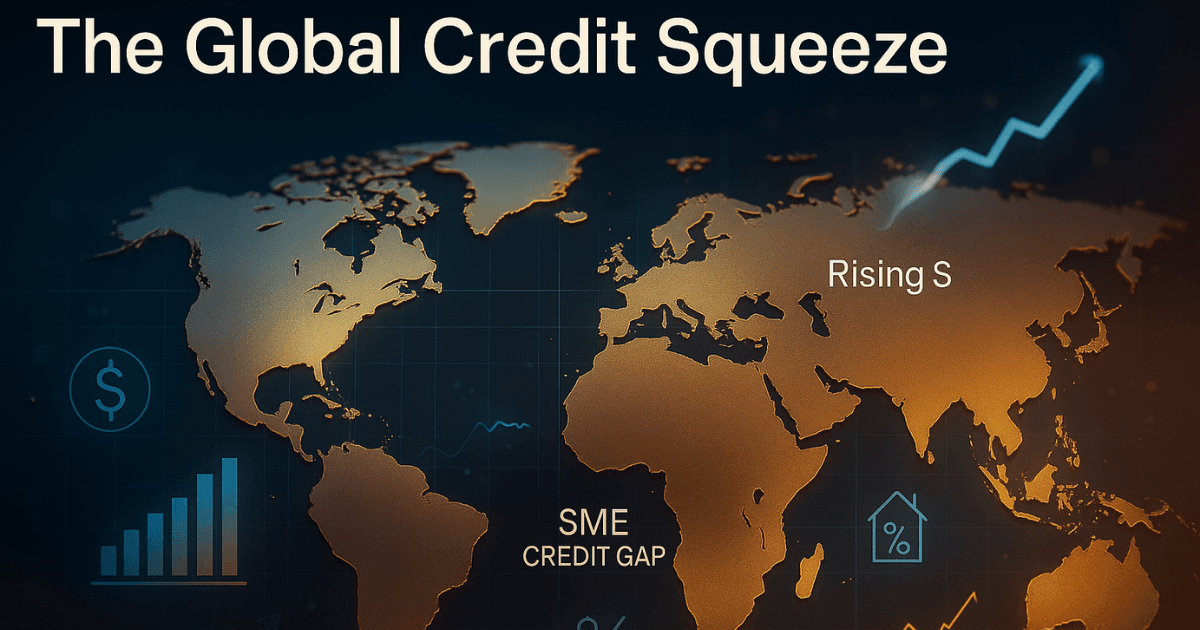
Credit might be invisible, but it behaves a lot like oxygen—markets breathe easier when it flows freely. Lately, though, the global system feels a little short-winded. SME finance gaps, household credit affordability, emerging-market sovereign debt stress, and persistent credit lending gaps are shaping the next phase of market behavior more than investors may realize. Across small business lending constraints, sovereign borrowing costs in emerging markets, and widening UK household financial wellbeing divides, the world is facing a recurring theme: capital is becoming harder to access just when demand is accelerating. Let’s unpack what’s happening underneath the surface—and why it matters to both cautious and opportunistic investors.
💼 SMEs Are Still Running on Empty: A Trillion-Dollar Credit Vacuum
Small and mid-sized firms are the backbone of employment and innovation, yet the global SME credit shortage remains astonishingly large. According to World Bank-linked studies, the SME finance gap now stands at around US$5.2 trillion in unmet credit demand, making it one of the most persistent business financing gaps globally. In developing nations, the SME loan gap is equivalent to roughly 10–15% of GDP, reflecting deep-seated structural challenges, including higher collateral requirements, risk-based pricing, and a banking system that is still slow to adopt inclusive lending models. Even in developed markets, banks remain cautious, thereby widening the small business financing gap rather than narrowing it. In the UK, nearly half of SME leaders feel optimistic about future growth; however, this optimism is continually being hindered by lending constraints and rising operational costs. It’s enthusiasm with a seatbelt on. 🧭 Smart Capital Signal: A large credit lending gap reduces productivity gains and slows expansion across mid-cap ecosystems. For investors, businesses that depend heavily on working-capital financing or refinancing cycles may face slower earnings momentum ahead.
🌍 Emerging Markets: Sovereign Yields Rise Faster Than Patience
In emerging economies, the credit tension is more dramatic. Rising global rates have pushed sovereign borrowing costs higher, accelerating emerging market sovereign debt stress and tightening domestic credit channels. Recent IMF discussions reveal three consistent vulnerabilities:
- Elevated sovereign yields are creating refinancing pressure
- Shrinking fiscal buffers, limiting support for private credit
- Reduced domestic lending appetite, squeezing local firms
In markets like Senegal, discussions around debt transparency and fiscal consolidation underscore the delicate nature of the situation. Higher yields don’t just burden governments—they cascade into the private sector, raising borrowing costs for firms already battling volatility. When emerging market sovereign debt stress increases, credit access for SMEs in those economies deteriorates even more rapidly. It’s a chain reaction investors often overlook. 🎯 Tactical Insight: Investors holding EM bonds, bank equities, or infrastructure projects should monitor refinancing risk, which now matters as much as headline GDP growth. Rising yields paired with slower lending cycles can turn small cracks into structural limitations.
🏠 UK Households: A Financial Divide That’s Becoming Structural
The UK is entering a credit story of its own: the widening household credit affordability gap. According to S&P Global surveys, the UK household financial well-being split between higher-income and lower-income families is widening, shaping consumption and borrowing patterns in subtle but important ways. Key indicators reveal:
- Sharp divergence in economic well-being scores
- Higher vulnerability to consumer credit stress in the UK among low-income households
- Reduced borrowing capacity as inflation continues to erode disposable income
Lower-income families are cutting back, delaying borrowing decisions, and facing tighter credit screening. Higher-income households, meanwhile, remain relatively insulated, which widens both spending patterns and credit outcomes. 📡 Investor Radar: For credit-exposed sectors and retail businesses tied to discretionary spending, this growing divide may reshape revenue expectations. Watch portfolios tied to lower-income borrower segments, where risk may rise faster than pricing models anticipate.
🔗 The Golden Thread Binding All Credit Stress Together
From SME finance gaps to emerging-market sovereign debt stress to widening household credit affordability challenges, the global economy is grappling with one interconnected truth:
Capital is more selective than ever.
- SMEs face a persistent global shortage of SME credit.
- Emerging markets battle rising sovereign borrowing costs
- UK households confront the realities of income-linked credit access.
This isn’t a crisis—it’s a global long-tail credit gap quietly shaping future growth. When credit tightens simultaneously across businesses, households, and governments, the economy doesn’t break—it softens. Edges crack before the center does.
✨ Final Serving: Credit Doesn’t Crash Markets—It Slowly Rewrites Them
A Premium Reflection for Long-Lens Investors
Nothing here screams panic. However, many whispers are out of balance. Small business lending constraints limit innovation. Emerging-market debt pressure narrows fiscal space. UK household financial stress slows down consumption. This is how cycles shift: not through shocks, but through slow, selective capital tightening. For strategic investors, this moment offers opportunity—understanding where credit is scarce helps identify where alternative finance, fintech, sovereign reform, or counter-cyclical lending may lead the next wave of returns. The credit world isn’t collapsing. It’s evolving. And the investors who listen closely will move before the market realizes the script has changed.
🔍 Sources
- World Bank – SME Finance Overview
- Global Finance – SME Finance Gap
- World Bank Blog – MSME Financing in India
- OECD – SME Financing Scoreboard 2025
- IMF – Emerging Market Sovereign Debt Report
- IMF Press Briefing – Dakar Mission
- S&P Global – UK Household Financial Disparity
Market Munchies and Mode Mobile communications are for informational purposes only, and are not a recommendation, solicitation, or research report relating to any investment strategy, security, or digital asset. All investments involve risk including the loss of principal and past performance does not guarantee future results.
Any information contained in this commentary does not purport to be a complete description of the securities, markets, or developments referred to in this material. The information has been obtained from sources considered to be reliable, but we do not guarantee that the foregoing material is accurate or complete. There is no guarantee that any statements or opinions provided herein will prove to be correct.