The Market Wants a Ceasefire But Oil Keeps Calling the Shots
Wednesday’s bounce looked encouraging, but it always felt a little too eager. Stocks finished higher as investors grabbed onto signs that the U.S. and Iran might be inching toward some kind of off-ramp, and oil pulled back enough to give the market a breather. The problem was…
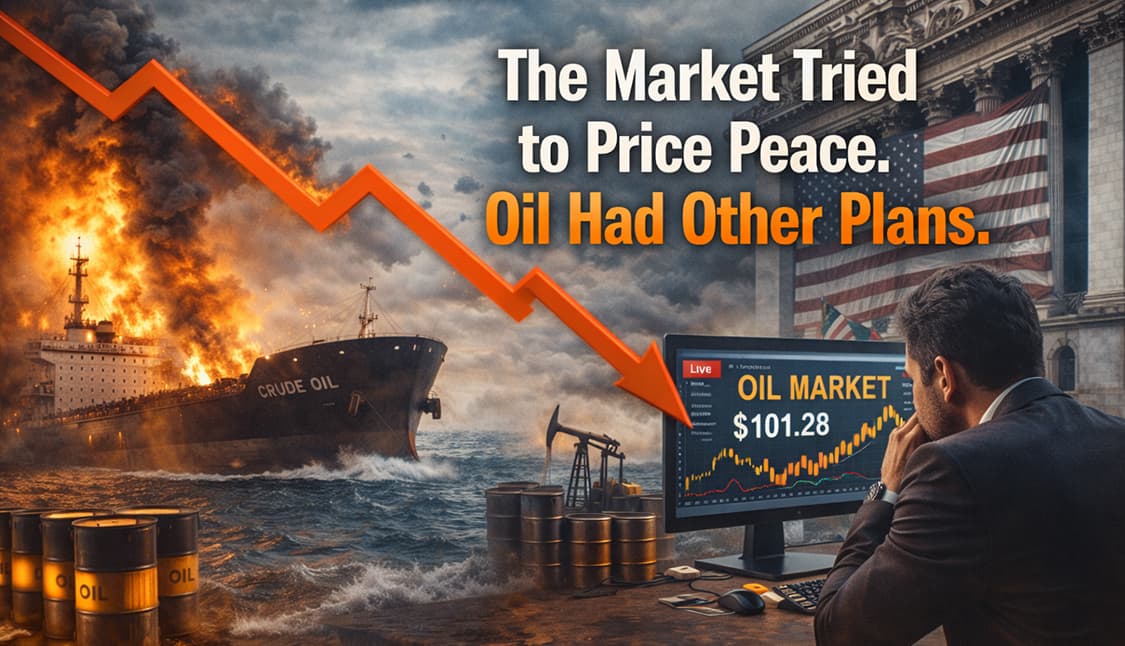
Wednesday’s bounce looked encouraging, but it always felt a little too eager. Stocks finished higher as investors grabbed onto signs that the U.S. and Iran might be inching toward some kind of off-ramp, and oil pulled back enough to give the market a breather. The problem was that the whole move depended on hope more than proof. It was a relief trade built on the idea that diplomacy was getting real, even though the facts on the ground were still muddy.
Thursday’s open has been a reminder that hope and progress are not the same thing. Iran says it is reviewing the U.S. proposal, but insists there are no talks. Trump is publicly pushing Tehran to move faster. Oil has pushed back above $100, and the major U.S. averages are under pressure again in morning trading, with tech taking the harder hit. The tone is not full panic, but it is clearly risk-off again.
That matters because the market is no longer just reacting to war headlines. It is reacting to what higher energy prices do to inflation, yields, Fed expectations, and eventually profit margins. Weekly jobless claims stayed low enough to say the labor market is still standing up fine. But that is not the point. The point is that a market can tolerate a stable labor backdrop and still get repriced fast if oil starts making “higher for longer” sound plausible again.
Stock of Interest Today: Carnival Corporation (CCL)
Carnival is one of the cleanest single-stock ways to read this market right now. It is not because the company has direct exposure to the Middle East. It is because Carnival sits right at the intersection of two things investors suddenly care about a lot again: fuel costs and consumer resilience. Reuters reported that Carnival is the only major U.S. cruise operator without fuel hedges, which leaves it more exposed than peers if oil stays elevated. In a tape like this, that makes the stock less of a travel story and more of a real-time stress test for margin durability.
What makes that especially interesting is that Carnival did not come into this stretch as a broken story. Quite the opposite. The company finished 2025 with record revenue, record adjusted net income of $3.1 billion, and record adjusted EBITDA, all signs that demand had stayed firm and the turnaround still had real legs. That is why the stock matters here. This is not a company trying to claw its way back to relevance. This is a company that had been executing well, and is now getting hit by a macro variable it cannot control.
The sensitivity here is not small enough to wave away. Reuters noted that a 10% move in fuel cost per metric ton would trim Carnival’s 2026 net income by $145 million. That is the kind of number investors ignore when oil is drifting lower and obsess over when oil is back above a psychologically important threshold. Cheap-looking stocks stay cheap when the market starts worrying that the “E” in P/E is about to get marked down. Carnival is not just exposed to oil. It is exposed in a way that makes the next earnings commentary matter more than usual.
That is the setup heading into Friday’s first-quarter report. Investors do not need management to make the geopolitical story disappear. They need reassurance that bookings are holding up, pricing is still healthy, and the fuel hit is painful but manageable rather than thesis-breaking. That is a much narrower question, but it is the right one. In this market, the companies that hold up are the ones that can prove the macro pressure is a speed bump, not a structural problem. Carnival gets a chance to make that case tomorrow.
Current price: $25.43Analyst expectation: $36.36
Five Market Themes to Watch
The market is trading two very different instincts at once. The first is the urge to buy any sign that this conflict might cool off, because lower oil would immediately ease pressure on inflation, rates, and margin-sensitive sectors. The second is the growing suspicion that every relief bounce is arriving before the actual evidence does. That tension is why the market can feel deceptively calm one day and visibly tense the next.
What made Wednesday useful was that it showed what investors want to believe. What makes Thursday more useful is that it is showing what they are willing to believe once the first emotional reaction wears off. Right now, the market is acting like it wants a diplomatic breakthrough, but does not trust one enough to price it in for long.
1) Tehran is reviewing the proposal, but it is not negotiating
The market got a little ahead of itself on Wednesday. There is a big difference between a government reviewing a proposal and a government actively negotiating its way toward a deal. Iran’s line has been clear: it is looking at the U.S. proposal, but it is not in talks. That distinction matters because markets had started trading as if the diplomacy had already moved into a more constructive phase than it actually has.
Trump’s public push for Tehran to “get serious” only sharpens that disconnect. Politically, that message is easy to understand. For markets, it mostly reinforces that the timeline is tight, the messaging is messy, and the gap between public signaling and real progress is still wide. When one side says talks are happening and the other side says they are not, investors usually default to pricing the commodity first and the optimism later.
Investor insight: Relief rallies built on ambiguous diplomacy can be tradeable, but they are usually a weak foundation for real conviction.
2) The five-day pause has become the market’s clock
One reason the market could rally on Wednesday is that Trump’s five-day postponement of strikes on Iranian energy infrastructure gave investors a window to imagine the story getting better. A pause creates room for optimism, especially when the market is desperate for any catalyst that might pull oil lower. But that same pause also creates a deadline, and deadlines have a habit of becoming the only thing anyone watches.
Now that the deadline is getting closer, the market is no longer trading the pause itself. It is trading what might happen when the pause expires. That is why the mood feels heavier again this morning. Even if no new escalation happens right away, investors still have to decide whether they want to hold fresh risk into a window where one headline can hit oil, inflation expectations, and equities all at once.
Investor insight: Deadlines matter less because of what they guarantee and more because of the decisions they force investors to make before they pass.
3) Oil is back in charge
The easiest way to understand the last two sessions is simple: oil fell, stocks bounced; oil rose, stocks rolled back over. That does not explain every move, but it explains enough. Reuters reported that Brent pushed back above $100 as investors worried about prolonged disruption around Hormuz, and Thursday’s open has kept that same logic intact. When oil is moving like this, it becomes the market’s lead narrator.
And this is not just a crude chart story. Barclays warned that a prolonged Hormuz disruption could remove 13 to 14 million barrels per day from global supply, while the OECD said the conflict has already erased its global growth upgrade and fanned inflation risks. Once oil becomes the dominant macro variable, every sector starts getting judged through the same lens: Who has pricing power? Who has hedges? Who is exposed? That is when the market stops being broad and starts getting very selective.
Investor insight: When oil takes over the macro conversation, the winners are rarely the flashiest names. They are usually the ones with protection, leverage to energy, or the ability to pass costs through.
4) Gold is sending a very strange message
One of the more telling quirks of this market is that gold is not behaving the way a textbook geopolitical panic says it should. Reuters reported that bullion dropped more than 2% as oil surged, the dollar strengthened, and Treasury yields moved higher. That is not the classic “run to safety” script. It is something more uncomfortable.
What gold is really signaling here is that the market’s deeper fear is not just war. It is inflation and policy. In a cleaner risk-off environment, gold usually catches a stronger bid. In this one, traders are looking at higher energy costs and thinking about tighter financial conditions, fewer rate cuts, and a stronger dollar. That is a very different kind of stress. It says the market is worried less about a temporary scare and more about a macro backdrop that gets more restrictive the longer this drags on.
Investor insight: When the usual safe havens stop acting like safe havens, it is often a sign that the real problem is policy risk dressed up as geopolitical risk.
5) Deutsche Bank’s warning is the one worth keeping in mind
The cleanest read on the mood may have come from Deutsche Bank’s Jim Reid, who said market attention is quickly turning to the end of Trump’s five-day deadline and that the prospect of fresh escalation remains top of mind. That is not a dramatic call, but it is an accurate one. It captures why Thursday feels more sober than Wednesday, even without some giant new shock.
Investors do not need a full escalation to stay cautious. They just need enough uncertainty to keep oil elevated and confidence shaky. That is why the market can rally on hope one day and give most of the emotional move back the next. The path to a cleaner advance probably does not run through more mixed messaging. It runs through a real easing in energy stress, or at the very least evidence that companies can absorb it without cutting into earnings power. Until then, caution is not pessimism. It is just respecting what the tape is already saying.
Investor insight: The market does not need perfect certainty to move higher. It just needs something more durable than crossed wires and wishful thinking.
Bottom Line
Wednesday’s rally was the market trying to price the best-case version of this story. Thursday’s open looks more like the market pricing the version that is actually in front of it. Oil is still elevated. Diplomacy is still fuzzy. And the pressure is already spilling out of energy and into rates, margins, and sentiment.
That is why Carnival matters. Not because it explains the whole market, but because it gives you a clean, company-level way to watch macro stress turn into something tangible. If management can convince investors that the fuel hit is manageable and demand is still intact, the stock can work. If not, it becomes a reminder of what this tape is punishing most aggressively right now: businesses that are still fundamentally solid, but suddenly look a lot more exposed than they did a week ago.
Sources:
- https://www.reuters.com/business/energy/global-markets-global-markets-2026-03-25/
- https://www.reuters.com/business/us-stock-futures-slip-middle-east-war-de-escalation-remains-uncertain-2026-03-26/
- https://www.reuters.com/world/asia-pacific/iran-says-it-is-reviewing-us-ceasefire-plan-no-talks-trump-says-tehran-leaders-2026-03-26/
- https://www.reuters.com/business/energy/us-oil-prices-rise-investors-assess-middle-east-de-escalation-2026-03-25/
- https://www.reuters.com/world/us/us-weekly-jobless-claims-increase-slightly-2026-03-26/
- https://www.reuters.com/world/india/gold-steady-markets-assess-mideast-ceasefire-talks-2026-03-26/
- https://www.reuters.com/world/china/oecd-iran-war-erases-global-growth-upgrade-fans-inflation-2026-03-26/
- https://www.reuters.com/business/energy/barclays-sees-1314-million-bpd-oil-supply-loss-prolonged-hormuz-disruption-2026-03-26/
- https://www.reuters.com/business/autos-transportation/us-cruises-sail-into-higher-costs-oil-prices-rally-carnival-could-be-hardest-hit-2026-03-16/
- https://www.carnivalcorp.com/wp-content/uploads/2025/03/2025-4Q-Earnings-Release-Final-Draft.pdf
- https://www.carnivalcorp.com/event/first-quarter-2026-earnings/
- https://www.marketwatch.com/investing/stock/ccl/analystestimates
- https://www.barrons.com/livecoverage/stock-market-news-today-032626/card/stock-futures-slide-as-iran-rebuffs-trump-mCSXOqPCiuwrh5awTIWf
Market Munchies and Mode Mobile communications are for informational purposes only, and are not a recommendation, solicitation, or research report relating to any investment strategy, security, or digital asset. All investments involve risk including the loss of principal and past performance does not guarantee future results.
Any information contained in this commentary does not purport to be a complete description of the securities, markets, or developments referred to in this material. The information has been obtained from sources considered to be reliable, but we do not guarantee that the foregoing material is accurate or complete. There is no guarantee that any statements or opinions provided herein will prove to be correct.