The New Market Regime: Why Headlines Now Move Billions
What Changed Overnight—And Why Markets Suddenly Feel… Unstable Have you noticed how markets don’t ease into moves anymore? They jump. They snap. They reverse—sometimes within hours. One moment, oil surges. Then a whisper of diplomacy hits the wires, and everything flips—stocks…
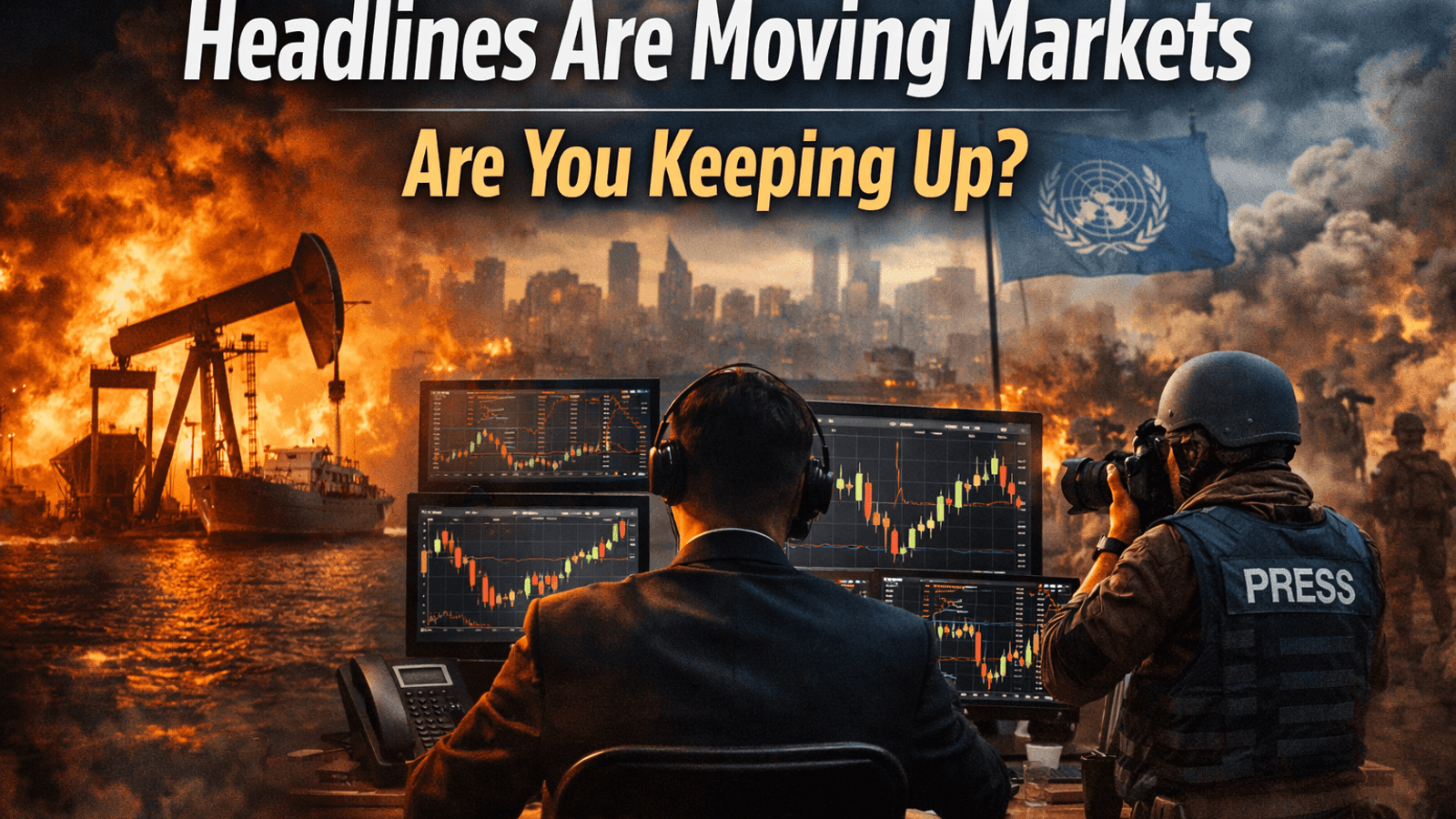
What Changed Overnight—And Why Markets Suddenly Feel… Unstable Have you noticed how markets don’t ease into moves anymore? They jump. They snap. They reverse—sometimes within hours. One moment, oil surges. Then a whisper of diplomacy hits the wires, and everything flips—stocks rally. Oil cools. Then—just as quickly—another headline undoes it all. If it feels chaotic, it’s because the rules have changed. You’re not just watching markets anymore. You’re watching a new regime—where headlines move billions faster than fundamentals ever could.
🚢 The Supply Chain Squeeze Isn’t Coming—It’s Already Here
At first glance, rising oil prices look like a familiar story. But zoom out, and you’ll see something more interconnected—and more fragile. Here’s what’s quietly tightening:
- Oil supply constraints through key global routes
- Shipping disruptions are forcing costly detours
- Fertilizer exports are slowing, pressuring agriculture
Individually, these are manageable. Together? They form a chain reaction. Oil ↑ → Freight ↑ → Fertilizer ↑ → Food ↑ → Inflation ↑ That pipeline is no longer theoretical. It’s forming in real time. And unlike demand-driven inflation, this kind of pressure doesn’t fade quickly—it spreads.
Smart Capital Signal
Watch for stress in input-sensitive sectors—food producers, transport-heavy businesses, and import-reliant economies. These tend to absorb the shock before it shows up in headline inflation.
📉 From Smooth Trends to Sudden Swings
Not long ago, markets had a rhythm. You had a narrative: rate cuts coming, inflation cooling, growth stabilizing. It wasn’t perfect, but it was predictable. That rhythm is gone. Now, markets behave differently:
- Sharp selloffs without warning
- Sudden rallies without confirmation
- Price action driven by events, not data
This isn’t random volatility. It’s a regime shift. You’ve moved from:
- Trend markets → Reaction markets
- Data-driven → Headline-driven
And that changes everything about how risk behaves.
Investor Radar
In this environment, conviction alone isn’t enough. You need flexibility, liquidity, and discipline—because markets can invalidate a thesis faster than before.
📊 When Headlines Become the Market
Here’s where things get interesting—and slightly uncomfortable. Markets are now reacting to possibilities, not just realities. A hint of negotiation? → Risk assets rally. A sign of escalation? → Oil spikes, equities drop. All within a single session. It’s almost binary:
- De-escalation = risk-on
- Escalation = risk-off
This creates a market where:
- Moves are faster
- Reversals are sharper
- Patience is constantly tested
And importantly, it compresses time. What used to play out over weeks now happens in hours.
Tactical Insight
You don’t need to chase every headline. But ignoring them completely? That’s no longer an option. In this regime, awareness is alpha.
🍽️ The Holiday Calm… That Might Not Last
Here’s the subtle twist. On the surface, parts of the economy still look steady. Spending holds up. Activity feels normal—even optimistic- for people. But underneath?
- Energy costs are climbing.
- Transport margins are tightening.
- Food input pressures are building quietly.
This is the kind of pressure that doesn’t show up immediately—but once it does, it tends to arrive all at once. Think of it like a well-run kitchen during a holiday rush. Everything looks smooth—until the backlog hits.
Portfolio Perspective
Short-term resilience can mask long-term pressure. If costs continue rising, margins compress—and eventually, earnings follow. That lag is where positioning matters most.
🧠 The Bigger Shift Most Investors Are Missing
This isn’t just about oil, or shipping, or even geopolitics. It’s about how markets are processing information differently. You’re entering a phase where
- Certainty is lower
- Outcomes are more binary
- Reactions are faster and more emotional
It’s a system under tension. And historically, when systems tighten like this, markets don’t drift—they snap, reprice, and reset.
🔚 Final Thought: Are You Trading Headlines—or Understanding the Regime?
Here’s the question that matters now: Are you reacting to each move… Or stepping back to understand what’s changed underneath? Because this environment rewards a different kind of investor. Not the fastest. Not the loudest. But the one who sees early that
- This isn’t temporary volatility
- This is a structural shift in how markets move
And once you recognize that, your strategy changes. You become less reactive. More selective. And a lot harder to shake out. Because in a world where headlines move billions… Understanding the system is the real edge.
Sources
- Reuters – Oil supply risks & Strait of Hormuz disruption
- Reuters – Energy executives warn on long-term supply damage
- Business Insider – Global economic impact of Middle East conflict
- Saxo Bank – Fertilizer supply disruption and food risk analysis
- FarmDoc (University of Illinois) – Fertilizer supply chain risks
- Barron’s – Market behavior under geopolitical stress
- Wall Street Journal – Oil & equity reactions to geopolitical developments
- TFG Global – Freight market disruption update
Market Munchies and Mode Mobile communications are for informational purposes only, and are not a recommendation, solicitation, or research report relating to any investment strategy, security, or digital asset. All investments involve risk including the loss of principal and past performance does not guarantee future results.
Any information contained in this commentary does not purport to be a complete description of the securities, markets, or developments referred to in this material. The information has been obtained from sources considered to be reliable, but we do not guarantee that the foregoing material is accurate or complete. There is no guarantee that any statements or opinions provided herein will prove to be correct.