The Pressure Points Investors Can’t Ignore
Wednesday’s close looked manageable on the surface, but the underlying message was less comforting. Stocks were mixed to weaker, while oil and Treasury yields pushed higher, which suggested the market was already starting to take the energy shock more seriously than the index…
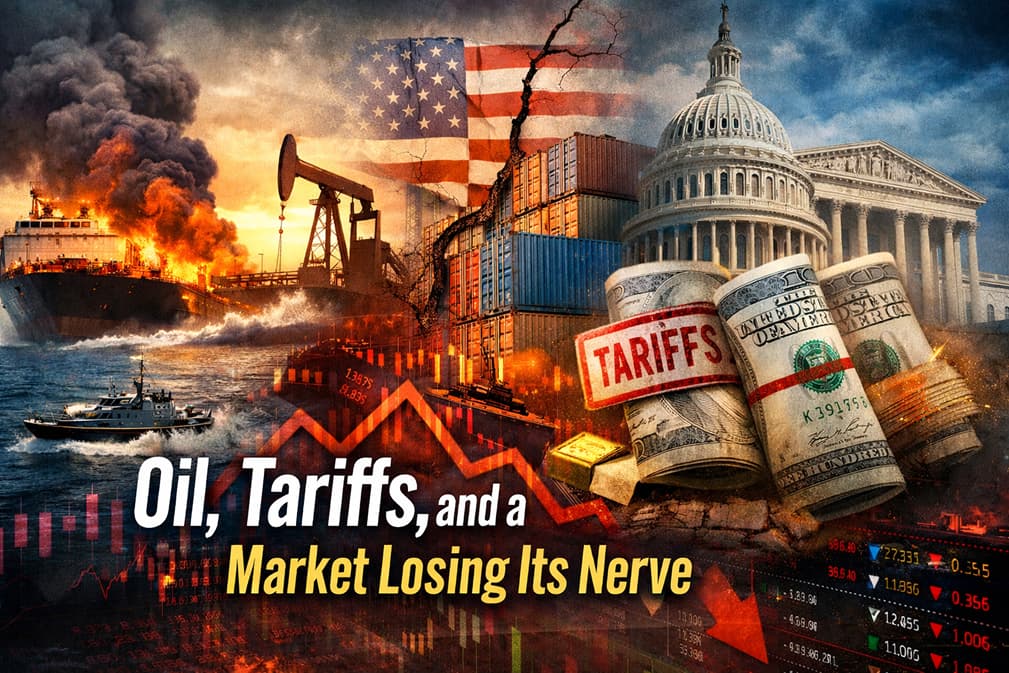
Wednesday’s close looked manageable on the surface, but the underlying message was less comforting. Stocks were mixed to weaker, while oil and Treasury yields pushed higher, which suggested the market was already starting to take the energy shock more seriously than the index tape alone made it seem. Reuters noted that global shares slipped and benchmark yields jumped as February inflation came in as expected and crude resumed its climb with the Iran conflict still unresolved.
That pressure intensified as Thursday trading began. Fresh attacks on commercial shipping in and around the Strait of Hormuz sent oil back toward $100 a barrel and pulled major U.S. indexes lower at the open. Reuters reported that the move in crude also forced traders to scale back expectations for Fed rate cuts, which is exactly why this story matters beyond geopolitics. It is no longer just about headlines out of the Gulf. It is about inflation, rates, and growth getting tangled together again.
The deeper issue is that the market now has to decide whether this is a short-lived shock or the start of a more durable repricing across energy, shipping, and trade-sensitive assets.
Stock of Interest Today: Pagaya Technologies (PGY)
Pagaya is not a clean, uncomplicated growth story right now. It is an AI-driven lending platform that increasingly looks like a profitability and balance-sheet story wrapped in fintech volatility. The company’s fourth-quarter and full-year 2025 results were strong in the ways that matter for a name like this. Pagaya reported $34 million of GAAP net income in the fourth quarter, up $272 million year over year, on total revenue and other income of $335 million, up 20%. It also finished the year with $288 million in cash and cash equivalents and $945 million in investments in loans and securities. That is not the profile of a business scrambling for credibility. It is the profile of a company that has started to build a real financial floor under the story.
The reason the stock remains interesting is that the market still does not seem fully sold on that improvement. For 2026, management guided for network volume of $11.25 billion to $13 billion and GAAP net income of $100 million to $150 million, which implies the return to profitability is not being framed as a one-quarter fluke. Even so, Yahoo Finance showed PGY trading around $11.10, while analyst estimates there pointed to an average target of $27.55. Zacks also showed the same $27.55 average price target. That gap does not prove the stock is mispriced, but it does show how wide the divide still is between current sentiment and modeled upside.
The second reason Pagaya stands out is that the macro backdrop may now be doing some of the sorting for investors. When oil is rising, inflation fears are firming, and rate-cut expectations are slipping, the market tends to become less patient with companies that only offer a narrative. Pagaya at least has earnings, liquidity, and forward guidance that still points to expansion. The obvious risk is that a weaker consumer-credit environment could hit the story quickly, but in a market getting more selective, Pagaya looks more like a controversial value setup than a speculative concept stock. That distinction matters.
Current price: $11.10
Analyst target: $27.55
Five Market Themes
The bigger story right now is the market backdrop itself. Investors are no longer reacting to just one headline or one asset class. Oil, shipping disruption, inflation risk, rate expectations, and trade policy are all starting to feed into the same market narrative, and that is making the broader tape feel more fragile.
What matters now is whether these pressures fade quickly or harden into something more persistent. If they do, the market may have to do more than simply absorb a geopolitical shock. It may have to reprice growth, risk, and valuation across a much wider set of sectors. Here are five market themes to watch.
1) Shipping attacks are broadening, not fading
One of the most important corrections to the early narrative is that this was not just a single dramatic incident. Reuters documented a broader cluster of attacks, including merchant ships near Hormuz and fuel tankers near Iraq. That changes the market math. A one-off strike can be treated like noise. A pattern of attacks starts to look like an operating condition. If that pattern persists, cyclical and high-beta equities are likely to remain under pressure because the market will have a harder time assuming a quick normalization in energy flows.
2) The Strait is not formally shut, but it is commercially impaired
Whether officials call the Strait of Hormuz “closed” is almost beside the point. Reuters’ shipping graphics and follow-up coverage showed tanker traffic grinding to a near standstill, with daily flows dropping to zero at one point and hundreds of vessels waiting outside the chokepoint. That is what matters to markets. The practical reality is that commercial movement through the route has been badly disrupted, and as long as that remains true, oil traders are going to keep pricing scarcity and delay rather than a clean return to normal.
3) Oil now has a recession threshold the market cannot ignore
The market does not need oil at recessionary levels today to care about where it could go next. Fortune, citing Oxford Economics, reported that oil averaging about $140 a barrel for two months could push parts of the global economy into a mild recession. Reuters reported Brent moving back near $100 as the latest shipping attacks hit the tape. That means investors are no longer just reacting to the spot move in crude. They are starting to think about the path from here, and once that happens, multiples usually compress before earnings forecasts catch down to reality.
4) The U.S. security backstop is still incomplete
Another reason the oil risk premium is proving sticky is that the market still does not have a clean answer on convoy protection. Reuters reported that the U.S. Navy cannot escort ships through the Strait for now, even though Energy Secretary Chris Wright said that could become possible later this month. That leaves commercial shipping exposed at exactly the moment traders most want reassurance. Until the market sees a credible and operational security umbrella, it is likely to keep assuming that the shipping risk is real and ongoing.
5) Tariff risk is being rebuilt through a different legal door
The other macro pressure point is trade. Reuters reported that after the Supreme Court struck down much of the earlier tariff regime, the administration moved quickly to reopen pressure through new Section 301 investigations. One probe targets structural excess capacity across 16 trading partners, and another examines forced-labor exposure across more than 60 countries. At the same time, the White House has already put in place a temporary 10% import duty under Section 122 for 150 days. In practical terms, that means the tariff story did not end. It just shifted into a different legal framework, which keeps industrial and manufacturing exposure squarely in focus.
Bottom Line
The market’s problem right now is not just that oil is high. It is that oil, inflation, rate expectations, and trade policy are all starting to reinforce one another. That usually makes investors more selective, not less. Pagaya is interesting in that environment because, whatever its risks, it can point to actual profitability, meaningful liquidity, and guidance that still leans higher. In a tape that is punishing wishful thinking, that is enough to keep the stock worth watching.
Sources:
- https://www.reuters.com/world/china/global-markets-pix-2026-03-11/
- https://www.reuters.com/business/wall-street-futures-drop-middle-east-tensions-lift-oil-above-100-2026-03-12/
- https://www.reuters.com/business/energy/oil-climbs-tankers-are-attacked-iraqi-waters-amid-middle-east-war-2026-03-12/
- https://www.reuters.com/world/asia-pacific/how-many-ships-have-been-attacked-gulf-since-start-iran-war-2026-03-11/
- https://www.reuters.com/graphics/IRAN-CRISIS/MAPS/znpnmelervl/2026-03-05/tanker-traffic-in-the-strait-of-hormuz-comes-to-a-standstill/
- https://www.reuters.com/world/middle-east/iran-war-see-how-tanker-traffic-collapsed-strait-hormuz-2026-03-06/
- https://www.reuters.com/graphics/IRAN-CRISIS/OIL-LNG/mopaokxlypa/
- https://investor.pagaya.com/news-releases/news-release-details/pagaya-reports-fourth-quarter-and-full-year-ended-2025-results
- https://investor.pagaya.com/static-files/0a76a70d-5a2a-4113-a06b-26840d093d5d
- https://ca.finance.yahoo.com/quote/PGY/
- https://ca.finance.yahoo.com/quote/PGY/analysis/
- https://www.zacks.com/stock/research/PGY/price-target-stock-forecast
- https://fortune.com/2026/03/12/recession-stagflation-oil-iran-trump-deutsche-oxford-economics/
- https://www.reuters.com/world/china/us-opens-new-unfair-trade-probes-rebuild-trumps-tariff-pressure-2026-03-11/
- https://www.whitehouse.gov/fact-sheets/2026/02/fact-sheet-president-donald-j-trump-imposes-a-temporary-import-duty-to-address-fundamental-international-payment-problems/
- https://www.whitehouse.gov/presidential-actions/2026/02/imposing-a-temporary-import-surcharge-to-address-fundamental-international-payments-problems/
Market Munchies and Mode Mobile communications are for informational purposes only, and are not a recommendation, solicitation, or research report relating to any investment strategy, security, or digital asset. All investments involve risk including the loss of principal and past performance does not guarantee future results.
Any information contained in this commentary does not purport to be a complete description of the securities, markets, or developments referred to in this material. The information has been obtained from sources considered to be reliable, but we do not guarantee that the foregoing material is accurate or complete. There is no guarantee that any statements or opinions provided herein will prove to be correct.