The Public-Domain Gold Rush: Who Actually Owns Classic Characters?
Every time a famous character enters the public domain, the internet reacts like it’s breaking news and then immediately trades off the headline. “Wait, so I can just use Cinderella, Snow White, Mickey Mouse, or Nancy Drew now?” Sometimes. But usually not in the way people mean…
Every time a famous character enters the public domain, the internet reacts like it’s breaking news and then immediately trades off the headline.
“Wait, so I can just use Cinderella, Snow White, Mickey Mouse, or Nancy Drew now?”
Sometimes. But usually not in the way people mean when they say that.
Because “public domain” is not a cheat code. It is a legal status that removes one layer of protection, copyright, from a specific work or version of a work. The moment you try to commercialize that character or story, especially with products, other parts of intellectual property law start to matter a lot.
Let’s walk through what is actually happening, why this is accelerating again in 2026, and how companies build real businesses on top of material that “belongs to everyone.”
Public domain is a legal status, not a free-for-all
The U.S. Copyright Office puts it bluntly: “The public domain is not a place.” A work is in the public domain if it is no longer under copyright protection (or never qualified). Works in the public domain may be used freely without permission from the former copyright owner.
That sounds simple, and it is, as far as copyright goes.
The catch is that copyright is only one part of the picture. A character or story can be public domain from a copyright standpoint, while other legal rights still shape what you can do in the real world, particularly when money changes hands and consumers are involved.
So if your plan is “use a classic character, slap it on a product, sell it online,” the public domain headline is only step one. The details are step two, and step two is where people get surprised.
Copyright and trademark are different problems, and most confusion starts here
Here is the simplest framing that actually holds up:
- Copyright protects creative expression. Think: a specific book, a specific film, a specific illustration, a specific character design.
- Trademark protects source identifiers in commerce. Think: names, logos, and branding that tell a buyer “this comes from that company.”
Trademark law is where the “but can I sell it?” question usually lives. The USPTO describes one of the core issues as “likelihood of confusion,” meaning consumers might mistakenly believe products come from the same source when marks are confusingly similar and goods/services are related.
This is why you can have a world where an early version of a character is free to use under copyright, but companies still actively protect how that character is used as a brand signal on merchandise, entertainment products, and licensing categories.
Duke Law’s public domain explainer for Mickey makes this overlap very explicit: copyrights can expire, but trademark rights can still cover the name and images used on products, because those function as branding.
The “version problem” is the part people ignore
Most people talk about characters like they are single, fixed assets. In practice, they are a stack of versions.
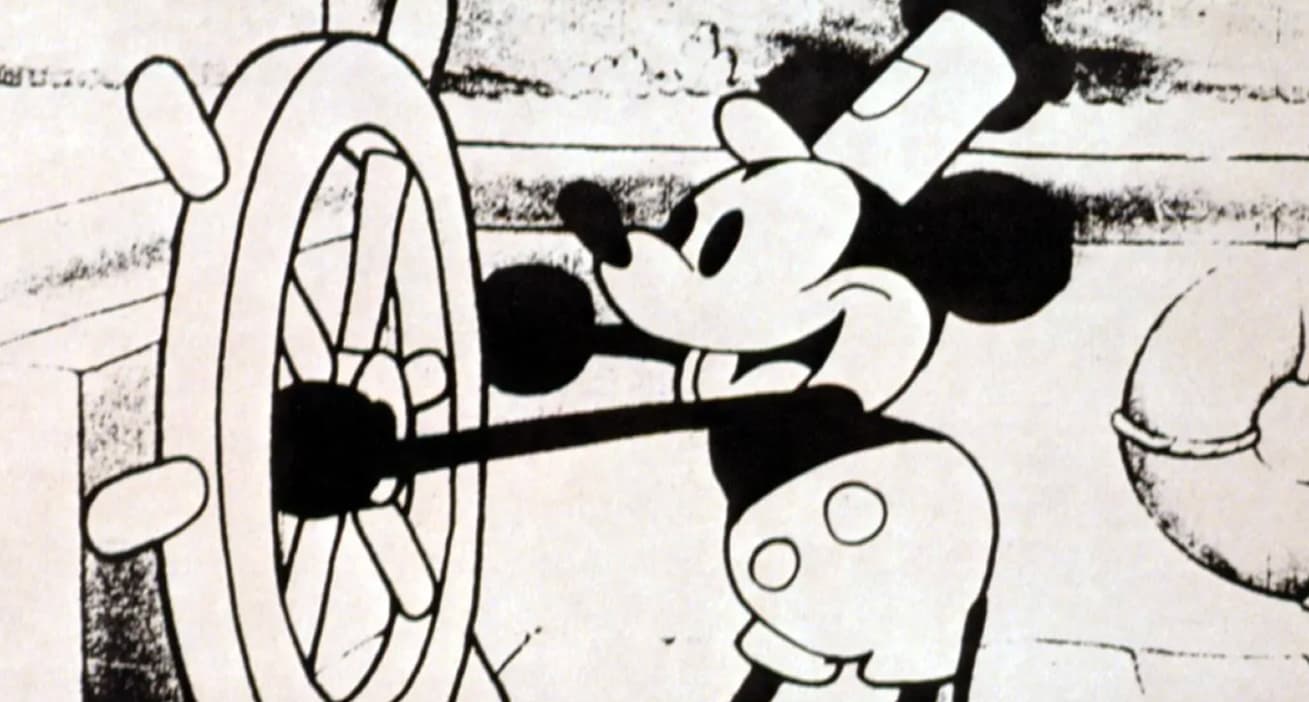
Mickey Mouse is the clean modern example. In January 2024, the 1928 short film Steamboat Willie entered the public domain in the U.S. That means the original version of Mickey in that film can be used without infringing copyright. It does not mean every later Mickey design is free. Later iterations remain protected.
Now zoom to 2026. Associated Press covered that the first appearances of Betty Boop and Blondie entered the public domain on January 1, 2026, along with a wave of other 1930 works. The key phrase is “first appearances.” It is not “every version you remember.”
This is the rule that matters if you are building content or products: public domain does not usually unlock the full franchise. It unlocks the earliest slice. Everything that got added later can still be protected.
If you want to use a classic character safely, you need to ask a more annoying, more accurate question: Which specific version is public domain, and what exactly appears in that version?
Derivative works are where new value gets built, and where people overreach
Once you are working with public-domain material, the “how do I make this mine?” instinct kicks in fast. That is where derivative works come in.
The Copyright Office’s Circular 14 spells out the core limitation: the copyright in a derivative work covers only the additions, changes, or other new material appearing for the first time. Protection does not extend to any preexisting material.
In plain English:
- You cannot take a public-domain fairy tale and magically re-lock it for everyone.
- You can create your own version and protect what you actually added: new designs, new plot elements, new scripts, new artwork, new world-building.
This is the real business play. The public domain is the foundation. The protectable asset is the execution layer you build on top.
That is also why public-domain remixes tend to cluster around formats that create obvious “new material” quickly: illustrated books, animation, games, character bibles, brand packages, and consumer products ecosystems.
Why this is heating up again in 2026
For a long time, public-domain talk in the U.S. felt theoretical because relatively little was entering the public domain each year. That has changed.
Duke Law’s Center for the Study of the Public Domain notes that January 1, 2026 is Public Domain Day in the U.S., with works from 1930 becoming open to all, along with sound recordings from 1925.
That matters for two reasons:
- A growing library of recognizable works becomes available annually.
- The cost of launching something “familiar” drops, because you can start with a story the culture already knows.
This creates a predictable cycle: creators and companies scan each year’s public-domain class, look for characters with built-in recognition, then rush to ship new versions before the category gets crowded.
This is not just a culture story. It is a strategy story.
The modern playbook: how people build franchises on public-domain foundations
If you zoom out, the same sequence shows up again and again:
- Start with a public-domain sourceWork from the original text or the specific early material that is actually public domain, not a modern adaptation you grew up with.
- Create a distinctive house versionNew look, new rules, new tone, new world. Something a consumer can recognize as a specific interpretation.
- Protect the brand layerTrademark the identifiers that connect your version to goods and services in the marketplace.
- Monetize through licensing and distributionBooks, apparel, toys, games, experiences, and content deals.
This is also where trademark becomes a practical tripwire. If your packaging, naming, or branding nudges consumers into thinking your product is “official” from some other brand, you are inviting the likelihood-of-confusion problem.
So yes, the story might be free. The market is not.
A real-world example
This is the part that makes the whole topic more than theoretical: companies are already running this strategy as a business model.
Elf Labs is one example that’s been covered in trade press as part of a wave of companies trying to build licensing programs around classic properties by developing alternate, trademarked versions and new content pipelines.
On its own site, Elf Labs describes a “decade-long legal effort” at the U.S. Patent & Trademark Office and says it secured rights tied to classic characters like Cinderella, Snow White, and Rapunzel.
And in an SEC Form C-A filing, Elf Labs states that the total copyrights in its portfolio stands at 435.
Whether you’re bullish or skeptical on any one company, the broader point is the same: the public domain is becoming a sourcing strategy—a way to start with recognizable cultural material and then compete on execution: design, distribution, branding, and licensing.
A practical checklist if you want to use public-domain characters
(This is not legal advice, just the sanity check most people skip.)
- Identify the exact public-domain source you are relying on. “The character is public domain” is not enough. You want the particular work and version that is free to use.
- Avoid assuming modern designs are included. With characters like Mickey, only the early version is public domain. Later versions remain protected.
- Treat merchandising as higher risk than storytelling. Trademark confusion is most likely to show up when you sell goods in categories where consumers expect “official” licensing.
- Build a distinct version if you want a defensible business. Derivative work protection covers what you add, not what already existed.
If you do those four things, you are already ahead of most of the internet.
The takeaway
Public domain is powerful, but it is not permission to copy whatever you remember from the most famous adaptation.
What is happening right now is more interesting than the headline. A growing batch of classic works becomes available every year. Creators can remix them. Companies can build franchises by creating distinctive versions and protecting the commercial brand layer.
In other words: the raw material may be open, but the competitive advantage comes from execution.
What to Read Next
Sources
- https://www.copyright.gov/help/faq-definitions.html
- https://www.copyright.gov/circs/circ14.pdf
- https://www.uspto.gov/trademarks/basics/trademark-patent-copyright
- https://www.uspto.gov/trademarks/search/likelihood-confusion
- https://web.law.duke.edu/cspd/publicdomainday/2026/
- https://web.law.duke.edu/cspd/mickey/
- https://apnews.com/article/public-domain-2026-betty-boop-40cb2f7a30ba9d7aec0bfc9191ab02c1
- https://time.com/6551496/mickey-mouse-public-domain-steamboat-willie/
- https://licensinginternational.org/news/new-plans-for-classic-properties/
- https://www.sec.gov/Archives/edgar/data/2019817/000164117225005893/formc.htm
Market Munchies and Mode Mobile communications are for informational purposes only, and are not a recommendation, solicitation, or research report relating to any investment strategy, security, or digital asset. All investments involve risk including the loss of principal and past performance does not guarantee future results.
Any information contained in this commentary does not purport to be a complete description of the securities, markets, or developments referred to in this material. The information has been obtained from sources considered to be reliable, but we do not guarantee that the foregoing material is accurate or complete. There is no guarantee that any statements or opinions provided herein will prove to be correct.