The UAE Just Quit OPEC. The Global Oil Market Will Never Look the Same.
The United Arab Emirates announced this morning that it is withdrawing from OPEC and OPEC+ effective May 1 — a departure that deals the most significant blow to the 59-year-old cartel since its founding, and one that arrives at the single worst possible moment for global energy…
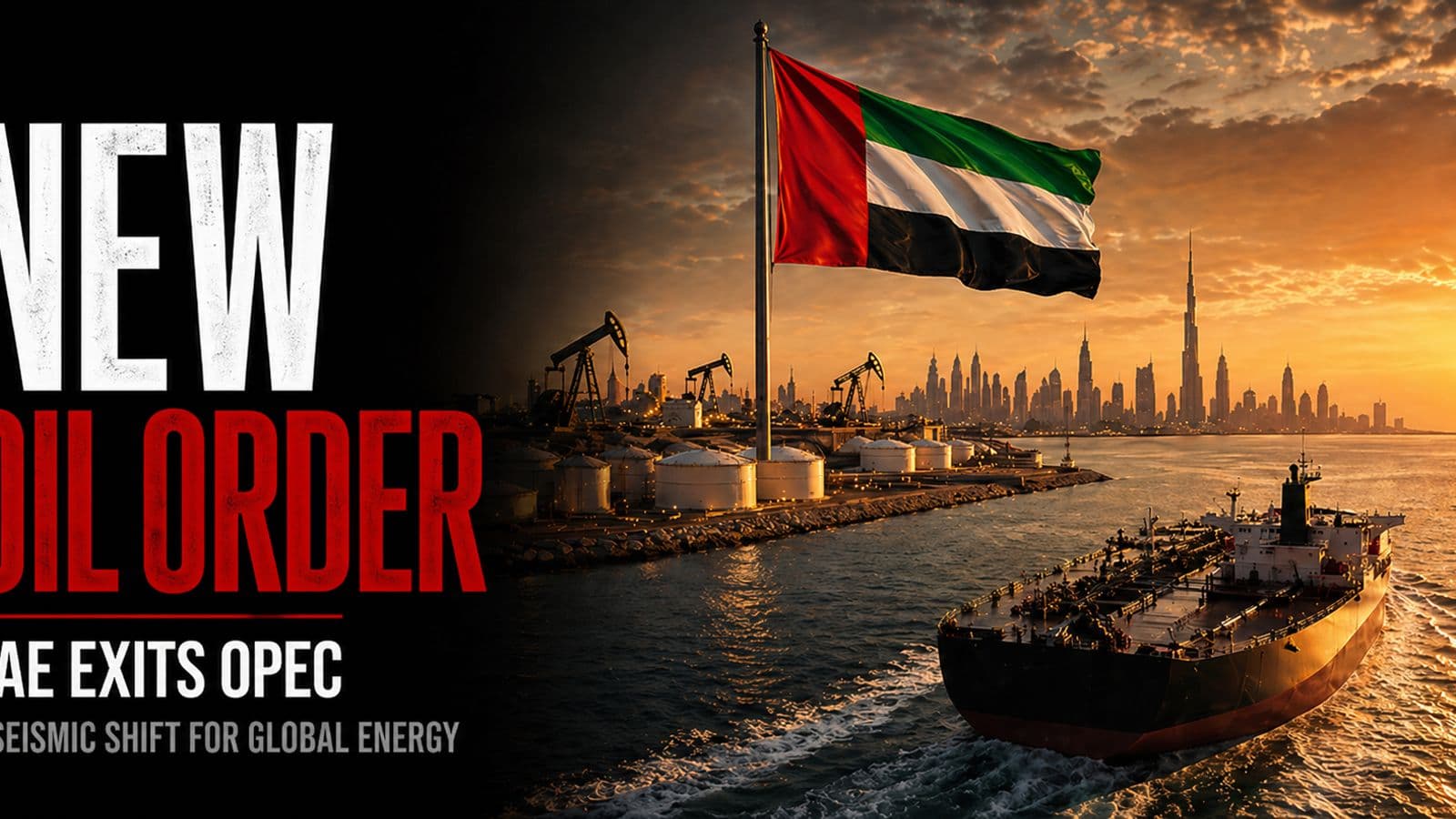
The United Arab Emirates announced this morning that it is withdrawing from OPEC and OPEC+ effective May 1 — a departure that deals the most significant blow to the 59-year-old cartel since its founding, and one that arrives at the single worst possible moment for global energy markets.
The announcement was delivered via UAE state news agency WAM as OPEC prepared to convene in Vienna on Wednesday. "This decision follows a comprehensive review of the UAE's production policy and its current and future capacity," WAM said, "and is based on our national interest and our commitment to contributing effectively to meeting the market's pressing needs."
That language is diplomatic. The context is not. The UAE has been quietly furious at its Gulf neighbors for months — and this morning, that fury became institutional.
Why the UAE Left — and Why It Was Always Coming
The Iran war was the match. The gasoline has been pooling for five years.
The structural tensions between Abu Dhabi and Riyadh inside OPEC are not new. They erupted publicly in July 2021, when the UAE refused to endorse a Saudi-led production increase unless its individual baseline quota was first raised — a demand Riyadh initially rejected. OPEC crisis talks collapsed entirely. One analyst at Again Capital wrote at the time that "OPEC solidarity dissolved today" and that the UAE could be "the first domino to fall." A compromise was eventually reached, with Abu Dhabi's baseline lifted from 3.17 million barrels per day to 3.65 million. But the underlying tension was only temporarily papered over.
The root of the dispute is structural and reflects a fundamental divergence in national interests. Saudi Arabia's fiscal breakeven oil price — the level it needs to balance its government budget — is estimated at roughly $80 to $90 per barrel, and some analysts put it higher given Vision 2030 spending commitments. The UAE's budget breakeven sits at approximately $50 per barrel. Riyadh needs price discipline. Abu Dhabi needs volume. Those two positions are, at scale, incompatible within the same production agreement.
The Iran war and the Gulf's response to it provided the final catalyst. The UAE sustained numerous Iranian missile and drone attacks since Operation Epic Fury launched on February 28. Its diplomatic adviser, Anwar Gargash, spelled out Abu Dhabi's frustration publicly just yesterday. "The Gulf Cooperation Council countries supported each other logistically, but politically and militarily, I think their position has been the weakest historically," he said. "I expect this weak stance from the Arab League and I am not surprised by it, but I haven't expected it from the GCC and I am surprised by it."
That is not the language of a country intending to remain in a coordinated production alliance with the neighbors it just publicly called out.
Trump's pressure also played a role. The U.S. president has repeatedly linked American military support for the Gulf with oil prices, arguing that Gulf states "exploit" Washington's protection by keeping prices artificially high. For the UAE — which has deepened its security alignment with the U.S. throughout the Iran war — leaving OPEC is in part a signal to Washington: Abu Dhabi is not Saudi Arabia, and it will not be held responsible for high oil prices.
What the UAE Brings to the Table — and Takes Away
The UAE is not a minor player walking out the door. It is one of OPEC's most consequential producers, and its departure removes a pillar of the cartel's spare capacity architecture at the most precarious moment in decades.
The UAE currently produces approximately 4 million barrels per day, with ADNOC — Abu Dhabi's state oil company — executing a $150 billion spending plan aimed at reaching 5 million barrels per day of capacity, with its energy minister having told Reuters the country could reach 6 million "if the market requires." Operating under OPEC quota constraints while running that buildout has been a persistent source of friction. Freed from those constraints this morning, Abu Dhabi will ramp production as quickly as it can.
The departure also strips OPEC of institutional credibility at a critical juncture. Qatar left in 2019, citing irrelevance as a gas-dominated economy. Angola left in early 2024 after a quota dispute. The UAE's exit is categorically different in scale and significance. Saudi Arabia now faces the prospect of managing a production alliance that has lost its second-largest Gulf producer — a country whose tensions with Riyadh date back to 2016 and exploded into public view in 2021 — while simultaneously trying to coordinate the market response to the worst energy crisis in modern history.
The Fujairah Correction: UAE Can Export Right Now
The immediate market implication of this morning's announcement is more bearish than it first appears — and that requires correcting a common misconception.
The Strait of Hormuz closure has not trapped UAE supply. Abu Dhabi intentionally built the Habshan-Fujairah pipeline (ADCOP) specifically to export crude oil by bypassing the Strait entirely. The 380-kilometer pipeline runs from Abu Dhabi's inland Habshan oil fields to the port of Fujairah on the Gulf of Oman, completely outside Iranian reach. Its nameplate capacity is 1.5 million barrels per day, expandable to 1.8 million barrels per day. As of mid-March, Kpler estimated it was operating at 71% utilization, leaving approximately 440,000 barrels per day of spare export capacity immediately available.
That matters enormously for the price signal from today's announcement. The UAE does not need the Hormuz strait to re-open before it can begin pumping extra barrels. The moment it decides to break from its former OPEC quota and ramp production, those additional barrels can exit through Fujairah to the Gulf of Oman and reach global markets. There is a caveat: Iranian drone strikes hit Fujairah's oil terminal in March, disrupting some loading operations, and the infrastructure risk remains real. But the pipeline itself is functional, and the export route exists.
This is the bearish shock the oil market was not fully pricing in before this morning. UAE production unconstrained by quotas, exportable through a Hormuz bypass that is already operational, represents near-term additional supply — not a promise of supply contingent on a peace deal that does not yet exist.
What This Means for Oil Markets
The price signal is now running in two competing directions simultaneously.
The bearish case: a country with nearly 4 million barrels per day of production and 440,000 barrels per day of immediately exportable Fujairah pipeline capacity is no longer bound by quotas. ADNOC has said it plans to "gradually" ramp output, but gradually by Gulf oil company standards means months, not years. The additional supply will hit the market.
The bullish case: OPEC as a price stabilization mechanism has been materially weakened. Saudi Arabia cannot compensate for the UAE's departure by cutting alone — it would need to sacrifice market share it cannot afford to lose at current oil prices. If other quota-constrained producers read today's announcement as permission to follow Abu Dhabi's lead, the fragmentation of the alliance becomes a self-reinforcing dynamic. A weakened OPEC means less coordinated supply management at precisely the moment when the world needs it most.
Brent crude was trading near $97 per barrel before the announcement. The next 24 hours will reveal which direction the market initially resolves this tension.
The Saudi Arabia Problem
The person with the most to lose from this morning's announcement is Saudi Crown Prince Mohammed bin Salman.
OPEC has been the mechanism through which Saudi Arabia has exercised de facto control over global oil prices for decades. The UAE's departure — announced the day before the Vienna meeting, timing that is almost certainly not accidental — removes a key pillar of that mechanism. It is a direct challenge to Riyadh's Gulf hegemony, coming from a country whose divergence from Saudi interests has been building since 2016 and nearly broke into open rupture in 2021.
If the Vienna meeting tomorrow fails to produce a credible unified response — and it is very difficult to see how it does, given that the agenda was rewritten 24 hours before convening — it will be the most public display of OPEC fragility in years. Saudi Aramco shares, which trade on the Riyadh Tadawul exchange, will be worth watching when Gulf markets open tonight.
What Investors Should Watch
Oil prices in the next 24 hours will tell you whether the market is initially reading this as bearish supply growth or bullish cartel fragmentation.
The OPEC Vienna meeting tomorrow is now a crisis session rather than a routine coordination meeting. Any statement from Saudi Arabia or the OPEC secretariat will be read for signs of whether Riyadh intends to compensate for UAE departure with deeper cuts — or whether additional members are considering following Abu Dhabi's lead.
For investors in energy equities, the UAE exit adds a new layer of complexity to the global supply picture. Integrated majors with ADNOC partnerships may see positive pressure as Abu Dhabi's production ambitions become unconstrained. Pure-play OPEC-aligned producers dependent on Saudi price discipline face a different calculation entirely.
The Strait of Hormuz peace talks now carry an additional dimension. A UAE no longer bound by OPEC quotas has an even stronger incentive to see Hormuz reopened — its Fujairah pipeline can move barrels, but it cannot move everything. The alignment of interests between Abu Dhabi and Washington on reopening the strait is genuinely new, and may change the diplomatic dynamics of the Iran negotiations in ways not yet fully visible.
Sources
- Reuters / U.S. News — "UAE Leaves OPEC and OPEC+ in Huge Blow to Global Oil Producers' Group": https://www.usnews.com/news/world/articles/2026-04-28/uae-leaves-opec-opec-in-huge-blow-to-global-oil-producers-group
- Bloomberg — "UAE to Leave OPEC and OPEC+ Next Month to Pursue New Strategy": https://www.bloomberg.com/news/articles/2026-04-28/uae-to-leave-opec-and-opec-next-month-to-pursue-new-strategy
- The National — "UAE announces it will leave OPEC": https://www.thenationalnews.com/business/2026/04/28/uae-announces-it-will-leave-opec/
- Al Jazeera — "UAE leaves OPEC and OPEC+": https://www.aljazeera.com/news/2026/4/28/uae-leaves-opec-and-opec
- CNBC — "The two oil pipelines helping Saudi Arabia and UAE bypass the Strait of Hormuz": https://www.cnbc.com/2026/03/12/strait-of-hormuz-oil-pipelines-iran-war-saudi-arabia-uae.html
- CNBC — "Strait of Hormuz: Alternative routes for oil exporters": https://www.cnbc.com/2026/04/23/strait-hormuz-closure-alternative-routes-middle-east-oil-gas-pipelines.html
- Engineering News-Record — "Hormuz Bypass Infrastructure Was Sized for a Short Disruption. This Is Not That.": https://www.enr.com/articles/62677-hormuz-bypass-infrastructure-was-sized-for-a-short-disruption-this-is-not-that
- CNBC — "OPEC+ crisis talks abandoned as Saudi Arabia and the UAE remain at loggerheads over oil output": https://www.cnbc.com/2021/07/05/opec-meeting-saudi-arabia-uae-in-focus-over-oil-output-policy.html
- Al Jazeera — "Saudi and UAE reach compromise in OPEC+ standoff": https://www.aljazeera.com/economy/2021/7/14/saudi-and-uae-reach-compromise-in-opec-standoff
- Al-Estiklal — "Silent Rift Between Saudi Arabia and the UAE Within OPEC": https://www.alestiklal.net/en/article/silent-rift-between-saudi-arabia-and-the-uae-within-opec-what-it-could-mean-for-the-organization-s-future
- The Middle East Insider — "OPEC+ Spare Capacity April 2026: The 5M Barrel Buffer": https://themiddleeastinsider.com/2026/04/22/opec-spare-capacity-april-2026/
- Global Banking and Finance — "UAE Leaves OPEC and OPEC+ in Major Blow to Global Oil Producers": https://www.globalbankingandfinance.com/uae-leaves-opec-opec-huge-blow-global-oil-producers-group/
Market Munchies and Mode Mobile communications are for informational purposes only, and are not a recommendation, solicitation, or research report relating to any investment strategy, security, or digital asset. All investments involve risk including the loss of principal and past performance does not guarantee future results.
Any information contained in this commentary does not purport to be a complete description of the securities, markets, or developments referred to in this material. The information has been obtained from sources considered to be reliable, but we do not guarantee that the foregoing material is accurate or complete. There is no guarantee that any statements or opinions provided herein will prove to be correct.