Vitalik Buterin Declares 2026 The Year Ethereum Reclaims Its Cypherpunk Roots
🔄 Buterin's Bold Declaration: Reversing A Decade Of Compromises Ethereum co-founder Vitalik Buterin announced on January 16, 2026 that this year marks a turning point for the network's commitment to self-sovereignty and decentralization. In a comprehensive post on X, Buterin…
🔄 Buterin's Bold Declaration: Reversing A Decade Of Compromises
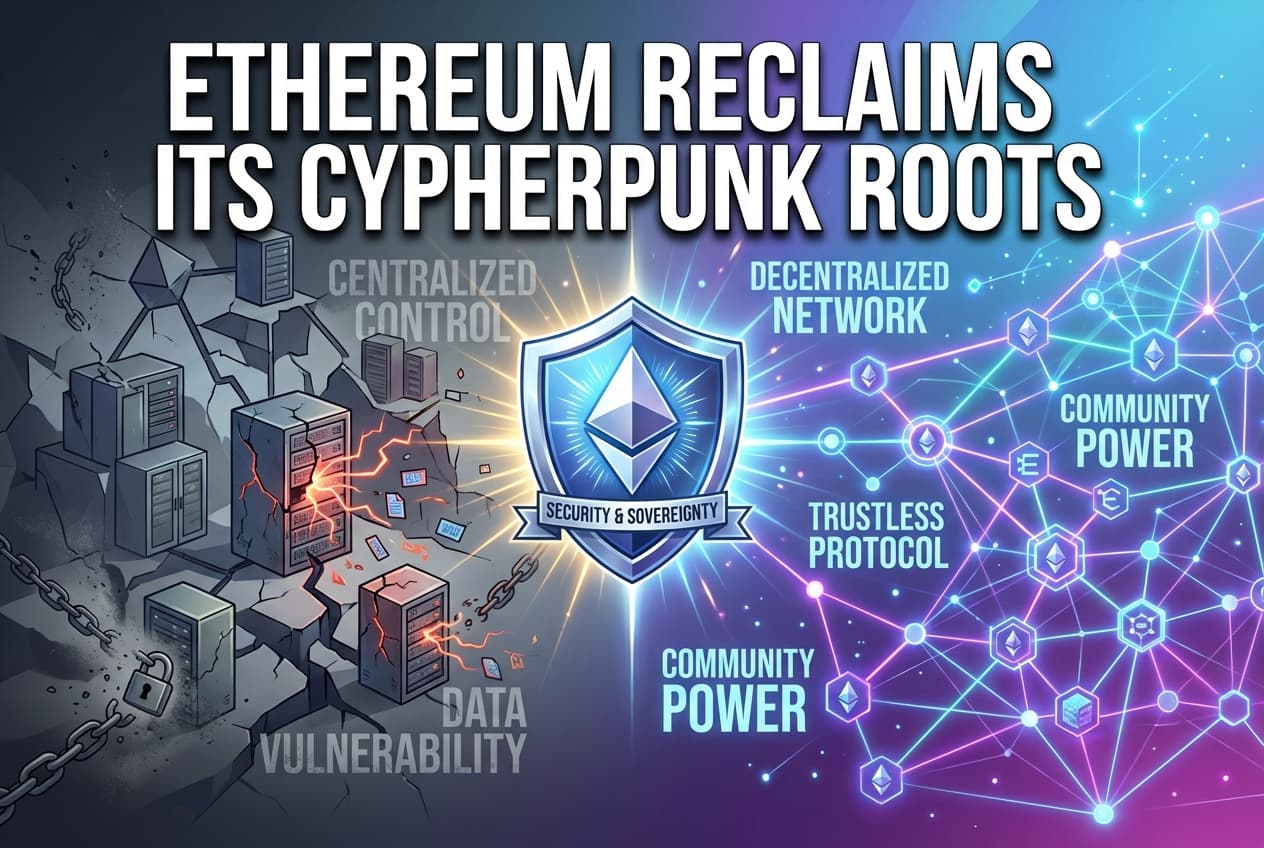
Ethereum co-founder Vitalik Buterin announced on January 16, 2026 that this year marks a turning point for the network's commitment to self-sovereignty and decentralization. In a comprehensive post on X, Buterin acknowledged that Ethereum has sacrificed core values in pursuit of mainstream adoption over the past decade. "2026 is the year that we take back lost ground in terms of self-sovereignty and trustlessness," he declared. The admission represents a significant strategic shift for the world's second-largest blockchain network. Buterin specifically cited problems like nodes becoming harder to run, dApps leaking user data to multiple servers, and block building centralization threatening transaction inclusion guarantees. For developers and users alike, this signals a renewed focus on technical infrastructure that prioritizes autonomy over convenience. Buterin emphasized that while the transformation will be gradual and won't achieve all objectives in upcoming releases, the commitment represents Ethereum's path toward deserving "a much greater place" in the blockchain ecosystem.
🔐 Privacy And Security: The Foundation Of User Sovereignty
Privacy improvements stand at the center of Ethereum's 2026 roadmap, addressing years of erosion in user autonomy. The Ethereum Foundation's Privacy Cluster has been refocused to develop the Kohaku wallet framework, which aims to make private payments as seamless as standard transactions. Buterin advocated for technologies like Oblivious RAM and Private Information Retrieval to prevent RPC providers from surveilling or censoring user activity. The Privacy Stewards of Ethereum initiative has outlined a three-track approach covering Private Writes, Private Reads, and Private Proving across the protocol stack. For traders and investors, enhanced privacy means reduced exposure of trading strategies and holdings to third parties who could front-run transactions. Layer 2 solutions like PlasmaFold are being developed under this privacy mandate. The infrastructure upgrades target a fundamental shift where privacy becomes the default rather than an opt-in feature, addressing concerns that have plagued Ethereum users who previously had to choose between convenience and confidentiality.
💼 Social Recovery Wallets: Protecting Investors From Catastrophic Loss
One of the most investor-friendly improvements coming to Ethereum involves social recovery wallets and timelocks, features designed to prevent total fund loss from misplaced seed phrases. Buterin has championed social recovery since 2021, and the concept began materializing with EIP-7702 in the May 2025 Pectra upgrade. These smart contract-based wallets allow users to designate trusted contacts who can help recover accounts without exposing seed phrases. The functionality addresses one of cryptocurrency's most persistent user experience problems, where a single mistake can result in permanent loss of funds. For institutional investors, social recovery mechanisms provide additional safeguards that make Ethereum custody more palatable compared to traditional finance standards. The integration with ERC-4337 for account abstraction further enhances these security features. Retail users benefit from reduced anxiety about cold storage, while maintaining the self-custody ethos that distinguishes cryptocurrency from traditional banking. The combination of social recovery and timelocks represents a significant step toward making Ethereum accessible without sacrificing the security that sophisticated users demand.
⚙️ Technical Infrastructure: Making Nodes Accessible Again
Ethereum's path back to decentralization requires making node operation feasible for ordinary users rather than requiring specialized hardware. Buterin outlined plans to simplify node operations through ZK-EVM and BAL technology, which would dramatically reduce computational requirements for verification. The lightweight Helios client already enables users to interact with Ethereum trustlessly without running full nodes, but further optimization is planned. For network participants, easier node operation means stronger decentralization and reduced reliance on centralized RPC providers. The upcoming Glamsterdam and Hegota upgrades are expected to introduce many of these infrastructure improvements. Buterin emphasized that nodes have become progressively harder to run over the past decade, creating barriers that concentrate power among well-resourced operators. By lowering hardware requirements and bandwidth consumption, Ethereum aims to redistribute validation power across a broader user base. The technical changes also support Layer 2 scaling solutions, which benefit from more efficient data availability verification methods introduced in recent upgrades like Fusaka in December 2025.
🏗️ Decentralized Applications: Reducing Third-Party Dependencies
Buterin's vision includes restructuring how users interact with decentralized applications to eliminate reliance on centralized servers that compromise security. He advocated for increased use of IPFS for onchain user interfaces, which would prevent scenarios where server downtime locks users out of asset recovery or server compromises result in fund theft. The current model where dApps have evolved into "complicated behemoths that leak all your data to a dozen servers" represents a departure from Ethereum's original trustless architecture. For dApp developers, this means rethinking application design to prioritize truly decentralized infrastructure over convenient but centralized solutions. Users would interact with applications that cannot be censored or manipulated by third parties, even momentarily. Network improvement proposals like FOCIL aim to enhance censorship resistance at the protocol level, complementing application-layer improvements. The shift requires coordination between application developers, infrastructure providers, and protocol researchers to rebuild patterns that prioritized user convenience at the expense of sovereignty. Buterin stressed that wallets routing traffic through self-selected RPCs rather than default provider choices represent part of this broader architectural reconsideration.
🎯 Strategic Implications: A Long-Term Bet On Core Values
Buterin's commitment to reversing Ethereum's "backsliding" represents more than technical upgrades; it signals a fundamental strategic repositioning that will unfold over multiple upgrade cycles. He acknowledged that objectives won't be fully realized in the next Kohaku release or even several subsequent hard forks, setting expectations for a multi-year transformation. For investors, this long-term perspective suggests Ethereum is prioritizing sustainable infrastructure over short-term adoption metrics that might compromise core values. The approach contrasts with competitors who may emphasize user experience and mainstream appeal without addressing underlying decentralization concerns. Institutional adoption continues alongside these technical improvements, with regulatory clarity in some jurisdictions supporting broader participation. The strategic recalibration positions Ethereum to compete not just on transaction throughput but on the trustless guarantees that distinguish blockchain technology from traditional systems. Buterin emphasized that completing infrastructure enhancements will be essential for Ethereum's enduring technological and community strength. The "walkaway test" he referenced suggests applications should function without ongoing oversight from their creators, embodying true decentralization. As Ethereum pursues quantum resistance, scalable ZK-EVM implementation, and censorship-resistant block building, the network aims to establish technical foundations that support its expanded role in global financial infrastructure.
Sources
https://www.theblock.co/post/386043/vitalik-buterin-declares-2026-the-year-ethereum-reverses-backsliding-of-self-sovereignty-and-trustlessness https://www.ainvest.com/news/ethereum-2026-decentralization-renaissance-strategic-buy-long-term-2601/ https://bingx.com/en/news/post/vitalik-buterin-sets-target-for-ethereum-to-restore-self-sovereignty-decentralization-and-privacy https://intellectia.ai/news/crypto/ethereum-cofounder-vitalik-buterin-calls-for-return-to-decentralization-values-by-2026
Market Munchies and Mode Mobile communications are for informational purposes only, and are not a recommendation, solicitation, or research report relating to any investment strategy, security, or digital asset. All investments involve risk including the loss of principal and past performance does not guarantee future results.
Any information contained in this commentary does not purport to be a complete description of the securities, markets, or developments referred to in this material. The information has been obtained from sources considered to be reliable, but we do not guarantee that the foregoing material is accurate or complete. There is no guarantee that any statements or opinions provided herein will prove to be correct.
Get fresh insights, breaking news, and hidden gems in the world of crypto—delivered straight to your inbox with our Crypto Cookies newsletter. Don't miss out—sign up now and get your first bite of insider knowledge!