Wall Street’s Confidence Test Starts Now
Markets are trying to steady themselves after Tuesday’s AI-driven wobble, but the early tone today is more cautious than celebratory. Wall Street opened mixed, with investors unwilling to make a big directional bet before a rare double catalyst: a Federal Reserve decision in…
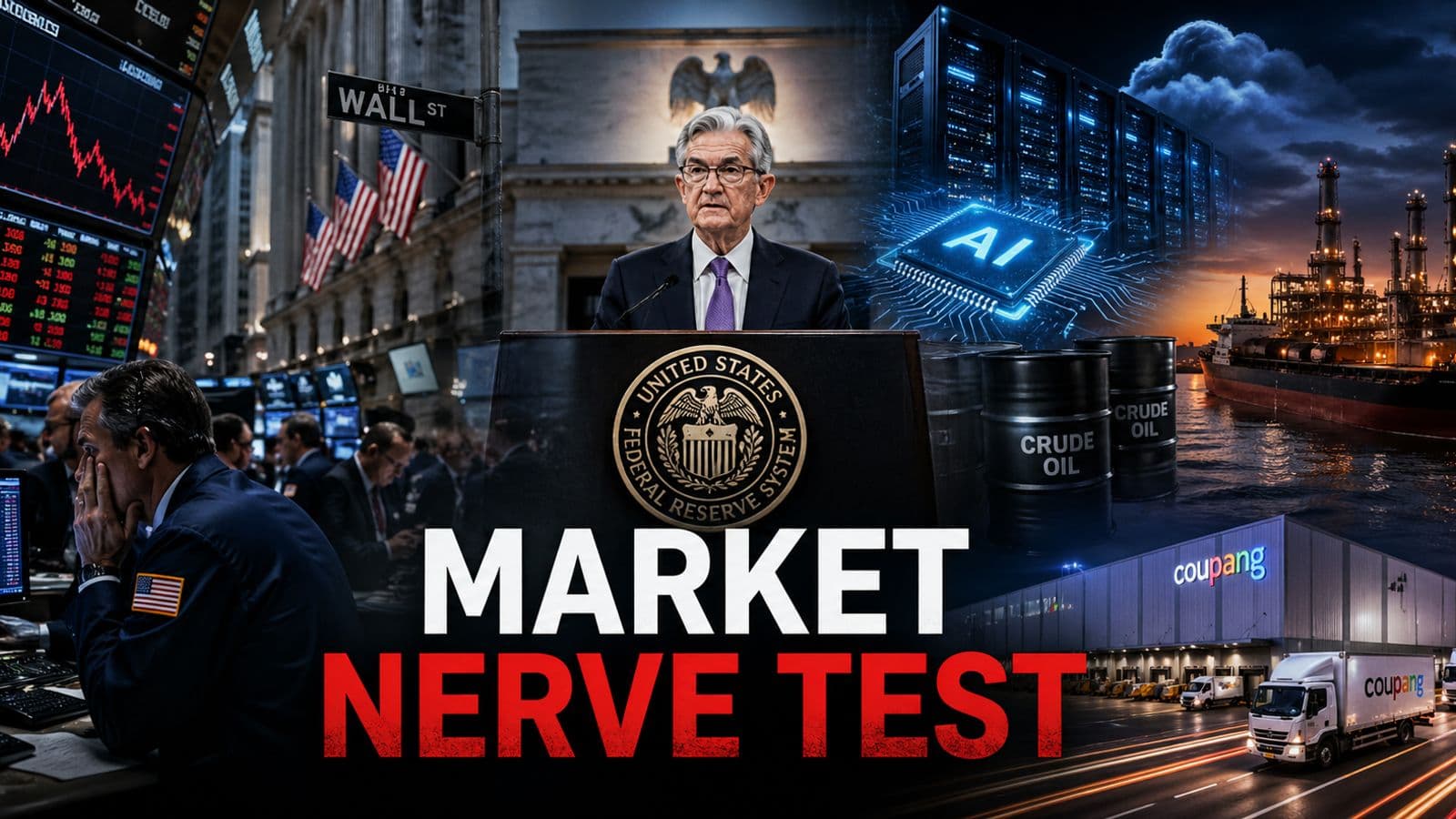
Markets are trying to steady themselves after Tuesday’s AI-driven wobble, but the early tone today is more cautious than celebratory. Wall Street opened mixed, with investors unwilling to make a big directional bet before a rare double catalyst: a Federal Reserve decision in the afternoon and earnings from Alphabet, Amazon, Meta, and Microsoft after the close.
The pressure point is simple: investors still like the long-term AI story, but they are getting more demanding about the math behind it. A report that OpenAI missed internal revenue and user targets rattled AI-linked stocks Tuesday, reminding the market that spending billions on chips, data centers, and cloud capacity only works if the revenue catches up.
At the same time, oil is adding an uncomfortable macro layer. Rising crude prices tied to the extended Iran blockade are keeping inflation risk in the conversation just as the Fed prepares to speak. That makes today less about one headline and more about whether investors can keep trusting the same rally ingredients: strong megacap earnings, manageable inflation, and a central bank that does not surprise anyone.
Stock of Interest Today: Coupang (CPNG)
Coupang remains one of the cleaner “infrastructure advantage” stories in global e-commerce. The company’s original pitch was not just online retail, but control over the delivery system itself. Coupang previously disclosed that roughly 70% of South Korea’s population lived within seven miles of a Coupang logistics center, giving it a physical density that many competitors would struggle to replicate without years of spending.
That network matters because speed is not just a customer perk. It is a competitive barrier. When a retailer owns more of the fulfillment chain, it can improve delivery reliability, reduce friction, increase repeat usage, and gather more data across the order cycle. The more often customers rely on Coupang for everyday purchases, the more valuable the system becomes.
The profitability angle is also becoming harder to ignore. Coupang’s Product Commerce segment produced roughly $2.5 billion of adjusted EBITDA in 2025 with an 8.4% margin, according to the company’s fourth-quarter release. That shows the core business is not merely growing, but gaining operating leverage as scale, routing density, and automation improve the economics.
The main watchpoint is that Coupang is not a pure-play margin expansion story. It is still investing in newer areas, including Taiwan, Eats, Play, fintech, and Farfetch. Those businesses can pressure consolidated profitability in the near term, but they also give Coupang multiple ways to extend the ecosystem if the core logistics engine keeps compounding.
There is also a fresh regulatory headline to watch. South Korea’s Fair Trade Commission has designated founder Bom Kim as the effective controlling shareholder of the group, and Coupang has said it plans to challenge the decision. That does not directly change the logistics story, but it does remind investors that Korean regulatory risk is part of the valuation debate.
Current price: $20.34 Analyst expectation: $27.94
Five Market Signals To Watch
Today’s market is not moving on one clean story. It is being pulled between earnings optimism, AI skepticism, oil-driven inflation pressure, and a possible Fed leadership transition. That is why the early action matters less than the market’s reaction to the next round of information.
The key question is not whether stocks can bounce for a few hours. It is whether the biggest companies in the market can prove that the spending boom behind the rally is still producing enough growth to justify investor confidence.
1) The AI dip is being tested, not erased
Investors are trying to look past Tuesday’s AI scare, but the market is not treating it as a harmless blip. OpenAI’s reported miss on internal revenue and user targets hit a sensitive nerve because so much of the current rally depends on the assumption that AI demand will keep scaling fast enough to absorb enormous infrastructure spending.
That is why today’s early mixed trading matters. A simple rebound would suggest investors see the OpenAI news as company-specific noise. A choppier response suggests something more important: the market is starting to separate AI enthusiasm from AI economics.
For investors, the useful takeaway is that “AI exposure” is becoming too broad a label. The market may continue rewarding companies that can show real revenue, pricing power, and capacity discipline, while punishing companies that rely mostly on future demand assumptions. That is a healthier market, but also a less forgiving one.
2) Big Tech earnings are now a referendum on AI spending
Alphabet, Amazon, Meta, and Microsoft all report after the close, making this one of the most important earnings nights of the season. These companies are not just large index weights. They are also the biggest public test of whether AI spending is translating into stronger cloud growth, advertising efficiency, productivity tools, and platform stickiness.
The market will not only care about revenue and earnings beats. It will care about capital spending guidance. If these companies signal that AI infrastructure demand remains strong and monetization is improving, investors may treat Tuesday’s selloff as a reset. If they raise spending without showing clearer returns, the market may start questioning whether the AI buildout is becoming too expensive.
This is especially important because megacap tech has carried a large share of the broader market’s momentum. When the leaders are priced for excellence, “good” results can sometimes be insufficient. The real test tonight is whether guidance makes investors more comfortable with the next dollar of AI spending.
3) Powell’s final Fed speech makes today’s hold more important
The Federal Reserve is widely expected to keep rates unchanged today, which means the decision itself may not be the real market mover. The bigger event is Jerome Powell’s likely final public appearance as Fed chair, where investors will be listening for any clue about how the central bank sees inflation, growth, oil prices, and the timing of future rate cuts.
That gives today’s Fed moment a strange kind of weight. Powell is not just explaining one policy decision. He is likely handing the market its final roadmap before a leadership transition begins. If he sounds patient and inflation-focused, investors may assume rates stay higher for longer. If he sounds more concerned about growth, the market could start pricing in a softer path.
For investors, the key is tone. A steady Fed decision paired with cautious language could keep pressure on rate-sensitive stocks, especially if oil remains elevated. But a calmer message could help stabilize a market already bracing for Big Tech earnings and AI spending updates. Either way, Powell’s final speech is less about today’s rate decision and more about the policy era the market may be leaving behind.
4) Oil is turning into the market’s inflation wild card
Oil’s move higher is not just an energy-sector story. Reports that the U.S. is preparing to extend pressure on Iran through a prolonged blockade have kept geopolitical risk embedded in crude prices, with Brent and WTI rising sharply in recent sessions.
That matters because oil touches almost everything eventually: gasoline, shipping, airlines, chemicals, and consumer psychology. Even if the first-order market reaction is concentrated in energy stocks, the second-order effect is broader. Higher oil can squeeze consumers, pressure corporate margins, and make the Fed more cautious about easing.
The key risk is not simply that oil is high. It is that oil is high at the wrong time. Markets are already balancing expensive tech valuations, massive AI spending plans, and uncertainty over monetary policy. A persistent energy shock would make that balancing act harder.
5) The Warsh transition could change how investors read the Fed
Kevin Warsh’s nomination to succeed Powell is expected to advance in the Senate Banking Committee, putting markets closer to a leadership change at the Fed. That makes today’s Powell press conference potentially more symbolic than usual, since investors are not just listening for the next policy move, but also trying to understand how the institution may change under new leadership.
Warsh has signaled support for significant changes to Fed policy and communications, while also facing questions about central bank independence. That matters because markets do not only price rates. They price trust in the process behind rate decisions.
A leadership transition does not automatically mean a policy shock. But it does introduce uncertainty into the path of rates, inflation credibility, and Fed messaging. In a market already sensitive to oil and AI spending, even small changes in central bank communication could have outsized effects.
Bottom Line
Today is a confidence test.
Stocks are not collapsing under the weight of Tuesday’s AI scare, but they are not fully shrugging it off either. Investors want proof from Big Tech that the AI boom is producing returns, not just bigger capital budgets. They want the Fed to stay predictable. They want oil to stop adding inflation risk. And they want a leadership transition at the central bank that does not scramble the policy outlook.
Coupang fits into that broader backdrop as a useful contrast. While much of the market is debating future AI returns, Coupang’s story is about a physical network that already exists, a logistics advantage that is hard to copy, and a core commerce business showing real operating leverage. The risk is regulation and investment drag. The opportunity is that infrastructure, when built well, can quietly become a moat.
For the broader market, the lesson is similar: investors are still willing to pay for growth, but they are getting more selective about what kind. The next leg of the rally will likely belong to companies that can connect big spending to visible returns.
Sources:
- https://www.reuters.com/business/wall-street-futures-mixed-ahead-big-tech-earnings-fed-meeting-2026-04-29/
- https://www.reuters.com/business/retail-consumer/hyperscaler-results-pose-major-test-ai-driven-us-stock-market-2026-04-29/
- https://www.wsj.com/livecoverage/fed-interest-rate-decision-earnings-04-29-2026/card/ai-tremors-heard-on-the-street-tuesday-recap-TwkmIG2voEN2LdiugFHG
- https://www.reuters.com/business/fed-likely-hold-rates-steady-what-may-be-last-meeting-powell-era-2026-04-29/
- https://apnews.com/article/4e09e4cdb25856635c94abe0021fc1d3
- https://www.reuters.com/business/energy/oil-rises-reports-us-will-extend-iran-blockade-prolonging-mideast-supply-2026-04-29/
- https://www.wsj.com/livecoverage/fed-interest-rate-decision-earnings-04-29-2026/card/oil-price-rises-above-107-after-trump-tells-aides-to-prepare-for-extended-blockade-EHsJrvjtux5fxfWpU7Pv
- https://www.reuters.com/business/fed-chief-nominee-warsh-set-clear-confirmation-hurdle-wednesday-2026-04-29/
- https://www.washingtonpost.com/business/2026/04/29/trump-federal-reserve-kevin-warsh-committee/
- https://ir.aboutcoupang.com/news-events/news/news-details/2026/Coupang-Announces-Results-for-Fourth-Quarter-2025/default.aspx
- https://www.sec.gov/Archives/edgar/data/1834584/000183458426000022/cpng-12312025ex991.htm
- https://www.sec.gov/Archives/edgar/data/1834584/000162828021001984/coupang-sx1.htm
- https://www.mk.co.kr/en/business/12031118
- https://www.marketwatch.com/investing/stock/cpng/analystestimates
- https://www.marketbeat.com/stocks/NYSE/CPNG/forecast/
Market Munchies and Mode Mobile communications are for informational purposes only, and are not a recommendation, solicitation, or research report relating to any investment strategy, security, or digital asset. All investments involve risk including the loss of principal and past performance does not guarantee future results.
Any information contained in this commentary does not purport to be a complete description of the securities, markets, or developments referred to in this material. The information has been obtained from sources considered to be reliable, but we do not guarantee that the foregoing material is accurate or complete. There is no guarantee that any statements or opinions provided herein will prove to be correct.