Wall Street’s Relief Rally Just Collided With Oil, Yields, and War Reality
Wednesday’s rebound already looks like a market that got ahead of itself. Stocks rose on April 1 as investors leaned into the idea that the Iran conflict might be nearing some sort of off-ramp, with oil easing and risk appetite returning just enough to let traders imagine a…
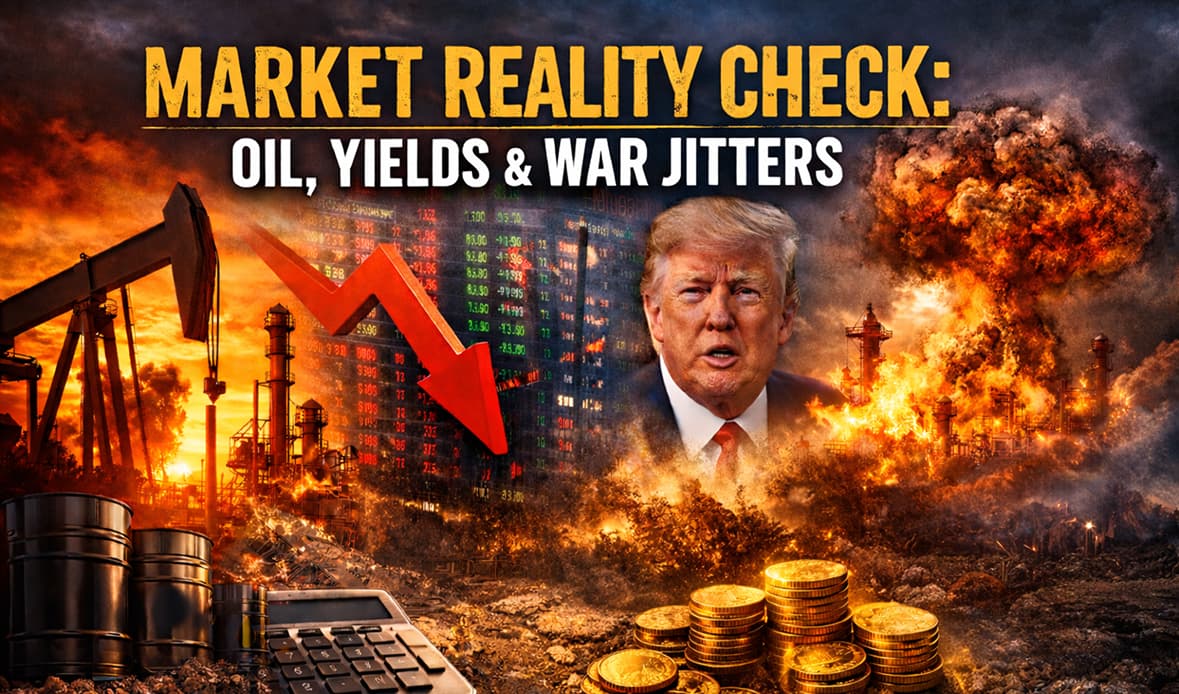
Wednesday’s rebound already looks like a market that got ahead of itself. Stocks rose on April 1 as investors leaned into the idea that the Iran conflict might be nearing some sort of off-ramp, with oil easing and risk appetite returning just enough to let traders imagine a calmer start to the quarter.
That mood broke overnight. President Trump’s address offered no concrete timetable for ending the war, kept the threat of further escalation front and center, and did little to clarify how disruption around the Strait of Hormuz might actually be resolved. By Thursday morning, the relief trade was already coming apart.
The U.S. open made the reset obvious. The S&P 500 opened sharply lower, down about 0.95%, while the Nasdaq fell about 1.7% as investors moved away from the parts of the market least suited to a world of higher oil and firmer yields. Oil surged back toward the $110 range, the dollar strengthened, and the broader message across assets turned decisively more defensive.
That matters because this is no longer just a geopolitical headline story. It is a macro story again. The market is being forced to think about what a prolonged energy shock does to inflation, what that means for rate-cut hopes, and which companies still make sense when the backdrop gets more volatile, more expensive, and less forgiving.
Stock of Interest Today: Global Partners LP (GLP)
If Wall Street is moving into a phase where infrastructure, distribution, and steady cash generation matter more than narrative momentum, Global Partners stands out. The company says it operates or maintains dedicated storage at 54 liquid energy terminals with rail, pipeline, and marine connectivity spanning from Maine to Florida and into the U.S. Gulf States. In a market suddenly obsessed with logistics risk and energy reliability, that kind of footprint looks more valuable, not less.
That does not make Global Partners immune to a broader selloff. It does, however, make the business easier to defend than the average stock in a tape dominated by oil shocks, inflation nerves, and renewed skepticism toward long-duration growth. This is a real-asset story tied to moving fuel through a stressed system, which is exactly the sort of business investors tend to rediscover when the macro backdrop gets harder.
Expectations also are not especially stretched. MarketBeat shows GLP recently trading around $44.23, with an average analyst target of $46.00, implying only modest upside from here. That is not the profile of a market darling. In this environment, it may be enough that the name looks sturdy, useful, and reasonably priced.
Current price: $44.23Analyst expectation: $50
Five Market Forces Driving the Tape
The key thing about Thursday’s action is that it does not look like a standard fear trade. In a classic geopolitical scare, you would usually expect stocks lower, bonds stronger, and gold behaving like a straightforward haven. Instead, stocks are lower while yields are rising, oil is surging, and the dollar is firmer. That is a much more inflationary and awkward mix.
That is why the tone feels worse than a routine headline wobble. Wall Street had already started to price a softer version of the story, one where the conflict cooled, oil backed off, and the market could go back to focusing on growth and rates. Thursday’s tape says that version of events is no longer the default assumption.
1) Trump’s speech removed the one thing markets wanted most: clarity
Investors did not need a peace deal on Wednesday night. They needed a believable path toward one. Instead, Trump claimed the U.S. was close to finishing the war while also threatening to hit Iran “extremely hard” over the next two to three weeks. That combination landed badly because it offered neither a clean exit strategy nor much confidence that the most disruptive phase of the conflict was ending soon.
Markets can handle bad news more easily than shapeless uncertainty. What they struggle with is ambiguity after they have already started pricing relief. Trump’s speech effectively told traders that the war may still broaden before it cools, and that the timetable remains more political than investable. That is why the reaction felt less like shock and more like a rapid correction to misplaced optimism.
2) Wednesday’s rebound was real, but it was built on fragile assumptions
The rally into the April 1 close was driven by hopes of de-escalation, with stocks rising and oil and the dollar easing as investors leaned on Trump’s earlier suggestion that the U.S. could exit the conflict relatively soon. For a few hours, the market was willing to believe the war premium might start coming out of the system.
But relief rallies tied to geopolitics are only as durable as the next headline. Once Trump’s address failed to deliver a clearer off-ramp, the logic behind that bounce collapsed almost instantly. Thursday’s lower open was not really a brand-new story. It was the market admitting it had leaned too hard into a hopeful interpretation of a conflict that is still unresolved.
3) Oil is back in charge of the entire conversation
Crude’s jump after the speech was the market’s clearest verdict. Reuters reported Brent around $109 and U.S. crude above $112 after Trump signaled attacks would continue, pushing energy back to the center of the macro picture. Once oil starts moving like that, the issue stops being confined to energy stocks and becomes a question about inflation, transport costs, margins, and consumer resilience.
That is also why the market tone feels harsher than a normal geopolitical wobble. Higher oil does not just hurt sentiment. It changes the math. It makes central banks more cautious, makes disinflation harder to sustain, and forces investors to rethink whether the sectors they liked most in a softer-rate world still deserve the same multiples. Energy can still work in that setup. Much of the rest of the market has a much harder case to make.
4) Gold’s past 24 hours say this is an inflation scare as much as a war scare
Gold traced the same emotional arc as the broader market over the past 24 hours. On April 1, bullion climbed as the dollar softened and hopes of de-escalation improved the mood across markets, with spot gold reaching its highest level since mid-March. That move fit a world in which investors still wanted some protection but were not yet fully embracing a prolonged inflation shock.
By Thursday, that changed sharply. Gold fell about 3.6% as the dollar strengthened and rising oil revived fears that the Fed would have less room to cut rates. That reversal matters because it shows the market is not treating this as a simple haven bid. Instead, inflation worries and higher yield expectations are starting to overpower the usual crisis trade, which is a much more uncomfortable message for the rest of the market.
5) Rising yields are making the rest of the market’s job much harder
Bond markets are reinforcing the same message as oil. Reuters reported that Treasuries slipped and yields rose as traders recalibrated for a longer conflict, higher energy prices, and a less comfortable inflation outlook. That is a difficult combination for long-duration growth stocks, speculative trades, and any sector that had been leaning on lower yields as a valuation tailwind.
This is what makes Thursday’s weakness feel broader than a one-day geopolitical selloff. The market is not simply marking down risk because the headlines are ugly. It is repricing an entire macro path. If oil stays elevated and yields keep rising, the burden on equities increases quickly, especially for companies that need a calm, low-rate backdrop to justify where they trade. In that environment, sturdier cash-flow stories and real-asset businesses start to look a lot more compelling.
Bottom Line
Thursday’s market looks like Wall Street waking up from a very brief fantasy. Investors spent part of Wednesday pricing a cleaner endgame, softer oil, and a return to a more comfortable macro narrative. By the open, they were being reminded that wars do not end on the schedule traders prefer, and that energy shocks have a way of dragging everything else back into the frame.
That leaves the setup awkward but fairly clear. Energy-linked infrastructure names like Global Partners look sturdier than much of the market because they do not need a perfect backdrop to stay relevant. Everything else still has to contend with the version of this story Wall Street was hoping to avoid: higher oil, firmer yields, a stronger dollar, and no reliable timeline for resolution. Until that changes, skepticism is probably the right setting.
Sources:
- https://www.reuters.com/business/us-stock-futures-climb-iran-war-de-escalation-optimism-lifts-sentiment-2026-04-01/
- https://apnews.com/article/9dcf631494ca1a1f3726c9c225c1549c
- https://www.reuters.com/world/asia-pacific/hopes-dim-swift-end-iran-war-after-trump-speech-oil-prices-surge-anew-2026-04-02/
- https://www.reuters.com/business/wall-st-futures-slide-trump-signals-tougher-iran-strikes-oil-jumps-6-2026-04-02/
- https://apnews.com/article/6fc90a2e50b1252cde130fc3e0ce0da3https://www.reuters.com/markets/europe/global-markets-view-europe-2026-04-02/
- https://www.reuters.com/world/china/global-markets-wrapup-1-2026-04-02/
- https://www.reuters.com/world/india/gold-falls-trump-gives-no-clarity-ending-iran-war-2026-04-02/
- https://www.reuters.com/world/asia-pacific/currencies-tread-water-investors-brace-trumps-iran-address-2026-04-02/
- https://www.barrons.com/livecoverage/stock-market-news-today-040226/card/dow-falls-600-points-oil-heads-for-largest-daily-spike-since-2020--uhPRXC6RSEnQM8k6ISfC
- https://www.barrons.com/livecoverage/stock-market-news-today-040226/card/dow-dives-stock-futures-slump-as-trumps-iran-address-rattles-the-market-pScGOtrPOg6DZv4BvCJx
- https://www.barrons.com/livecoverage/stock-market-news-today-040226/card/u-s-treasury-yields-rise-as-mideast-concerns-continue-to-linger-CR6VDHEO3UNYWwyndHsu
- https://www.bloomberg.com/news/articles/2026-04-01/latest-oil-market-news-and-analysis-for-april-2
- https://www.bloomberg.com/news/newsletters/2026-04-02/europe-s-diesel-shock-deepens-as-supplies-head-elsewhere
- https://ir.globalp.com/news/news-details/2026/Global-Partners-Reports-Fourth-Quarter-and-Full-Year-2025-Financial-Results/default.aspx
- https://ir.globalp.com/news/news-details/2026/Global-Partners-Declares-Fourth-Quarter-2025-Cash-Distribution-of-0-7600-on-Common-Units/default.aspx
- https://ir.globalp.com/stock-info/default.aspx
- https://s203.q4cdn.com/707163571/files/doc_presentations/2026/Feb/27/GLP_Q4-2025_Investor-Presentation_vF.pdf
- https://www.marketbeat.com/stocks/NYSE/GLP/forecast/
Market Munchies and Mode Mobile communications are for informational purposes only, and are not a recommendation, solicitation, or research report relating to any investment strategy, security, or digital asset. All investments involve risk including the loss of principal and past performance does not guarantee future results.
Any information contained in this commentary does not purport to be a complete description of the securities, markets, or developments referred to in this material. The information has been obtained from sources considered to be reliable, but we do not guarantee that the foregoing material is accurate or complete. There is no guarantee that any statements or opinions provided herein will prove to be correct.