When Your Front Door Becomes the Weakest Link in Crypto Security
🚨 The San Francisco Heist That Proves Digital Assets Need Physical Defense A fake delivery driver walked into a San Francisco home near Mission Dolores on the morning of November 22, 2025, and left with $11 million in cryptocurrency. According to the San Francisco Chronicle ,…
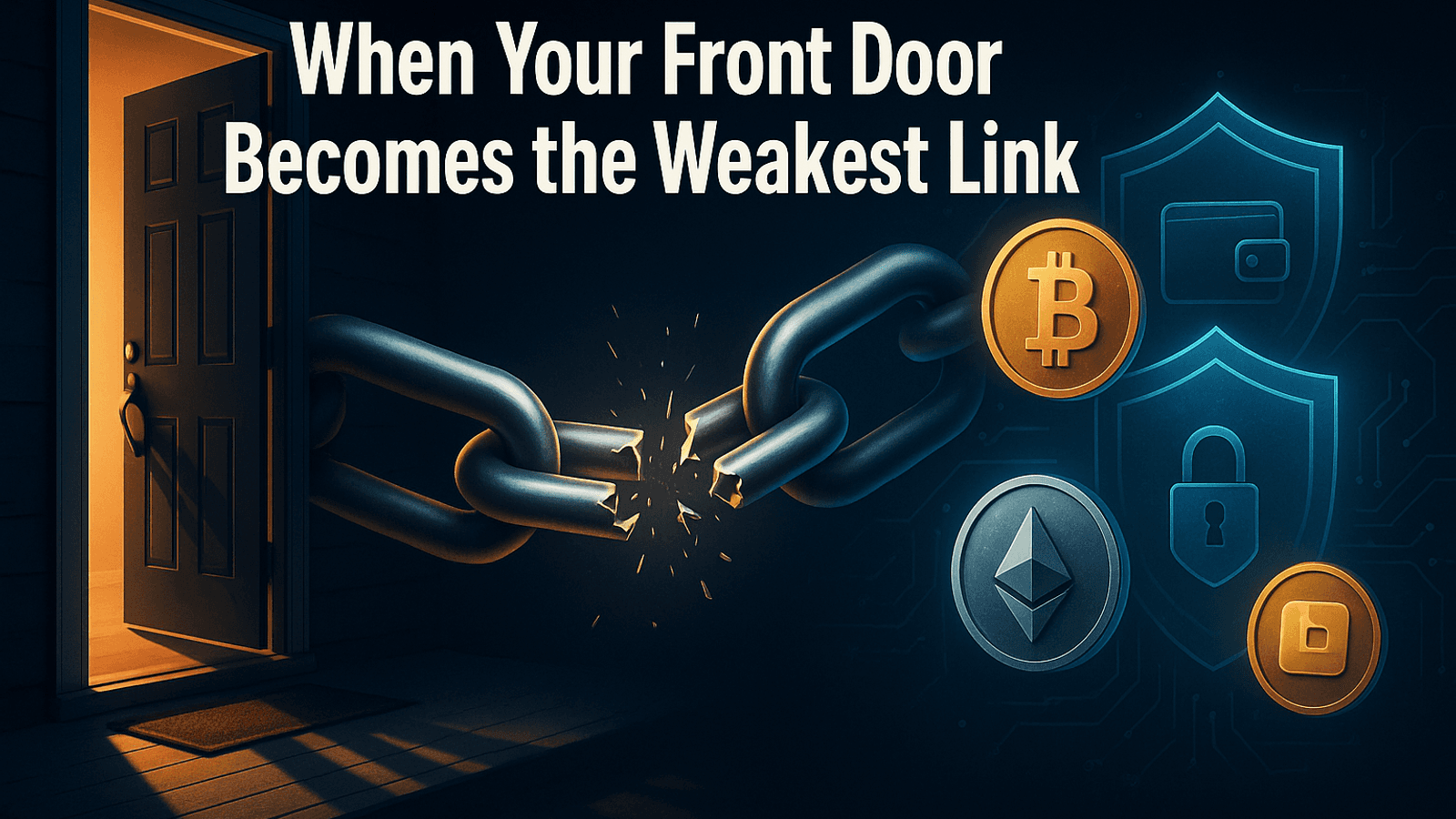
🚨 The San Francisco Heist That Proves Digital Assets Need Physical Defense
A fake delivery driver walked into a San Francisco home near Mission Dolores on the morning of November 22, 2025, and left with $11 million in cryptocurrency. According to the San Francisco Chronicle, the suspect entered the residence around 6:45 a.m., restrained the victim, and took a phone, laptop, and access to digital assets. Police have not announced arrests, and no details about the specific cryptocurrencies or blockchain networks involved have been released. The incident represents the latest in a growing pattern of physical attacks targeting crypto holders. For self-custody advocates, the robbery exposes a fundamental tension between controlling your own keys and the real-world risks that come with that control. This event forces investors to reconsider whether hardware security measures alone can protect high-value holdings when attackers simply bypass the technology by targeting the person holding it.
📈 Home Invasions Targeting Crypto Are Becoming More Frequent and Sophisticated
The San Francisco case joins a mounting list of physical attacks on cryptocurrency holders worldwide. Recent incidents include a $4.3 million home invasion in the UK, a kidnapping and torture case in New York where attackers held a victim for two weeks to force access to Bitcoin keys, and a series of kidnappings in France that prompted government intervention. High-profile holders have responded with extreme measures. The Bitcoin Family has split their seed phrase across four continents to reduce single-point vulnerability. Wealthy investors are increasingly hiring personal security teams and restructuring their digital asset storage to minimize exposure during potential physical confrontations. These attacks, sometimes called wrench attacks, demonstrate how criminals are shifting tactics from hacking wallets to directly coercing holders. For traders managing significant portfolios, the question is no longer just about choosing the right hardware wallet but also about creating physical security protocols that match the value of the assets they hold.
🔗 Stolen Crypto Triggers an Immediate On-Chain Recovery Race
Once digital assets leave a victim's control, the theft shifts from a physical crime to an on-chain tracking problem where speed determines recovery odds. Stablecoins have become the primary vehicle for illicit transactions, accounting for approximately 63 percent of illegal transaction volume in 2024 according to Chainalysis. This shift matters for law enforcement because centralized stablecoin issuers like Tether and Circle can freeze assets at the token level when notified by authorities. The T3 Financial Crime Unit, a collaboration between Tether, Tron, and analytics firms, has frozen over $250 million in tainted tokens since late 2024. If the San Francisco heist involved USDT on Tron or USDC on Ethereum, investigators have a realistic window to blacklist addresses before funds reach an off-ramp. Bitcoin and Ethereum flows present harder challenges since those networks lack central control, but exchanges and analytics companies can still tag suspicious addresses and block deposits at KYC chokepoints. Recovery probability drops sharply if stolen funds route through mixers, cross-chain bridges, or privacy coins like Monero before investigators can map the flow and coordinate with platforms.
🛡️ Self-Custody Technology Is Evolving to Counter Physical Coercion
Wallet developers are building new tools specifically designed to reduce risks during in-person attacks where a thief has access to phones or laptops. Multi-party computation wallets and account abstraction architectures now support features like daily spending limits, time-locked withdrawals, and multi-factor approval requirements that slow down large transfers even when a device is compromised. These systems eliminate single private keys that can be extracted under duress and instead distribute control across multiple devices or approval mechanisms. Hardware wallets from Ledger, Trezor, and others continue to provide offline key storage, but newer models incorporate transaction verification screens and passphrase protection that add friction to unauthorized access. Contract-level controls allow users to set conditions that prevent immediate high-value transfers, creating time windows during which issuers or exchanges can be notified if an account shows signs of compromise. For holders managing substantial portfolios, the emerging best practice combines hardware isolation with smart contract guardrails and multi-signature requirements that no single device or person can override. These technical defenses do not eliminate physical risk, but they reduce the attack surface by ensuring that gaining access to one device or forcing one person to cooperate is not enough to drain an entire portfolio.
⚖️ Regulatory Frameworks Are Starting to Support Asset Recovery Efforts
California's Digital Financial Assets Law took effect in July 2025, giving state regulators enforcement authority over certain custody providers and exchanges operating within the state. The law does not cover self-custodied assets directly, but it creates compliance requirements for any off-ramp service or OTC broker that stolen funds might touch when converting to fiat. If the San Francisco theft involved any California-licensed platform, state authorities could coordinate freezes and information sharing with law enforcement. At the federal level, stablecoin regulation advanced in 2025 with frameworks requiring reserve transparency, anti-money laundering compliance, and coordination with the Bank Secrecy Act. The FBI's Internet Crime Complaint Center reported $16.6 billion in cyber and scam losses in 2024, with crypto investment fraud rising 66 percent year over year. These figures have pushed Congress and regulators to develop faster response protocols for digital asset theft. Meanwhile, the Treasury Department's March 2025 decision to remove Tornado Cash from the Specially Designated Nationals list reduced some compliance barriers around mixer interactions, though it did not legalize money laundering or remove analytics visibility. For victims of physical crypto theft, these regulatory developments mean that law enforcement now has more tools and clearer authority to freeze assets and compel information from exchanges, though recovery success still depends heavily on how quickly stolen funds can be traced and whether they touch regulated infrastructure before disappearing into privacy layers.
🎯 What This Means for Crypto Holders and Investors
The San Francisco robbery makes clear that holding significant cryptocurrency creates physical security obligations that extend beyond password strength and hardware choices. For individual holders, the practical steps include limiting public disclosure of crypto ownership, using multi-signature or MPC wallets with approval delays for large transfers, storing hardware devices in secure locations separate from everyday phones and laptops, and considering geographic distribution of backup keys to prevent single-location compromise. Investors managing portfolios above certain thresholds should evaluate whether self-custody remains appropriate or if institutional custody services with insurance and multi-party controls offer better risk management. The rise in wrench attacks also highlights the importance of operational security practices, such as avoiding discussions of holdings in public forums, being cautious about delivery and service appointments at home addresses, and maintaining security systems that create time barriers for intruders. The on-chain recovery data shows that immediate reporting to issuers and law enforcement provides the best chance of freezing assets, especially when stablecoins are involved. As physical attacks on crypto holders continue to increase globally, the community faces a fundamental trade-off between the sovereignty that comes with self-custody and the security that centralized custody or heavily compartmentalized systems can provide. The answer likely varies by portfolio size, technical sophistication, and personal threat model, but the San Francisco case proves that ignoring the physical dimension of crypto security is no longer an option.
Sources
https://www.sfchronicle.com/crime/article/sf-cryptocurrency-robbery-21203804.php https://cryptoslate.com/fake-delivery-driver-stole-11-million-in-digital-assets-this-weekend-as-crypto-home-invasions-increase-report/ https://www.trmlabs.com/reports-and-whitepapers/2025-crypto-crime-report https://www.ic3.gov/AnnualReport/Reports/2024_IC3Report.pdf https://www.ledger.com/academy/topics/security/crypto-wallet-security-checklist-2025-protect-crypto-with-ledger https://www.tokenmetrics.com/blog/how-do-you-implement-multi-signature-wallets-2025-guide
Market Munchies and Mode Mobile communications are for informational purposes only, and are not a recommendation, solicitation, or research report relating to any investment strategy, security, or digital asset. All investments involve risk including the loss of principal and past performance does not guarantee future results.
Any information contained in this commentary does not purport to be a complete description of the securities, markets, or developments referred to in this material. The information has been obtained from sources considered to be reliable, but we do not guarantee that the foregoing material is accurate or complete. There is no guarantee that any statements or opinions provided herein will prove to be correct.
Hungry for the latest in crypto? Get fresh insights, breaking news, and hidden gems in the world of crypto—delivered straight to your inbox with our Crypto Cookies newsletter.Don’t miss out—sign up now and get your first bite of insider knowledge!