Why Geopolitical Shocks Aren’t Spooking Investors Anymore
How investor sentiment, risk appetite, and global capital flows are quietly adapting. Have you noticed how geopolitical risk barely rattles financial markets the way it used to? Oil supply headlines flash. Political tension escalates. AI valuations dominate investor…
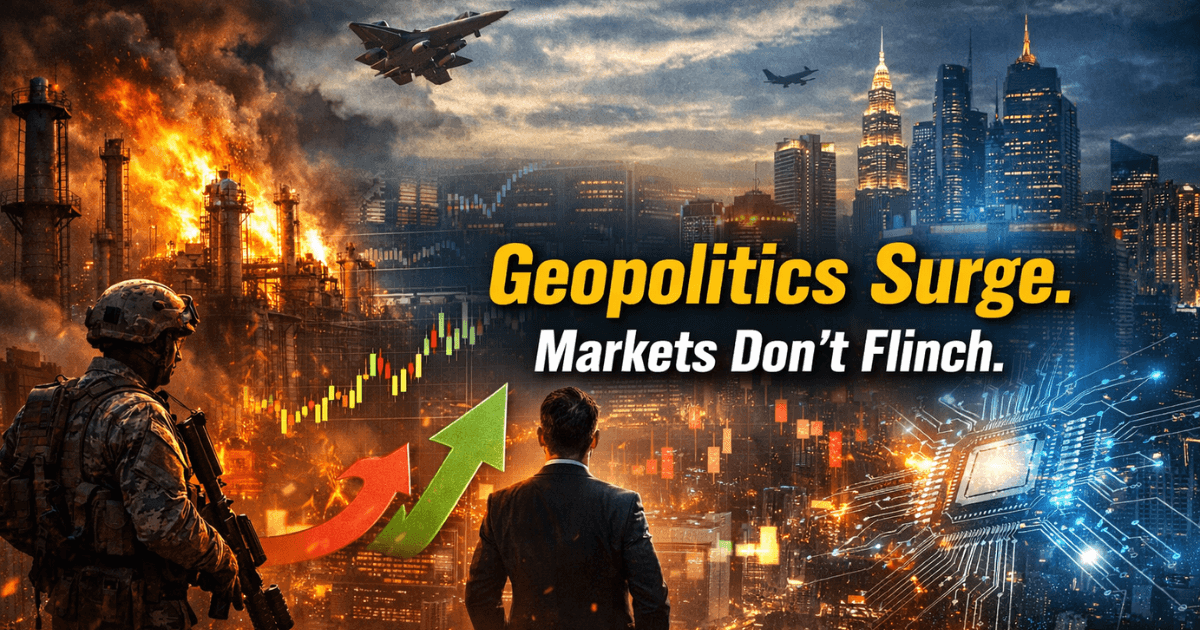
How investor sentiment, risk appetite, and global capital flows are quietly adapting.
Have you noticed how geopolitical risk barely rattles financial markets the way it used to? Oil supply headlines flash. Political tension escalates. AI valuations dominate investor conversations. Yet stock markets, risk assets, and global equities continue to move with surprising composure. Prices adjust. Capital flows rotate. Market risk appetite holds. That shift isn’t denial. It’s an adaptation. Experienced investors now separate market noise from structural investment risk—and portfolios are reflecting that discipline.
Geopolitical Risk Still Matters—But Markets Price It Differently Now
Political instability tied to Venezuela injected fresh uncertainty into oil market dynamics and emerging market equities. Energy stocks reacted. Defense names saw renewed interest. Bonds briefly caught a safety bid. But the reaction stayed contained. Oil prices climbed modestly rather than spiking. Global markets analysis showed selective buying, not panic-driven selling. Broader risk asset allocation remained intact. Investors understand the reality: Venezuela’s oil output faces infrastructure constraints, legal hurdles, and long timelines for recovery. Near-term supply shocks rarely justify long-term portfolio shifts. Smart Capital Signal: Geopolitical risk investing increasingly creates tactical trades—not wholesale reallocations—unless supply chains or policy frameworks materially change.
Investor Sentiment Remains Constructive—Not Careless
Despite persistent global uncertainty, investor sentiment remains cautiously optimistic. Equities continue attracting flows. Emerging market stocks hold up well. Safe-haven assets serve as insurance rather than shelter. Portfolio diversification strategies stay balanced rather than defensive. That behavior reflects a more mature investment risk management mindset. Investors aren’t chasing returns unthinkingly, but they’re also not abandoning opportunity. Investor Radar: Sustained risk appetite alongside disciplined positioning often signals confidence rooted in data—not denial.
AI Investment Trends Are Reshaping Capital Allocation
The AI investment trend hasn’t cooled—it has narrowed. Instead of speculative application plays, capital is rotating into AI infrastructure investing: Memory chip demand, data storage stocks, and semiconductor sector outlook leaders. AI models consume data relentlessly. Data centers require storage at scale. Semiconductor supply remains tight. Pricing power follows. Several companies in this space posted strong gains, yet investor behavior looks methodical. Long-term contracts, recurring revenue, and tangible demand matter more than headlines. Tactical Insight: Speculation clusters at the edges. Durable AI infrastructure attracts patient, conviction-based capital.
Asian Markets Reflect a Quiet Reallocation
While valuation debates dominate Western media, Asian tech stocks continue attracting interest. The Hang Seng Index performance reflects renewed confidence tied to technology optimism, improving manufacturing signals, and expectations around stable global monetary conditions. Institutional investors seeking growth without peak multiples are broadening exposure across Asian equities. Capital flows appear deliberate rather than reactive. Capital Compass: Strength in Asian markets without speculative excess often signals thoughtful global diversification.
Bubble Talk Persists—But Capital Is More Selective
Concerns about an AI bubble debate are part of every growth cycle. History demands caution. Valuations deserve scrutiny. Still, bubble environments rarely feature this level of skepticism. Capital is filtering aggressively. Cash-flow-backed infrastructure wins favor. Hedging activity increases. Position sizing tightens. Long-term investing strategies take priority over momentum chasing. Reality Check: Healthy skepticism tends to refine trends—not end them.
Seasonality Shapes Market Behavior More Than Headlines Suggest
Holiday periods often distort perception. Trading volumes are thin. Volatility compresses. Headlines feel louder than price action. Yet institutional investors remain active beneath the surface. Portfolio rebalancing happens quietly. Risk exposure adjusts incrementally. Strategic capital allocation takes precedence over short-term narratives. Market Insight: Calm markets during seasonal slowdowns often reflect confidence—not complacency.
Final Words: Calm Markets, Active Capital
Why disciplined investors are still making meaningful moves
Geopolitical uncertainty hasn’t vanished. AI investment risks still exist. Valuations still matter. What has changed is how capital responds. Modern markets absorb shocks more efficiently. Investor sentiment prioritizes resilience over reaction. Capital flows adjust without drama. For careful investors focused on where to invest money with clarity and patience, this environment rewards discipline, diversification, and structural thinking. Markets may appear calm—but capital is far from idle.
Sources
- Reuters — AI-driven memory chip demand and semiconductor supply
- Reuters — Oil market reaction to geopolitical developments
- IG Markets — Asian equity momentum and Hang Seng analysis
- Financial Times — AI infrastructure demand and valuation discussion
- Wikipedia — Global memory supply shortage and AI infrastructure context
Market Munchies and Mode Mobile communications are for informational purposes only, and are not a recommendation, solicitation, or research report relating to any investment strategy, security, or digital asset. All investments involve risk including the loss of principal and past performance does not guarantee future results.
Any information contained in this commentary does not purport to be a complete description of the securities, markets, or developments referred to in this material. The information has been obtained from sources considered to be reliable, but we do not guarantee that the foregoing material is accurate or complete. There is no guarantee that any statements or opinions provided herein will prove to be correct.