Why the Government Shutdown Just Complicated Crypto's Path to Regulatory Clarity
📍 The Shutdown's Unexpected Timing The U.S. government shutdown arrived at perhaps the worst moment for cryptocurrency advocates. As Congress failed to reach a funding agreement, federal agencies furloughed employees and halted most operations, directly impacting lawmakers…
📍 The Shutdown's Unexpected Timing
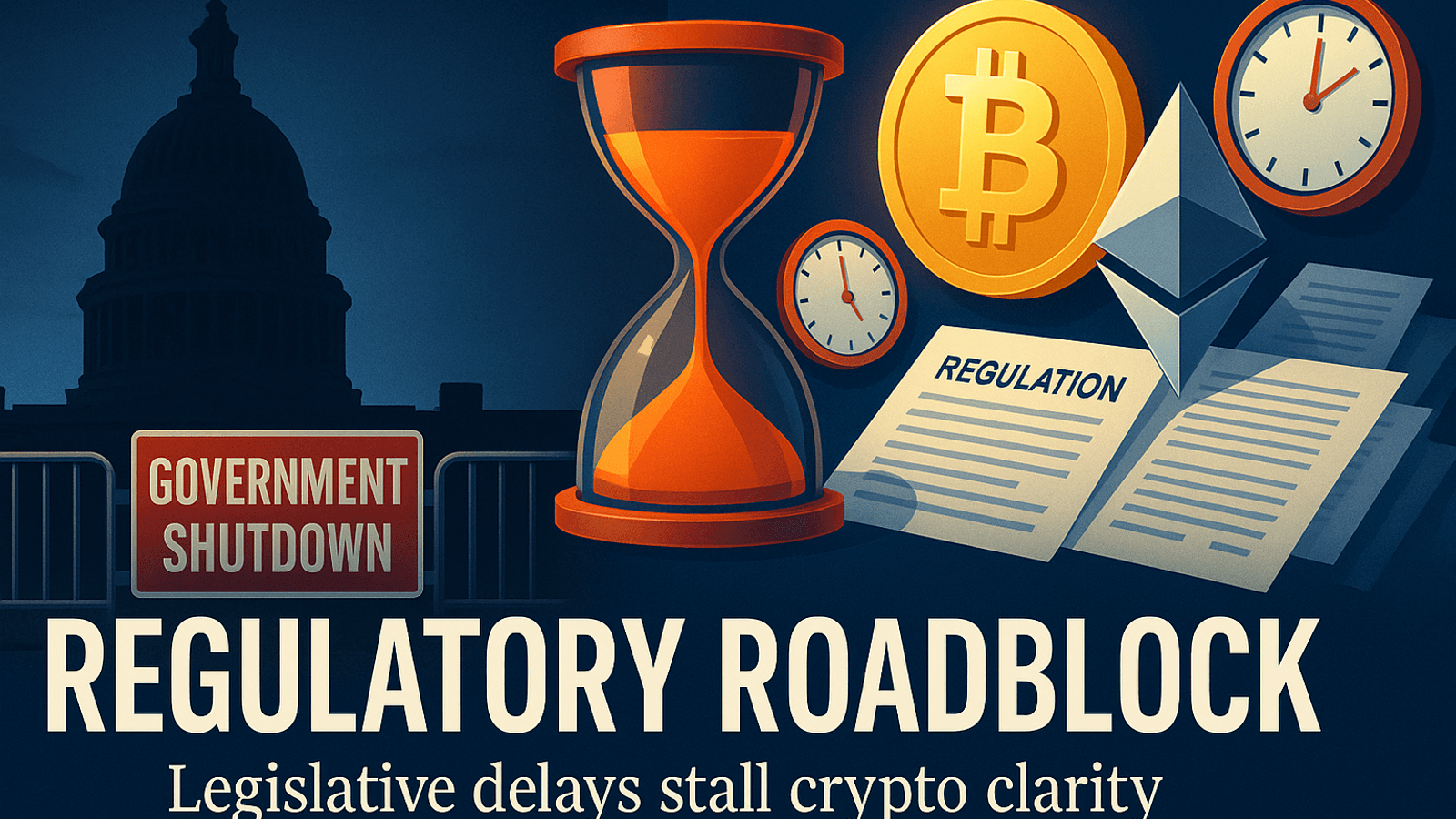
The U.S. government shutdown arrived at perhaps the worst moment for cryptocurrency advocates. As Congress failed to reach a funding agreement, federal agencies furloughed employees and halted most operations, directly impacting lawmakers deep in the drafting process for a comprehensive digital asset market structure bill. The Senate Banking Committee, which has jurisdiction over these regulatory efforts, suddenly lost a critical resource: the expert staff from the SEC and CFTC who advise lawmakers on technical details. "This is probably the biggest setback at this time," said Kristin Smith, president at the Solana Policy Institute, noting that furloughed staff can no longer contribute their expertise. While some optimism remains about continued behind-the-scenes discussions, the practical impact is undeniable. Complex legislation requires agency guidance every step of the way, and extended closures compound delays exponentially.
🏛️ Understanding the Legislative Landscape
The crypto regulation battle involves two competing visions playing out across Congress. The House passed the CLARITY Act in July 2025, establishing clearer lines between SEC and CFTC jurisdiction over digital assets. The Senate Banking Committee drafted its own version with a crucial difference: it introduces a new category called "ancillary assets" for tokens tied to investment contracts but which don't themselves carry traditional security rights. This distinction fundamentally changes how regulators approach token classification. The Senate Agriculture Committee, which oversees the CFTC, hasn't yet released its version, creating additional uncertainty. These bills must ultimately be reconciled before reaching President Trump's desk, and experts warn that the Senate draft's complexity makes consensus harder to achieve than the House's more straightforward approach.
⚡ Political Complications and the Trump Factor
The Trump administration's pro-crypto stance initially promised smoother legislative passage, evidenced by the swift signing of the GENIUS stablecoin Act this summer. However, complications have emerged from an unexpected source: the President's own financial ties to crypto. Reports estimate the Trump family has profited some $620 million from ventures including World Liberty Financial and meme coin launches, creating ammunition for Democratic opposition. As the 2026 midterm elections approach, the political calculus shifts. Democrats increasingly view crypto as a "talking point" to attack Trump's financial interests rather than a policy area for bipartisan cooperation. Rebecca Liao, co-founder of Saga and a Biden campaign veteran, notes that while short shutdowns won't derail crypto priorities, longer delays combined with election-year politics could fundamentally alter legislative momentum and Democratic support.
💰 TradFi vs. Crypto: The Banking Lobby Emerges
Beyond government operations, another powerful force shapes market structure legislation: traditional finance's lobbying machine. Major banks have launched aggressive campaigns to prevent crypto exchanges from offering yield on stablecoins, viewing this as direct competition for deposits and financial services. This battle represents a fundamental clash between decentralized finance advocates and established banking interests. The decentralized finance industry has rallied around protections for "ancillary assets" in the Senate draft, hoping to preserve yield opportunities. Banks counter that crypto yield poses financial stability risks, bringing regulatory allies to their cause. Ron Hammond, head of policy at Wintermute, describes this as "a battle of the juggernauts in DC of crypto versus TradFi." The outcome remains uncertain, but the intensity of banking industry opposition suggests this remains a significant obstacle to any final bill.
📈 Timeline and Probability Assessment
Industry experts offer cautiously measured timelines for legislative passage. Ron Hammond estimates a 60% probability that the Senate votes on its market structure version before year-end, assuming the shutdown lasts only a couple of weeks. However, extended closures dramatically shift this calculus. If the shutdown stretches beyond a month or legislative work stalls into spring 2026, Hammond's probability drops below 50%. The SEC Chair has urged fast-tracking the bill, and the White House expects passage in 2025, creating some pressure for expedited action. Yet timing matters enormously. Lawmakers will prioritize mid-term election preparations, and crypto may lose priority if other urgent matters consume legislative bandwidth. The window for passing market structure legislation before election season fundamentally reshapes probability calculations downward.
🎯 What's at Stake for the Crypto Market
Regulatory clarity represents the crypto industry's most valuable commodity right now. Unlike the GENIUS stablecoin bill, which addressed a narrower issue, market structure legislation will establish the foundational rules governing how tokens are classified, traded, and regulated for years to come. Getting these rules right requires balancing innovation with consumer protection, preventing regulatory arbitrage while supporting developer flexibility, and establishing clear jurisdiction without creating conflicts between agencies. Teresa Goody Guillén, former SEC litigation counsel, warns that overly complex definitions like "ancillary assets" create confusion rather than clarity. Investors face genuine uncertainty about which regulatory framework will ultimately govern their holdings. A well-crafted market structure bill would reduce this uncertainty premium and unlock institutional adoption. Conversely, prolonged gridlock or a poorly designed bill could further entrench skepticism among traditional finance participants.
💡 The Investor Takeaway
The government shutdown introduces meaningful delays to crypto's regulatory timeline, but it is not a fatal blow if resolved quickly. More concerning is the emerging political complexity surrounding crypto legislation. The Trump administration's personal financial stakes in crypto, combined with Democratic opposition and powerful banking lobbies, create multiple headwinds for passage. Investors should monitor two key metrics: first, when the government reopens and whether agency staff resume legislative support, and second, whether the Senate Agriculture Committee moves its CFTC version forward in parallel with the Banking Committee. A market structure bill signed into law before the 2026 midterms would represent a major regulatory victory and potential market catalyst. However, if legislative momentum stalls into spring, probability of passage drops sharply. Near-term, expect volatility around shutdown duration and legislative updates rather than swift regulatory progress.
Sources
https://www.theblock.co/post/373723/us-government-shutdown-complicates-crypto-market-structure-bills-path-forward https://www.congress.gov/bill/119th-congress/house-bill/3633 https://unchainedcrypto.com/landmark-crypto-bill-set-to-take-a-big-step-in-the-senate-despite-shutdown/ https://www.jdsupra.com/legalnews/cryptocurrency-and-digital-assets-under-9807316/ https://finance.yahoo.com/news/sec-chair-urges-fast-track-214912662.html
Market Munchies and Mode Mobile communications are for informational purposes only, and are not a recommendation, solicitation, or research report relating to any investment strategy, security, or digital asset. All investments involve risk including the loss of principal and past performance does not guarantee future results.
Any information contained in this commentary does not purport to be a complete description of the securities, markets, or developments referred to in this material. The information has been obtained from sources considered to be reliable, but we do not guarantee that the foregoing material is accurate or complete. There is no guarantee that any statements or opinions provided herein will prove to be correct.
Hungry for the latest in crypto? 🍪
Get fresh insights, breaking news, and hidden gems in the world of crypto—delivered straight to your inbox with our Crypto Cookies newsletter. Don’t miss out—sign up now and get your first bite of insider knowledge!